Developing Stoichiometric Combustion Process Calculator using MATLAB
% Developing code for Stoichiometric Combustion Process Calculator

% About: The stoichiometric combustion is the ideal combustion process in
% which right amount of mixture of oxygen & fuel has been used for the
% combustion process & the process generates the optimum amount heat
% through the process and maximum combustion efficiency has been achieved
% everytime. In combustion process, the mixture burnt 100% without any
% leftover.

% Normally, combustion process of fuel & air generates many elements
% like co2, co, oh, h2o, no, n2o & many other elements in very small
% quantities. The air is also the made of various gases like nitrogen,
% oxygen, argon, carbon dioxide, neon & hydrogen.

% Assumptions: In stoichiometric process, we consider the air is made of
% just nitrogen & oxygen and the by products of combustion process are co2,
% h2o & n2.

% Objectives
% 1. Calculating the stoichiometric co-efficient (ar) for each fuel types
% (Alkanes, Alkenes & Alkynes)
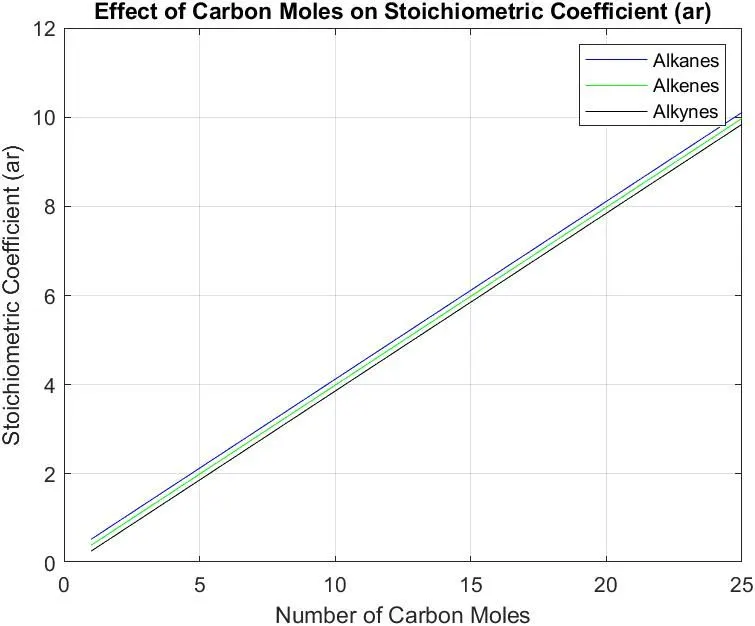
% 2. Generating the plot to compare the effect of number of carbon moles on
% the stoichiometric co-efficient (ar) & also comparing the trnd between
% all three fuel types

% The combustion process for Alkanes is as follows:
% CnH(2n+2) + ar(O2 + 3.76N2) = aCo2 + bH2o + cN2
% In equation, n = number of moles of Carbon(C)
% a,b,c = Number of moles for carbin dioxide, water & nitrogen respectively

% Similarly, the combustion process for Alkenes
% CnH(2n) + ar(O2 + 3.76N2) = aCo2 + bH2o + cN2

% And the combustion process for Alkynes is as follows:
% CnH(2n-2) + ar(O2 + 3.76N2) = aCo2 + bH2o + cN2

close all; clear all; clc;

% Number of Carbon moles
n = 1:25;

% Procedure:
% Using the Mass balancing concept, equations will be created by comparing
% the moles of the Carbon, Hydrogen, Oxygen & Nitrogen on both sides.

% For Alkanes, using Mass balancing concept
% a = n;  For Carbon
% b = n +1;  For Hydrogen. Actual, 2b = 2n +2
% c = 3.76*ar;  For Nitrogen
% For Oxygen, 3.76*ar = a + (b/2)
    % Inserting, the values of a & b into "ar" eqaution
    % 3.76*ar = n + (n+1)/2 = (3n + 1)/2
    % ar = (3n + 1)/(3.76*2) = (3n + 1)/7.52

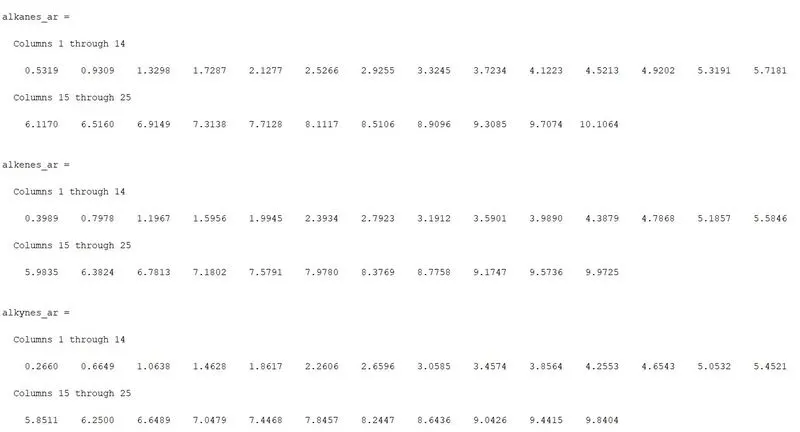
alkanes_ar = (3*n + 1)/7.52

% For Alkenes, using Mass balancing concept
% a = n; For Carbon
% b = n; For Hydrogen
% c = 3.76*ar; For Nitrogen
% 3.76*ar = a + (b/2); For Oxygen
    % Inserting the values of a & b
    % ar = (n + n/2)/3.76 = 3n/7.52
    % ar = 0.3989*n

alkenes_ar = 0.3989*n

% For Alkynes, using Mass balancing concept
% a = n;  For Carbon
% b = n - 1;  For Hydrogen. Actual, 2b = 2n +2
% c = 3.76*ar;  For Nitrogen
% For Oxygen, 3.76*ar = a + (b/2)
    % Inserting, the values of a & b into "ar" eqaution
    % 3.76*ar = n + (n-1)/2 = (3n - 1)/2
    % ar = (3n - 1)/(3.76*2) = (3n - 1)/7.52

alkynes_ar = (3*n - 1)/7.52

% Plotting to compare the carbon mole effect on the stoichiometric
% coefficient (ar)
plot(n, alkanes_ar, 'b', n, alkenes_ar, 'g', n, alkynes_ar, 'k')
grid on
xlabel('Number of Carbon Moles')
ylabel('Stoichiometric Coefficient (ar)')
legend('Alkanes', 'Alkenes', 'Alkynes')
title('Effect of Carbon Moles on Stoichiometric Coefficient (ar)')
The results of the MATLAB Program:
1. Graph to represent the effect of carbon moles on stoichiometric coefficient for all three types of fuels
2. Values of Stoichiometric coefficent for each fuels for 1 to 25 Carbon moles shown through 1 X 25 matrix.