Section Modulus calculation and optimization
OBJECTIVE :
To calculate the section modulus of the hood and modify the design to increase the strength of the hood assembly.
SECTION MODULUS :
Section modulud is the geometric property for a given cross section used in the design of beams or flexural members. Other geometric properties used in design include area of tension and shear, radius of gyration of compression and moment of inertia and polar moment of inertia for stiffness. Any relationship between these properties is highly dependent on the shape.
There are two types ,
- Elastic section modulus
- Plastic section modulus
Section modulus is a direct measure of strength of any section area of an object about an reference axis ( Neutral axis). Strength is a capable of supporting great loads, The strength can be measured directly section odulud formula, The elastic section modulus is defined as
S=I/Y I = Moment of inertia, Y = Distance from the neural axis to any given fibre, y=c
Moment of inertia is nothing but offering resistance againsist of moment, bending or twisting. If, we applied any external loads on the body, How much resistance it's offering to bend and deform.
So, the higher value of moment of inertia having the higher resistance to deform under the load.
Yield moment (My) such that My = S × σy, where σy is the yield strength of the material.
PROCEDURE :
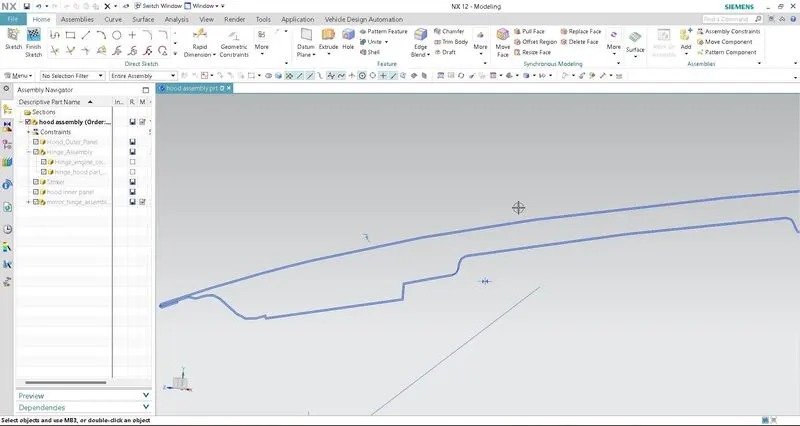
The middle section of the hood is selected by using the intersecting tool in NX CAD. Th emost portio the oter and inner panel were extracted as shown below,
Then, we have to use project the curve in workbench, We connect the both required curve and trime the unused curve. Now, we drawen the closed curve
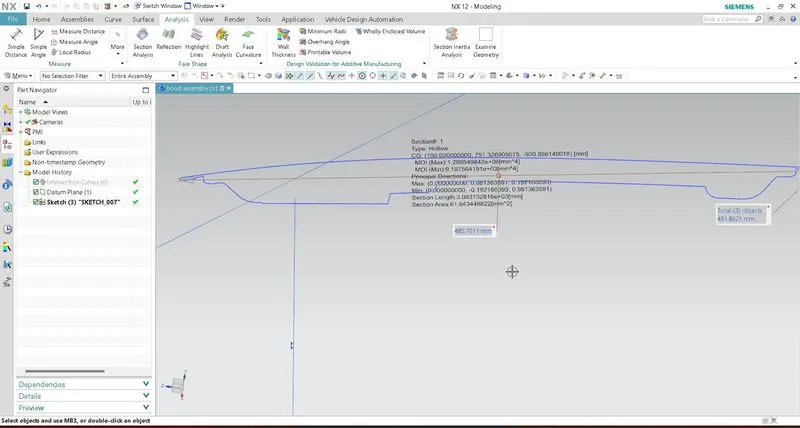
(491.86/2 = 245.93)
The calculations are as given below.
Section modulus, S = I/y
Where,
S - Section modulus
I - Area moment of inertia
y - Distance between neutral axis and extreme end of the fibre
Therefore, I max = 1.2895 × 10^6 mm^4
y = 245.93mm
So, Section modulus, S = 1.2895 × 10^6 mm^4/ 245.93 mm
= 5243.36 mm^3
Therefore, I min = 9.1875 × 10^3 mm^4
y = 245.93mm
So, Section modulus, S = 9.1875 × 10^3 mm^4/ 245.93 mm
= 37.358 mm^3
Hood strength varies from 37.358 mm^3 to 5243.36 mm^3.
Yield moment, My = S × σy
where,
σy - Yield strength of material - Stainless steel AISI 302 - cold - rolled
σy = 520 N/mm^2
So, yield moment, My = 5243.36 × 520
= 2726547.2 N.mm
(Note : 302 stainless steel is an austenitic, non_magnetic, extremly tough and ductile ss alloy. AISI 302 annealed stainless stell is highly corrosion resistant and maintains it's strength at high temp up to 550°F. Additionally, 302 stainless stell is non magnetic in the annealed condition and cannot be further hardened by heat treatment. As an added benifits both the hardness and tensile strength of AISI 302 can be increased by cold working)
MODIFICATIONS TO IMPROVE THE STRENGTH
Now, in order to improve the strength, I tried changing the distance between inner and outer panel of hood assembly. So, I offsetted the outer contour of inner panel by 0.4mm (outwards).
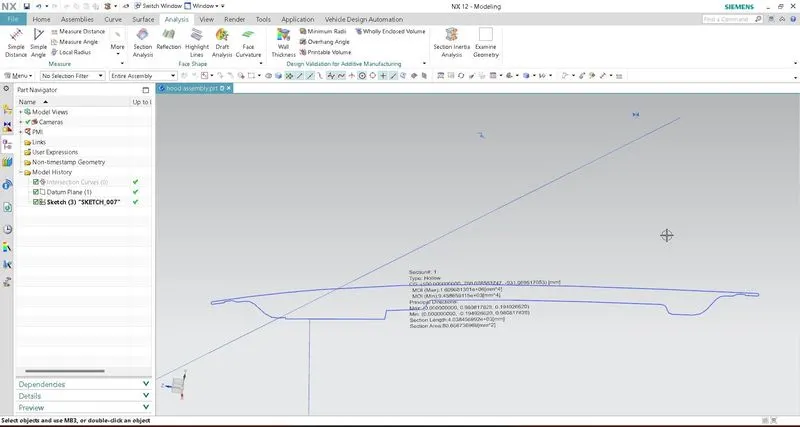
The calculations are as given below.
Section modulus, S = I/y
Where,
S - Section modulus
I - Area moment of inertia
y - Distance between neutral axis and extreme end of the fibre
Therefore, I max = 1.6096 × 10^6 mm^4
y = 245.93mm
So, Section modulus, S = 1.6096× 10^6 mm^4/ 245.93 mm
= 6544.95 mm^3
Therefore, I min = 9.4586 × 10^3 mm^4
y = 245.93mm
So, Section modulus, S = 9.4586 × 10^3 mm^4/ 245.93 mm
= 38.46 mm^3
Hood strength varies from 38.46 mm^3 to 6544.96 mm^3.
Yield moment, My = S × σy
where,
σy - Yield strength of material - Stainless steel AISI 302 - cold - rolled
σy = 520 N/mm^2
So, yield moment, My = 6544.95 × 520
= 3403374 N.mm
CONCLUSION
Thus the strength of the hood assembly was successfully increased by modifying it. Thus the safety of the vehicle also improved.