Section Modulus calculation and optimization
Aim
To calculate the section modulus of the previously designed hood for analyzing its strength and also optimizing the design to see the difference in the bending strength of the hood.
Section modulus
Section modulus is a geometric property for a given cross-section used in the design of beams or flexural members. Other geometric properties used in design include area for tension and shear, radius of gyration for compression, and moment of inertia and polar moment of inertia for stiffness. Any relationship between these properties is highly dependent on the shape in question. Equations for the section moduli of common shapes are given below. There are two types of section moduli, the elastic section modulus and the plastic section modulus. The section moduli of different profiles can also be found as numerical values for common profiles in tables listing properties of such.
- It is defined as the ratio of the moment resisted by the section to the stress in the extreme fibre. It gives an idea that most of the work in bending is being done by the extreme fibres of the beam, ie the top and bottom fibres of the section. The distance of the fibres from top to bottom is therefore built into the calculation. If the section modulus increases the moment of resistance increases & hence its load bearing capacity. A section that has longer section modulus than another will be stronger and capable of supporting greater loads.
- Though generally section modulus is calculated for the extreme tensile or compressive fibres in a bending beam, often compression is the most critical case due to onset of flexural torsional (F/T) buckling. Generally (except for brittle materials like concrete) tensile extreme fibres have a higher allowable stress or capacity than compressive fibres.
- In the case of T-sections if there are tensile fibres at the bottom of the T they may still be more critical than the compressive fibres at the top due to a generally much larger distance from the neutral axis so despite having a higher allowable stress the elastic section modulus is also lower. In this case F/T buckling must still be assessed as the beam length and restraints may result in reduced compressive member bending allowable stress or capacity.
- There may also be a number of different critical cases that require consideration, such as there being different values for orthogonal and principal axes and in the case of unequal angle sections in the principal axes there is a section modulus for each corner.
For a conservative (safe) design, civil structural engineers are often concerned with the combination of the highest load (tensile or compressive) and lowest elastic section modulus for a given section station along a beam, although if the loading is well understood one can take advantage of different section modulus for tension and compression to get more out of the design. For aeronautical and space applications where designs must be much less conservative for weight saving, structural testing is often required to ensure safety as reliance on structural analysis alone is more difficult (and expensive) to justify.
Calculation of Section Modulus:
S=I/Y
Here,
S = Section modulus
I= Moment of Inertia (Unit mm 4)
Y= Distance from Neutral axis to the extreme end (unit mm)
The Unit of a “section modulus” is (mm3)
DESIGN STUDY
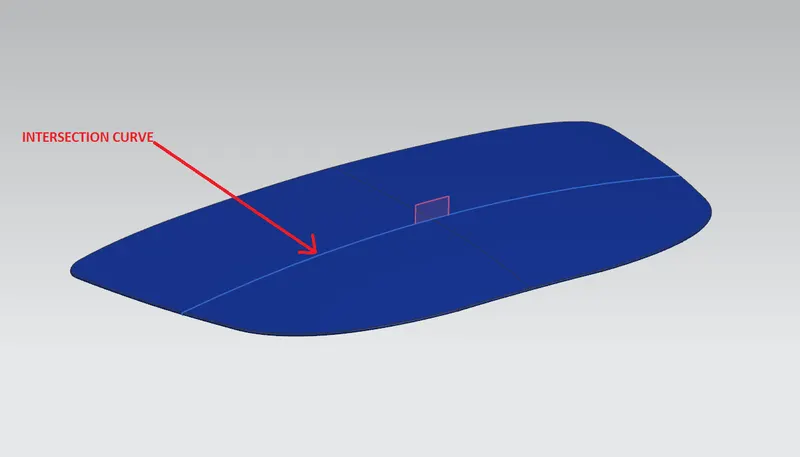
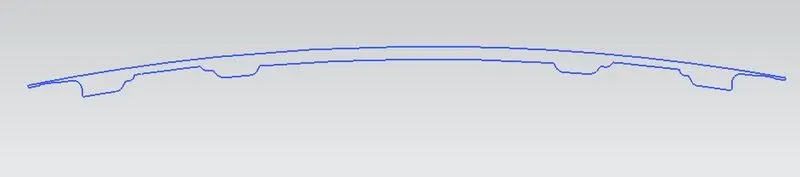
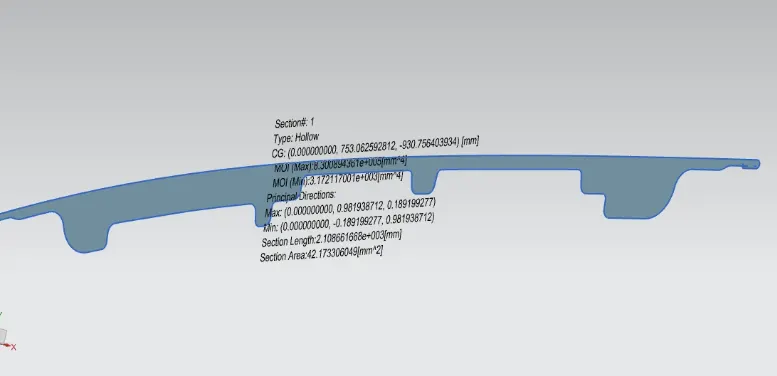
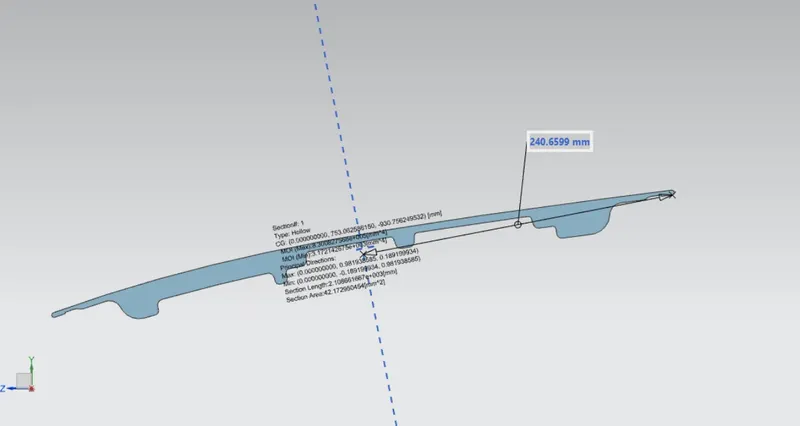
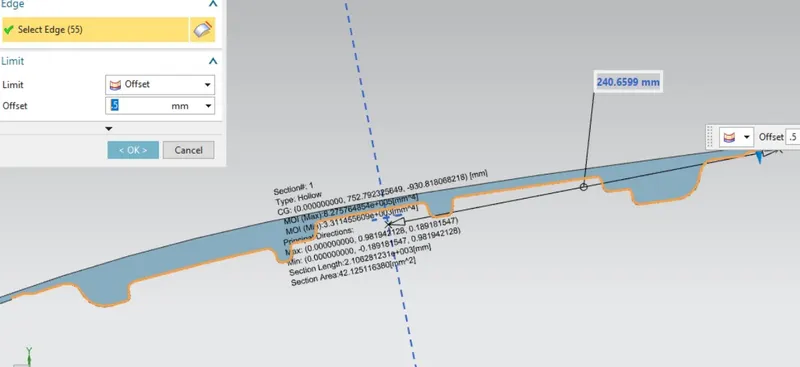
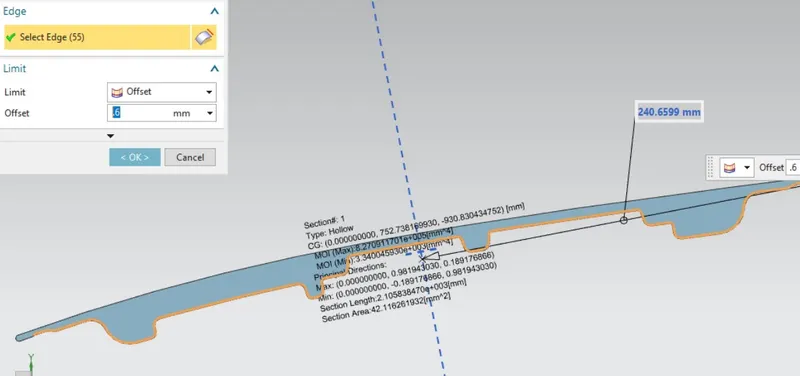
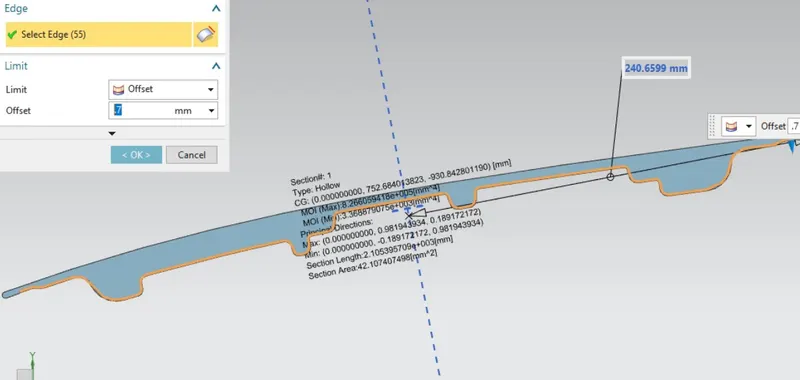
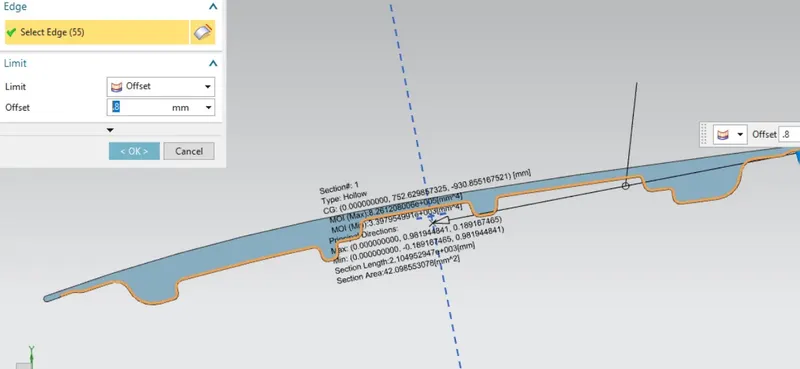
From the above images we can find that,
I = moment of inertia(min.) = 3.1721*10^3 mm^4
y = distance from neutral axis to extreme end = 240.7 mm
Hence, S = 13.17mm^3
TABULATION:
| SL NO | extension |
MOI(min.) |
Value of 'y' |
Section Modulus |
||
|
1 |
0.5 | 3.3114*10^3 |
|
|
||
| 2 | 0.6 |
|
240.7 |
|
||
| 3 | 0.7 |
|
240.7 |
|
||
| 4 | 0.8 |
|
240.7 | 14.1167428334 |
As 'Moment of inertia' is directly proportional to the 'section modulus'
CONCLUSION:
The section modulus of my hood section is 13.17mm^3 . And after extending the lowermost edge of the inner panel & calculating the section modulus, we found that with the extent of lowermost edge of inner panel by 0.1mm, the section modulus is improved by 0.12 mm^3,then largest section modulus of hood section is 14.11 mm^3, which is the hood section with 0.8 extension of the lowermost edge of inner pnael.
So the difference can be seen in the moment of inertia and the change in the section modulus can be seen by the change in the design(depth).