Section Modulus calculation and optimization
SECTION MODULUS CALUCULATION AND OPTIMIZATION
SECTION MODULUS:
It is a way of quantifying a cross-section of a given geometry. It is directly proportional to the area moment of inertia of the cross-section. Higher the section modulus, the more the moment of inertia, more stiffness and thus more resistance to deformation and bending. Section modulus can be improved by varying the geometry of the cross-section. In other words, stiffness can be improved by just improving the geometry without the need for adding extra material.
Formula of Section Modulus: It may be defined as the ration of total moment resisted by the section to the stress in the extreme fibre which is equal to yield stress.
There fore
S = I/Y, Where
S = Section modulus (mm^3)
I = Moment of Inertia of the section about the bending axis. (mm^4)
Y = Distance between the neutral axis and extreme end of the object (mm)
Calculation:
Section#:1
The Hood which was already created is imported and the section inertia analysis is done.
We have to make sure that the curve obtained is a single/closed curve.
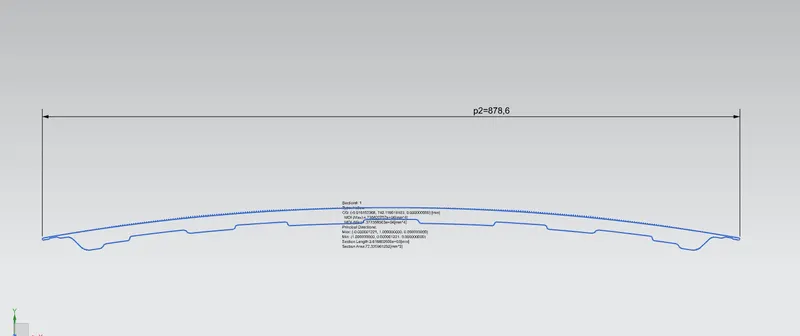
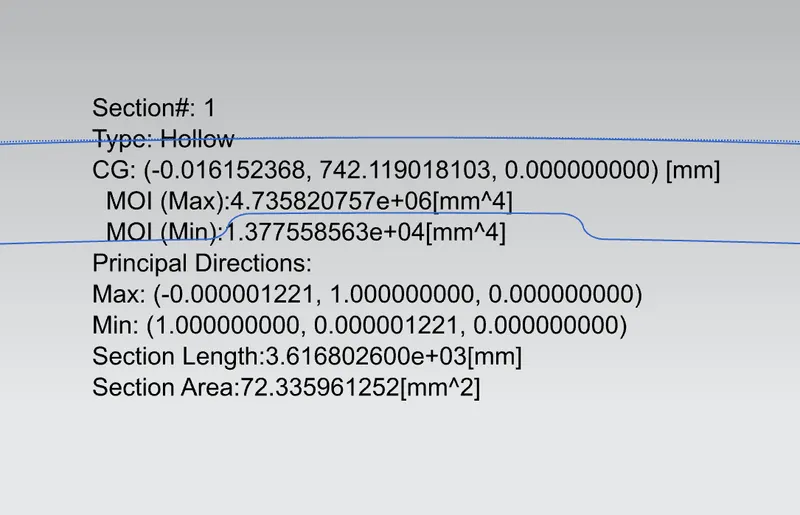
MOI (Max): 4.735820757e+06[mm^4]
MOI (Min):1.377558563e+04[mm^4]
Distance of Extreme Layer from Neutral Axis (Y) = 878.6/2 = 439.3mm
Section Modulus (s) = I / Y
= 13775.58563 / 439.3 = 31.358 mm^3
Section#:2
The hood inner panel’s curve is offset by 0.5mm outwards and section inertia analysis is done same as case 1 for a closed curve.
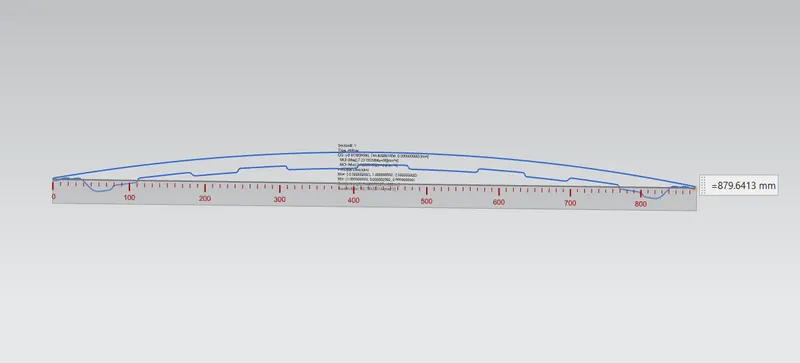
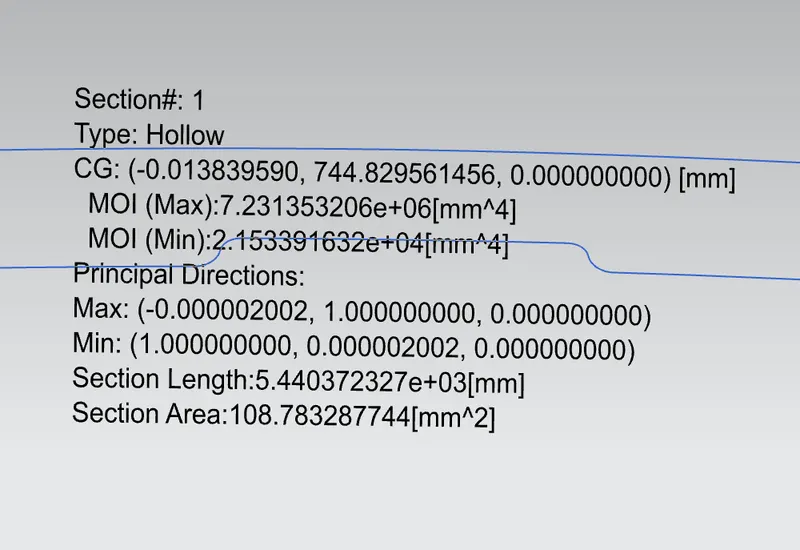
MOI (max) = 7.231353206e+06[mm^4]
MOI (min) = 2.153391632e+04[mm^4]
Distance of Extreme Layer from Neutral Axis (Y) = 879.64/2 = 439.82mm
Section Modulus (s) = I / Y
= 21533.91632 / 439.82 = 48.96 mm^3
Conclusion:
Hence when comparing case 1 & case 2,
1. The section modulus value of case 2 is higher than the case 1
2. As we increase the section area, the moment of inertia & section modulus increases which means strength and load carryability of material also increase