Section Modulus calculation and optimization
AIM: To calculate the section modulus of the designed hood for analyzing its strength and also optimizing the design to see the difference in the bending strength of the hood. Higher the section modulus of a structure, the more the resistive it becomes to bending.
What is Section Modulus?
Section modulus is a geometric property for a given cross-section used in the design of beams or flexural members. Other geometric properties used in design include area for tension and shear, radius of gyration for compression, and moment of inertia and polar moment of inertia for stiffness.
Section Modulus is a geometric property used to calculate the bending stresses in a structural member.
Section Modulus(S) = Moment of inertia(I) / distance between the neutral axis and the extreme end of the object (y)
S = I / y
Types of Section Modulus
Elastic Section Modulus (ESM): The elastic section modulus is applicable up to the yield point of material. It is used in most engineering application.
- ESM of Rectangle: S = bd^2 / 6
- ESM of Circle: S = 𝜋D^3 / 32
- ESM of Square Tube: S = a^3/6 - (a – 2t) ^4/6a
- ESM of Hollow Rectangle: S = BD^2/6 - bd^3/6D
Plastic Section Modulus (PSM): The plastic section modulus is necessary to calculate plastic moment capacity of the section. The plastic section modulus is the addition of moment of area of area under compression about PNA (plastic neutral axis) and the moment of area of area under tensile stress.
The plastic section modulus is given by,
Zp =
∑ ∑
AcYc +
∑ ∑
AtYt
Where,
Ac = Area of cross-section under compression.
At = Area of cross-section under tension.
Yc = Distance from PNA to CG of the areas under compression.
Yt = Distance from PND to CG of areas under tension.
Steps to calculate PSM:
- Locate the plastic neutral axis. At the neutral axis, the Area under compression is equal to the area under tension.
Ac = At
By using this relation, we can find the position of the plastic neutral axis.
- Find the summation of the product of area of section undergoing compression and the distance of its CG from PNA that is
∑AcYc
- Find the summation of the product of the area of cross-section undergoing tension and distance between CG of that area from PNA that is
∑AtYt
- Find the plastic section modulus using the formula.
- PSM of circle: Zp = d^3/6
- PSM of rectangle: Zp = bd^2/4
Section Modulus of Initial Hood
To find the section modulus,We will consider the minimum MOI.
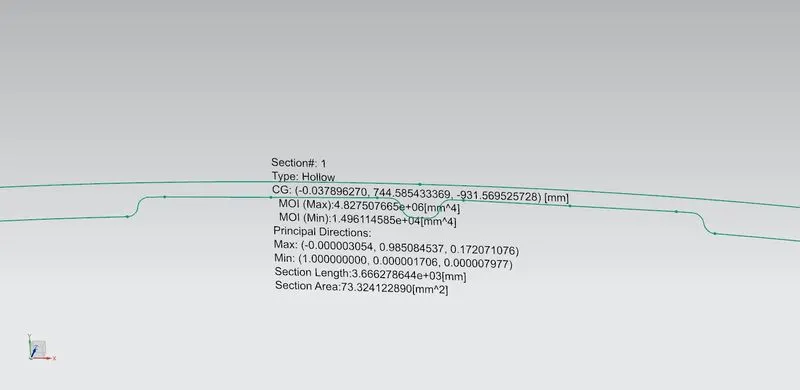
Moment of Inertia = 1.4961 * 10^4
Y = 877.0058/2 = 438.5029
S = I/Y
= 34.1183 mm^3
Section Modulus of Optimized Hood
After offseting the surface to 0.5mm the area of the hood increases, So section modulus will also increase.
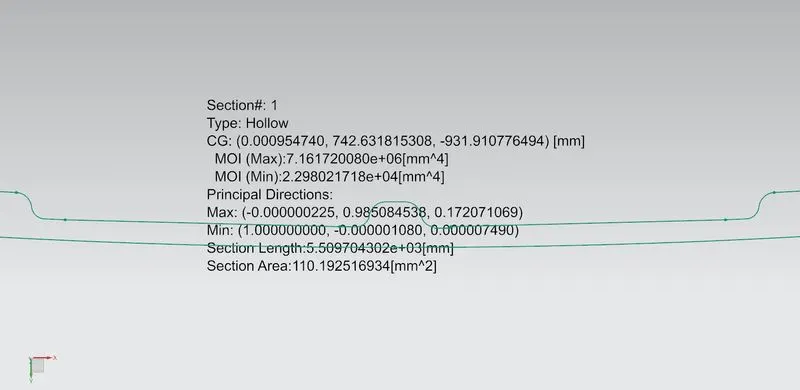
Moment of Inertia = 2.298 * 10^4
Y = 877.0058/2 = 438.5029
S = I/Y
= 52.4055mm^3
Conclusion
Here we can see that the Section of Modulus is increased after offsetting the surface by 0.5mm.