Section Modulus calculation and optimization
Section Modulus Calculation and Optimization
Aim: To find the section modulus of the hood and optimization to improve the overall section modulus.
Section Modulus: The section modulus (S) is the geometric property of the cross-section used for designing beams and flexural members. It does not represent anything physically.
Formula of section Modulus: It may defined as the ratio of total moment resisted by the section to the stress in the extreme fibre which is equal to yield stress.
Therefore
S= I/Y
Where S= Section Modulus (mm˄3)
I= Moment of Inertia of the section about the bending axis. (mm˄4)
Y= Distance between the neutral axis and extreme end of the object(mm)
Area moment of Inertia: The area moment of inertia of a beam's cross-sectional area measures the beam's ability to resist bending. The larger the moment of inertia less will be the bend.
Where M= Bending moment
I= Area Moment of Inertia
E= Youngs modulus
R= Radius of gyration
Neutral axis: When the beam is subjected to pure bending the topmost fibres of the beam are subjected to maximum compression, while the bottommost fibres of the beams are subjected to maximum tension.
Material Data: Stainless steel AISI 302 – cold rolled
Where the yield strength of stainless is 520Mpa = 520 N/mm ˄2
Calculation:
CASE1: Before Optimization
The Hood which was already created is imported and the section inertia is done. We have to make sure that the curve obtained is a single/ closed curve.
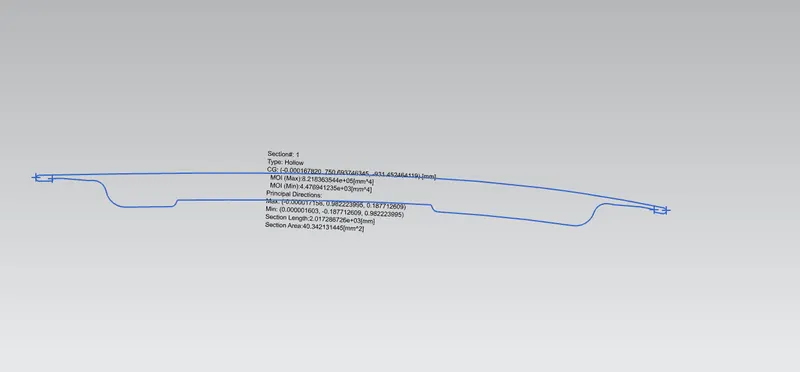
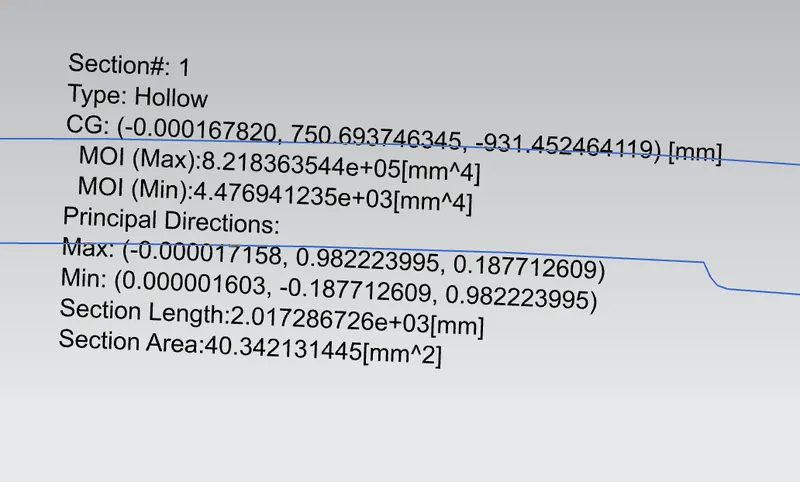
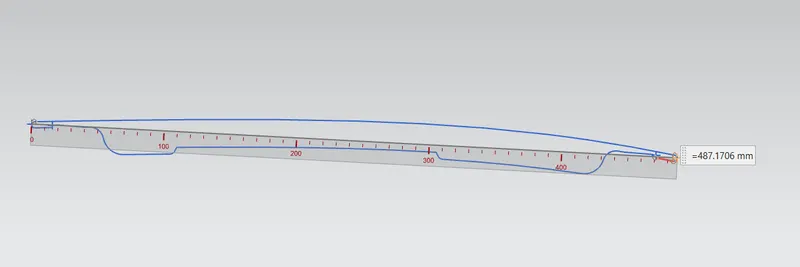
MOI (max) = 8.218363544e+05 (mm ˄4)
MOI (min) = 4.476941235e+03 (mm ˄4)
As per the section modulus equation,
S = I/Y
I = MOI (min) value is considered
Y = Total Distance/ 2= 487.1706mm/2
Y = 243.5853mm
Therefore, S = 447694.1235 mm ˄4/ 243.5853mm
S = 1837.9357 mm ˄3
CASE 2: After optimization
The hood inner panel’s curve is offset by 0.5 mm outwards and section inertia analysis is done the same as in case 1 for a closed curve.
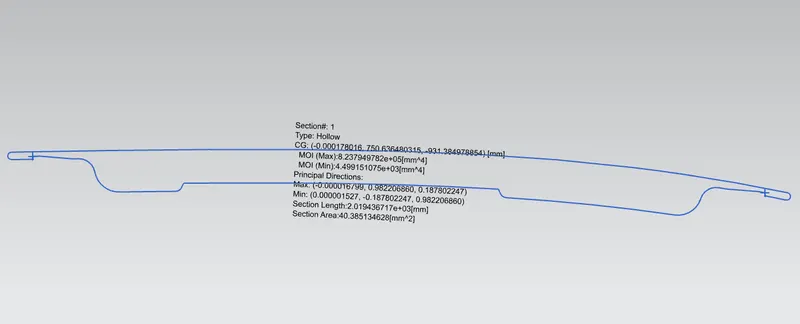
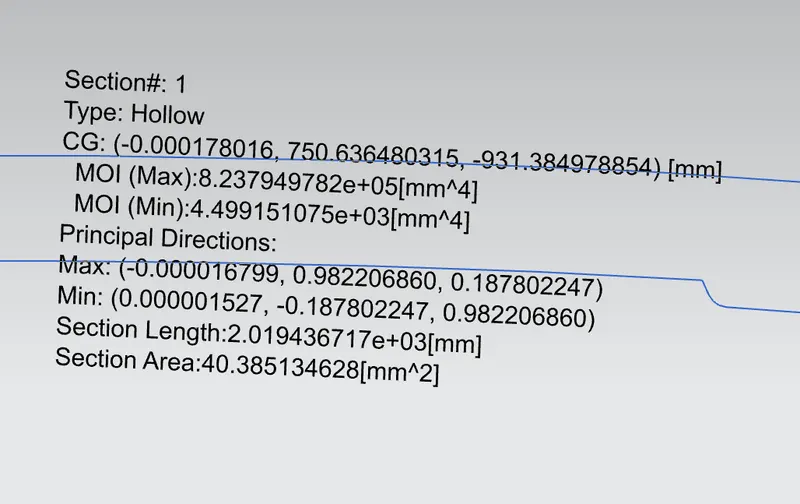
MOI (max) = 8.237949782e+05 (mm ˄4)
MOI (min) = 4.499151075e+03 (mm ˄4)
As per the section modulus equation,
S = I/ Y
I = MOI (min) value is considered
Y = Total distance/ 2, Total distance = 487.1706mm/2
Y = 243.5853mm
Therefore, S = 449915.1075 mm ˄4 / 243.5853mm
S = 1847.0536 mm ˄3
Conclusion:
Hence when comparing case 1& case2,
- The section modulus value of case 2 is higher than that of case 1
As we increase the section area, the moment of inertia & section modulus increase which means strength and load material also increases.