Section Modulus calculation and optimization
Section Modulus (S):-
Section Modulus:
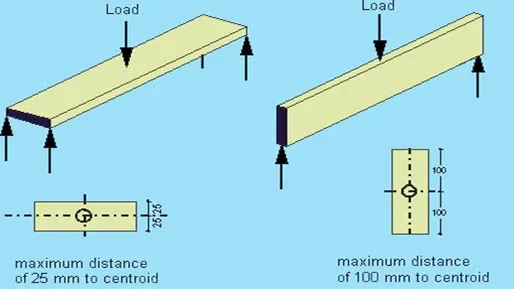
The section modulus (S) is geometry property of the cross section used for designing beams and flexural members. It does not represent anything physically.
Formula of section Modulus: It may be defined as the ratio of total moment resisted by the section to the stress in the extreme fiber which is equal to yield stress.
Therefore
S=I/y, Where
S= Section modulus (mm^3)
I = Moment of inertia of the section to the stress in the extreme end of the object (mm^4)
Y= Distance between the neutral axis and extreme end of the object (mm).
Section modulus depends only on the cross-section shape of the structure. For symmetric sections, the value of “section modulus” is for both above and below of centroid of the fiber. An asymmetric section has two values for top and bottom of the fiber due to different distance from the centroid to the top and bottom of the material, the maximum “section modulus” is S max and the minimum section modulus is S min.
The section modulus is classified into two types:-
1] Elastic section modulus:- The elastic section modulus is applicable up to the yield point of material. It is used in most engineering applications.
2] Plastic section modulus:- The plastic section modulus is generally used for material in which plastic behavior is observed
Elastic Section Modulus:-
Elastic section modulus is the ratio of moment of inertia about a neutral axis (INA) and the maximum distance between the neutral axis and outermost fiber of beam (Y max).
Elastic section modulus equation:-
The formula of elastic section modulus is given by,
S= I NA / Y max
Where,
I = Moment of inertia (mm4)
Y = Distance between neutral axes and outermost fiber (mm)
Steps to calculate elastic section modulus:-
- Step 1:-Find location of centroid of given cross section.
- Step 2:-Find moment of inertia about neutral axis (INA)
- Step 3:-Find Y max from neutral axis.
- Step 4:-Find elastic section modulus using the formula provided above.
Elastic section modulus of different sections:-
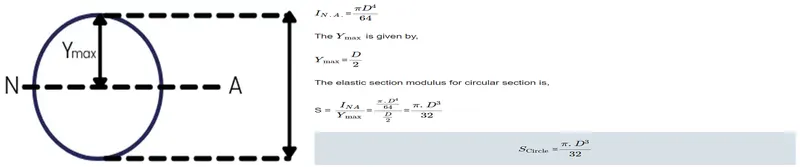
1] Elastic section modulus of circle:-
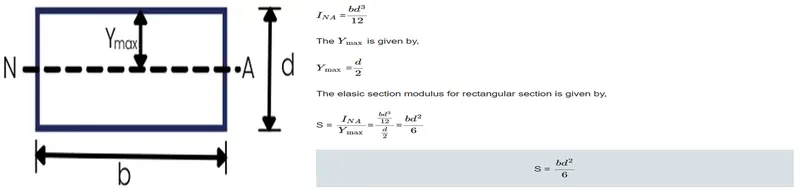
] Elastic section modulus of rectangular section:-
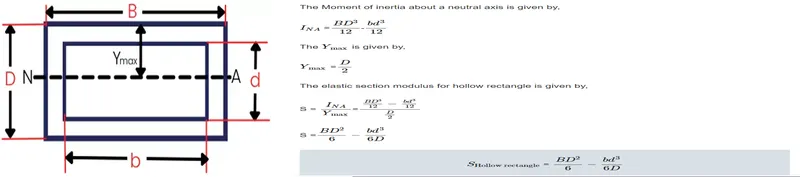
3] Elastic section modulus of hollow rectangle:-
Plastic Section Modulus:-
The plastic section modulus is necessary to calculate plastic moment capacity of the section.
The plastic section modulus is the addition of moment of area of area under compression about PNA (plastic neutral axis) and the moment of area of area under tensile stress.
Plastic section modulus equation:–
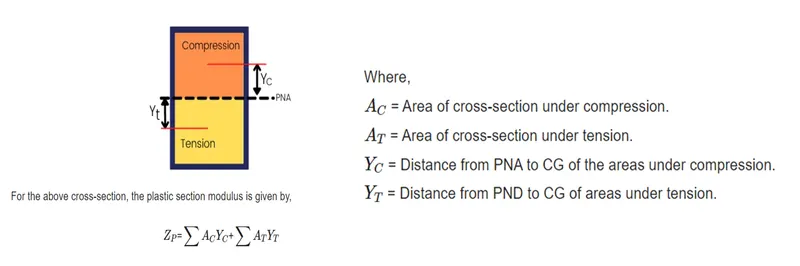
Plastic section modulus of different sections:–
1] Plastic section modulus of circle:-
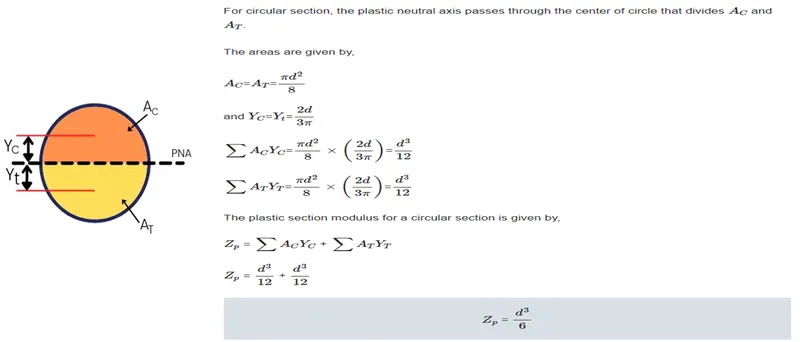
2] Plastic section modulus of rectangle:-
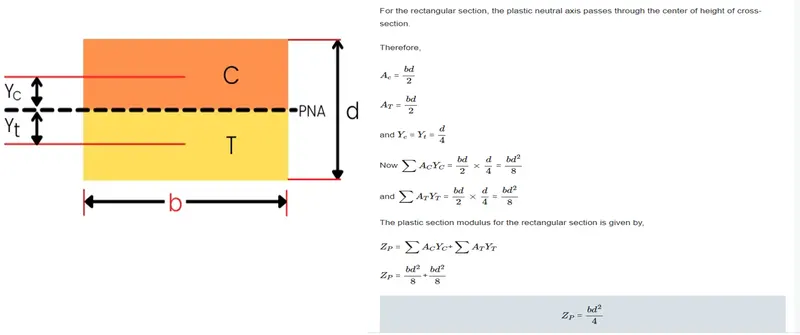
Moment of Inertia (I):-
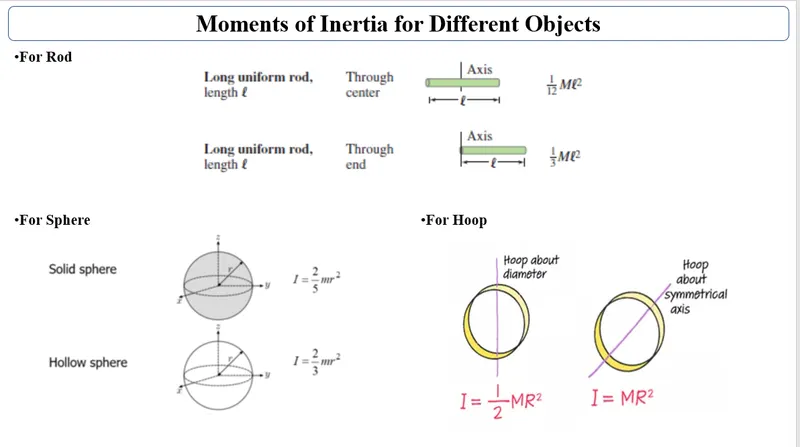
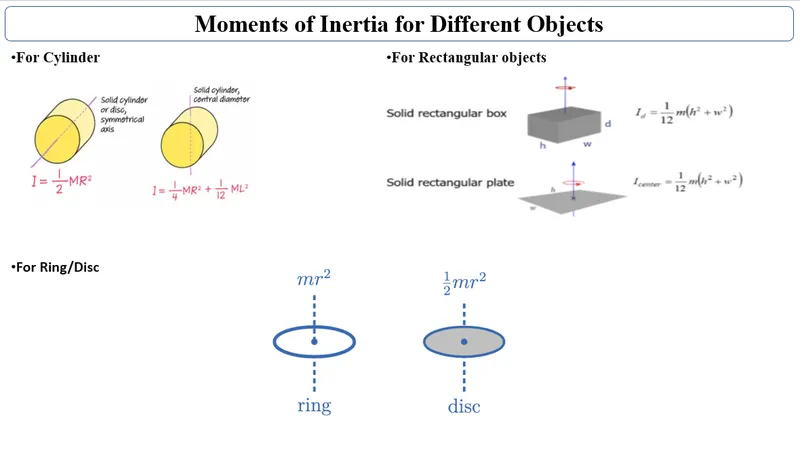
Moment of inertia also known as the angular mass or rotational inertia can be defined w.r.t. rotation axis, as a quantity that decides the amount of torque required for a desired angular acceleration or a property of a body due to which it resists angular acceleration. The formula for the moment of inertia is the “sum of the product of mass” of each particle with the “square of its distance from the axis of the rotation”. The formula of Moment of Inertia is expressed as I = Σ miri2.
What is Moment of Inertia:-
The moment of inertia of an object is a determined measurement for a rigid body rotating around a fixed axis. The axis might be internal or external, and it can be fixed or not. However, the moment of inertia (I) is always described in relation to that axis.
The moment of Inertia depends on the distribution of the mass around its axis of rotation. MOI varies depending upon the position of the axis that is chosen. That is, depending on the location and direction of the axis of rotation, the same item might have various moment of inertia values.
Angular mass or rotational inertia are other names for the moment of inertia.
The SI unit of moment of inertia is kg m2.
Moment of Inertia Example :-
Imagine you are on a bus right now. You find a seat and sit down. The bus starts moving forward. After a few minutes, you arrive at a bus stop and the bus stops. What did you experience at this point? Yes. When the bus stopped, your upper body moved forward whereas your lower body did not move.
Why is that? It is because of Inertia. Your lower body is in contact with the bus but your upper body is not in contact with the bus directly. Therefore, when the bus stopped, your lower body stopped with the bus but your upper body kept moving forward, that is, it resisted change in its state.
Similarly, when you board a moving train, you experience a force that pushes you backwards. That is because before boarding the train you were at rest. As soon as you board the moving train, your lower body comes in contact with the train but your upper body is still at rest. Therefore, it gets pushed backwards, that is, it resists change in its state.
Example
A system of point particles is shown in the following figure. Each particle has a mass of 0.3 kg and they all lie in the same plane. What is the moment of inertia of the system about the given axis?
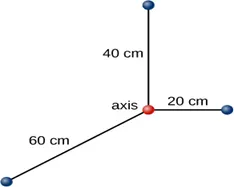
Answer:
The mass of all the particles is equal. Hence, m = 0.3 kg
I = Σ miri2 = m Σ ri2 = 0.3 [0.62 + 0.42 + 0.22] …..(Converting the distance of the particles to meter)
I = 0.168 kg m2
CASE 1: Initial Hood Design:-
The hood which was already created is imported and the section inertia analysis is done.
We have to make sure that the curve obtained is a single/closed curve.
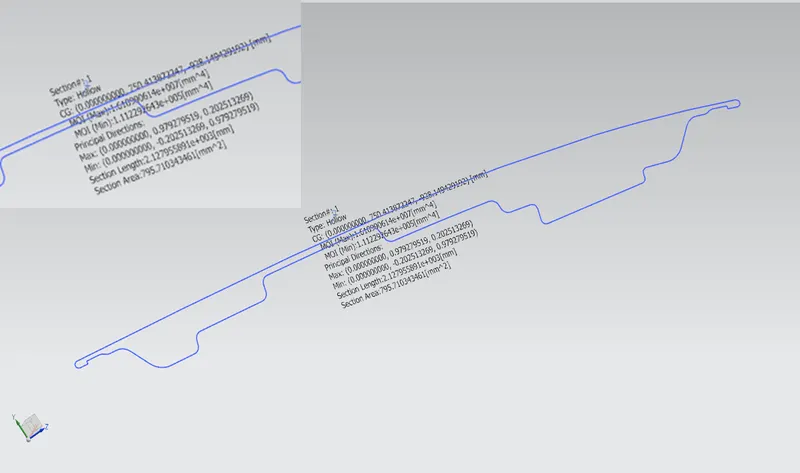
Area Moment of Inertia: I(min)
MOI(min): 1.112292643e+005 mm^4
Total Length L=485.44
Y=L/2 = 485.44/2= 272.72
Section Modules S = I(min)/Y
= (1.1122 X 1000)/272.72
= 4.078 mm^3
CASE 2: Optimization in Hood Design:-
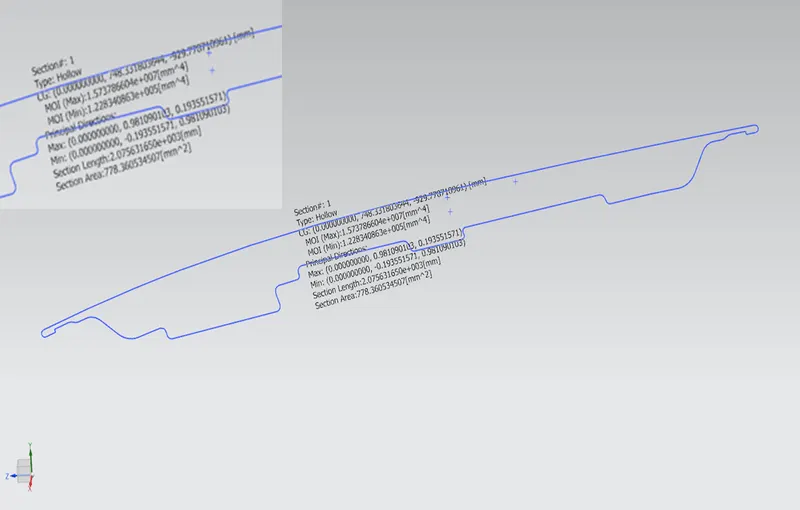
Area Moment of Inertia: I(min)
MOI(min): 1.228340863e+005 mm^4
Total Length L=485.44
Y=L/2 = 485.44/2= 272.72
Section Modules S = I(min)/Y
= (1.2283 X 1000)/272.72
= 4.503 mm^3
Conclusion:-
Resulting by comparing case 1 & case 2,
1.The section modulus value of case 2 is higher than the case 1
2.As we increase the section area, the moment of inertia & section modulus increase which means strength
- and load material also increase. Which the moment of inertia directly proportional to the strength of the material.