Section Modulus calculation and optimization
Section Modulus:
Section modulus is a geometric property for a given cross-section used in the design of beams or flexural members. Other geometric properties used in design include area for tension and shear, radius of gyration for compression, and moment of inertia and polar moment of inertia for stiffness. Any relationship between these properties is highly dependent on the shape in question. Equations for the section moduli of common shapes are given below. There are two types of section moduli, the elastic section modulus and the plastic section modulus.
The elastic section modulus is defined as S = I / y
where,
I- is the second moment of area (or moment of inertia) and
y- is the distance from the neutral axis to any given fiber.
It is often reported using y = c, where c is the distance from the neutral axis to the most extreme fiber
moment of inertia:-
Moment of inertia is the name given to rotational inertia, the rotational analog of mass for linear motion. It appears in the relationships for the dynamics of rotational motion. The moment of inertia must be specified with respect to a chosen axis of rotation. For a point mass, the moment of inertia is just the mass times the square of the perpendicular distance to the rotation axis, I = mr2. That point mass relationship becomes the basis for all other moments of inertia since any object can be built up from a collection point masses.
section modulus : It is the ratio of moment of inertia of the beam section about this are neutral axis and extreme layer distance from neutral axis
bending stress : the section internal resistance offered by the internal stresses to the modulus moment is known as bending stress .
common moment of inertia
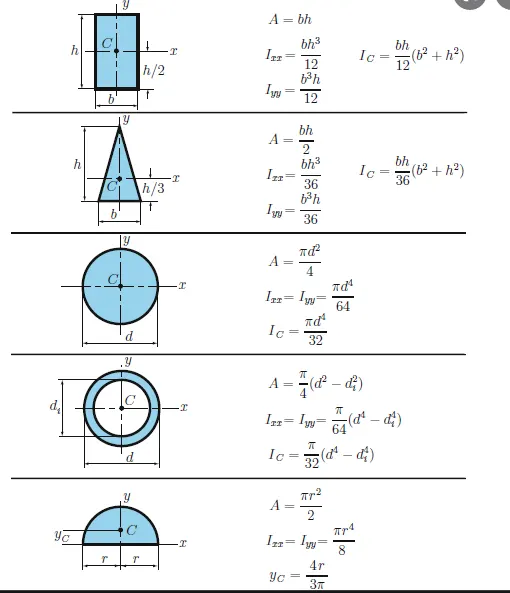
Section modulus (S) :
The section modulus of the cross sectional shape is of significant importance in designing beams. It is a direct measure of the strength of the beam. A beam that has a larger section modulus than another will be stronger and capable of supporting greater loads.
Section modulus is denoted by S. To calculate S, the distance (y) to the extream fibers from the centroid (or neutral axis) must be found as that is where the maximum stress could cause failure.
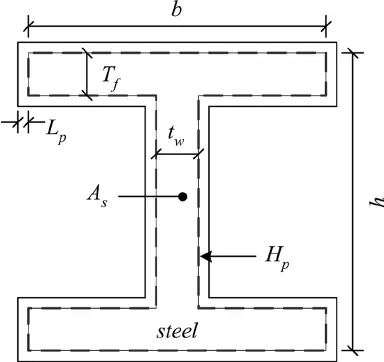
Calculating the section modulus by S=I/y
Where,
I - Moment of inertia.
y - Distance from centroid to top.
for symmetrical section the value of S is the same above or below the centroid. For a symemetrical sections, two values are found S max and S min.
Section Modulus calculation of the Hood Design:
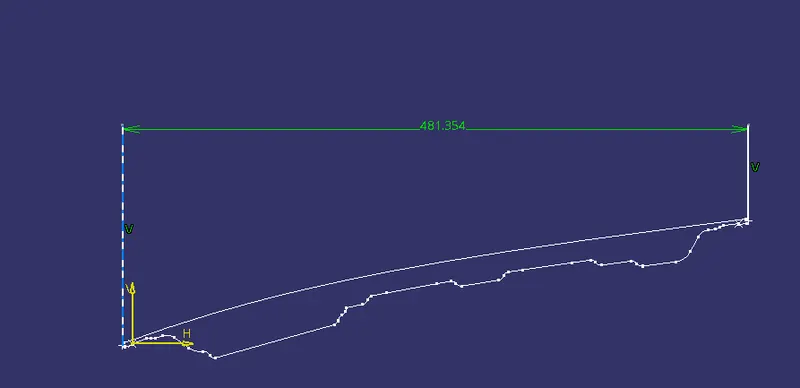
In CATIA intersect the inner panel and outer panel to the plane.
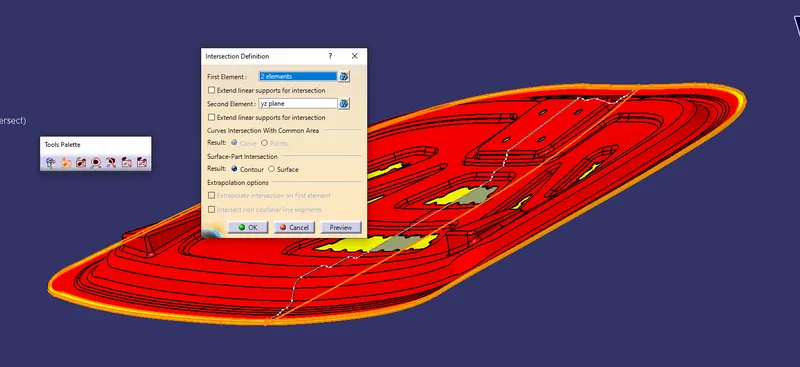
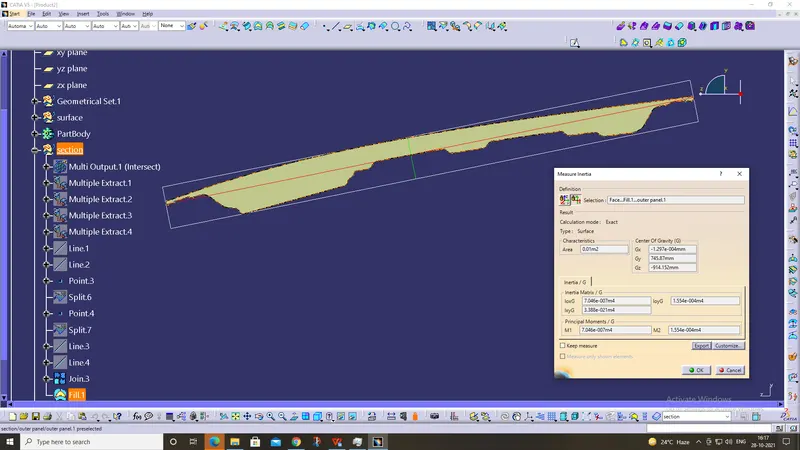
CASE 1: Initial Hood Design
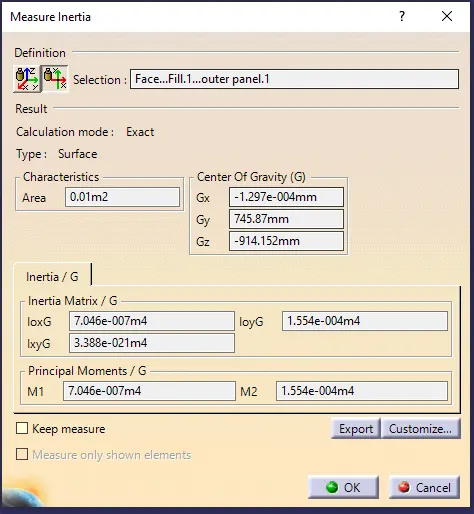
I min:-7.046X10^5 mm^4
I max:-1.554x10^8 mm^4
For Calculation, considering the minimum value
Then
The total length of the model value was 481.354mm
So, at the neutral axis, we need 'Y' value:-total length/2=481.354/2=240.677mm
1)Section modulus(S):-I/Y=7.046X10^5 mm^4 /240.677mm
=2.927X10^3mm^4
CASE 2: Modified Hood Design
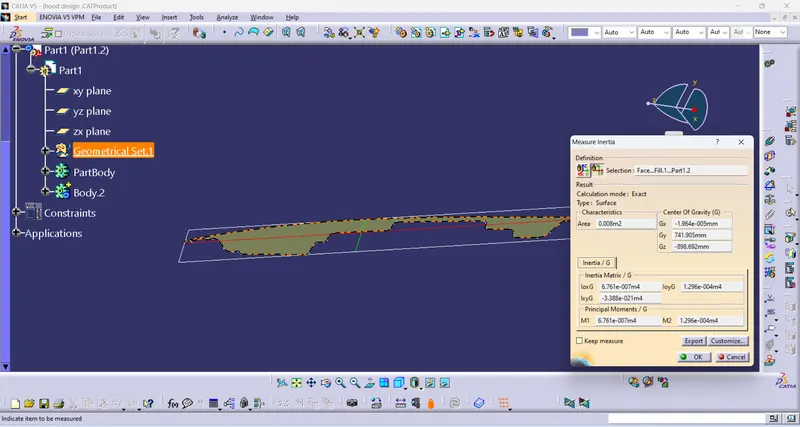
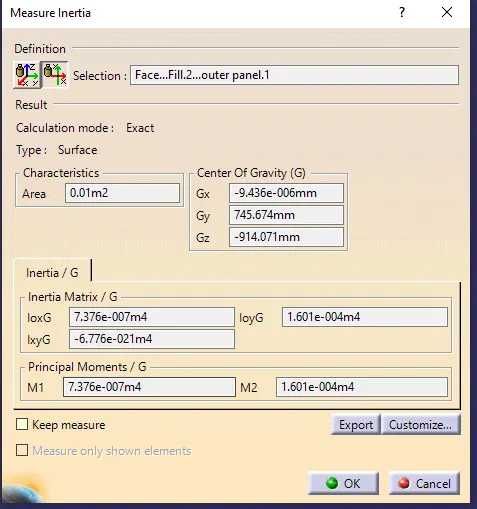
I min:-7.376X10^5 mm^4
I max:-1.601x10^8 mm^4
For Calculation, considering the minimum value
Then
The total length of the model value was 481.354mm
So, at the neutral axis, we need 'Y' value:-total length/2=481.354/2=240.677mm
1)Section modulus(S):-I/Y=7.376X10^5 mm^4 /240.677mm
=3.064X10^3mm^4.
RESULT:
In this challenge analysed the section modulus of the hood design by two ways.