Section Modulus calculation and optimization
AIM:
In order to assess the hood's strength and optimize the design to see variations in the bending strength, we had to compute the section modulus of the hood. A structure becomes more resistant to bending as its section modulus increases.
OBJECTIVES:
Come up with a new section that has an improved section modulus compared to the previous one and mention what changes you made that resulted in the increased strength.
INTRODUCTION:
Section Modulus
Section Modulus is a geometric property used to calculate the bending stresses in a structural member. Mathematically, it is defined as the ratio of the moment of inertia of a section about its centroidal axis and to the distance of the extreme layer from the neutral axis.
Section modulus is a direct measure of strength of any sectional area of an object about a reference axis (neutral axis). Strength is the capability for supporting greater loads. So, higher the strength, higher will be the capability to support greater loads.
Section modulus S = I/Y
I = moment of inertia (min)
Y= distance from the reference line (neutral axis) to one of the extreme end of an object.
Moment of inertia is the resistance against moment, bending or twisting when we apply an external load on the body.
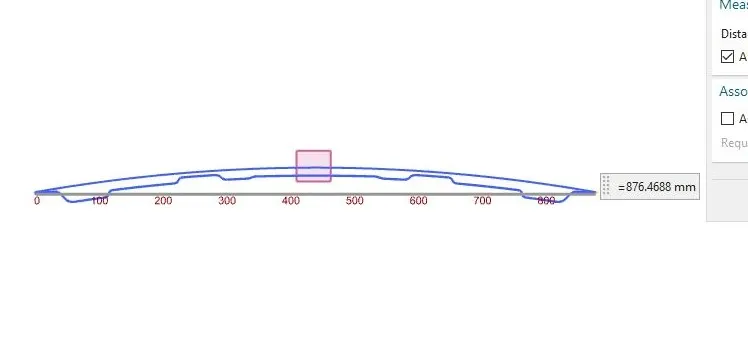
Y= 876.46/2 = 438.23 mm
Case 1
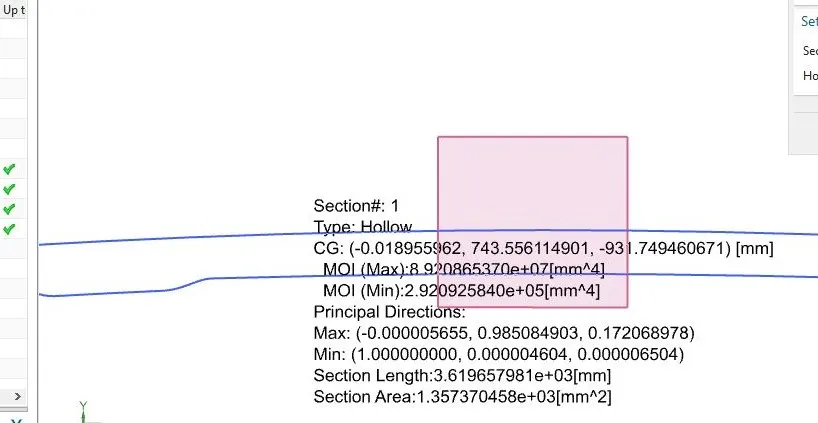
According to the question, I calculated the section modulus of my hood design with the help of the given formula.
The values of my design are:
Moment of inertia (min.), I = 2.920925840 x 10^3 mm^4
The distance between the extreme ends of hood = 876.46 mm
So, Y= 876.46/2 = 438.23 mm
Therefore, Section Modulus, S1 = 2.920925840 x 10^3/438.23
S1 = 6.665280 mm^3.
Case 2
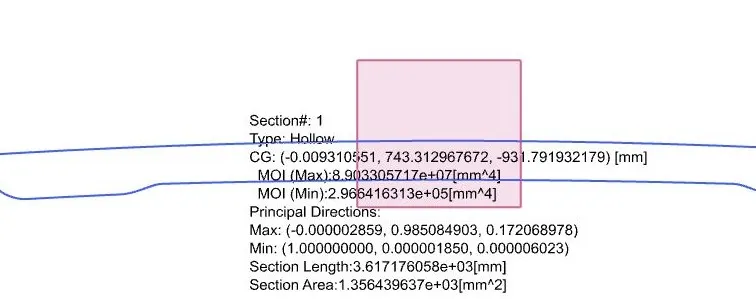
In the second case, I modified a section curve to improve the moment of inertia and thereby the section modulus. To increase the moment of inertia the area of cross section should be increased. To increase the area of cross section, I offseted the curve of the inner panel downwards to a distance 0.5 mm. Since clearance of about 90-100 mm should be maintained between the hood and the components inside, further offsetting cannot be feasible.
The values of the improved design are:
I (min.) = 2.966416313 x 10^3/mm^4
Y = 438.23 mm
Therefore S2 = 2.966416313 x 10^3/438.23
S2 = 6.76908544143 mm^3.
Conclusion:
- Here we checking both case and got different output, and comparatively, Case 2 is greater than Case 1 (S2 > S1)
- Strength and load material rise in tandem with an increase in section area due to increases in section modulus and moment of inertia. where the material's strength is directly correlated with the moment of inertia.