Section Modulus calculation and optimization
Goal:
Utilizing the section from your Hood design, use the formula S=I/y to determine the section modulus.
Modulus of Section:
Section modulus is a geometric property for a given cross-section used in the design of beams or flexural members. Section Modulus can also be defined as the ratio of the total Moment resisted by the section to the stress in the extreme fiber, which is equal to yield stress.
When designing beams and flexural members, the cross section's geometrical property, the section modulus (S), is used. It is not a physical representation of anything.
Section modulus formula: It can be described as the ratio of the section's total Moment resisted to the yield stress, which is the stress in the extreme fiber.
Whose yield stress is equivalent to.
Consequently
S=I/y, Where
S= Section modulus (mm^3)
I = Moment of inertia of the section to the stress in the extreme end of the object (mm^4)
Y = Distance between the neutral axis and the extreme end of the object (mm).
The body's resistance to angular acceleration is known as the Moment of inertia, and it is calculated by multiplying each particle's mass by the square of its distance from the axis of rotation. Simply put, it is a number that determines how much torque is required for a specific angular acceleration in a rotational axis. Rotational inertia or angular mass are other names for the Moment of inertia. Kg m2 is the SI unit of the Moment of inertia.
Observation:
Section Modulus
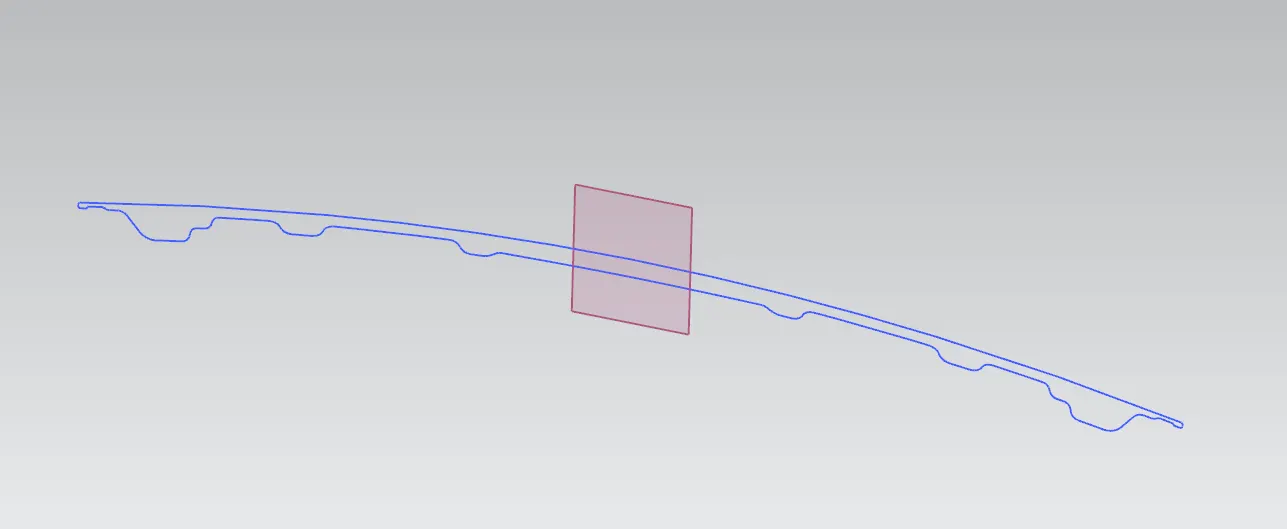
CASE-1
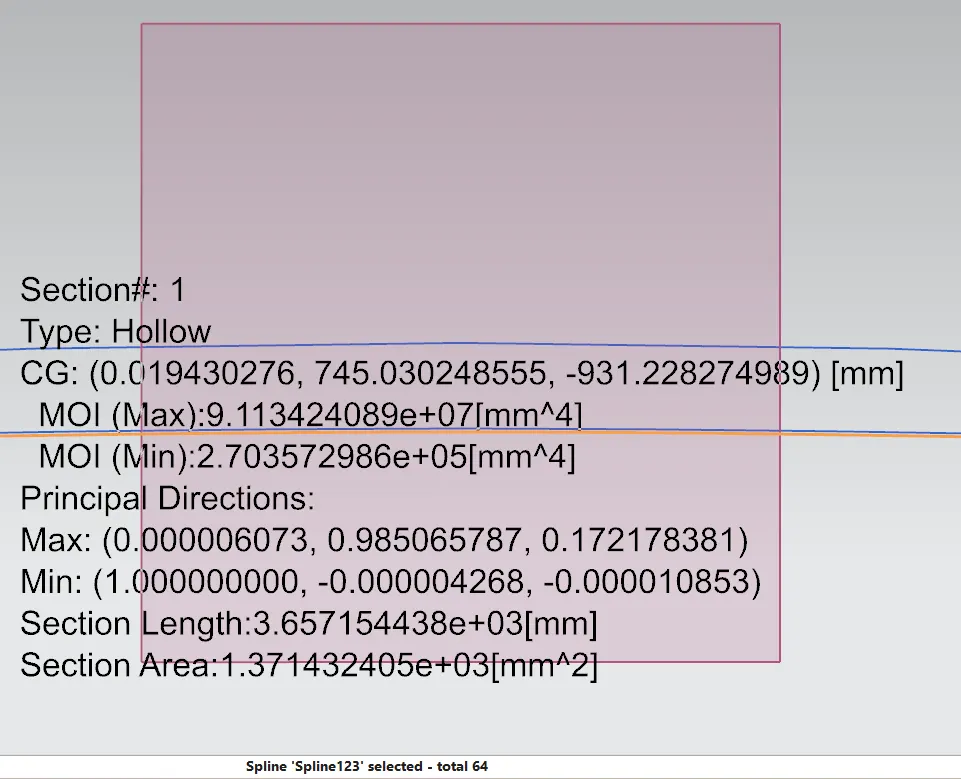
In this case, we are analyzing the inertia analysis component of the inner panel. Following our actions, we obtained the intended outcomes, as seen in the diagram above.
I (MAX) = 9.113424089e+07[mm^4]
I (MIN) = 2.703572986e+05[mm^4]
As per the section modulus equation,
S = I/Y
I = MOI (min) Value is considered
Y = Total distance / 2
Y=875.34/2
Y=437.67 mm
Therefore,
S = 2.703572986e+05[mm^4]/437.67 mm
So, 437.67mm2.703572986×105mm4≈617.52mm3.
S1 = 617.52mm3.
CASE-2
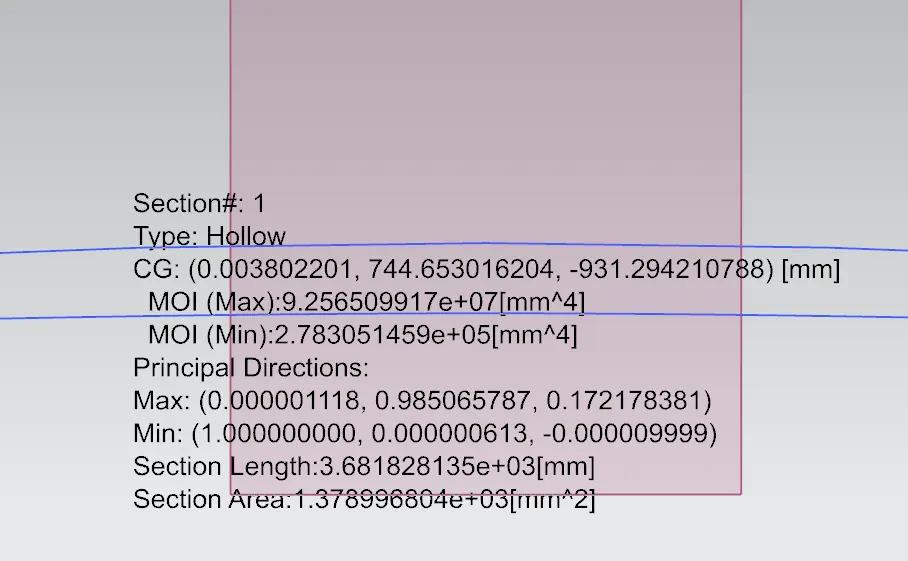
Here, we consider this an inner panel section at the curved position. Through analysis, we obtained the intended outcomes, which can be seen below.
I (MAX) = 9.256509917e+07[mm^4]
I (MIN) = 2.783051459e+05[mm^4]
As per the section modulus equation,
S = I/Y
I = MOI (min) Value is considered
Y = Total distance / 2
Y=875.34/2
Y=437.67 mm
Therefore,
S = 2.783051459e+05[mm^4]/437.67 mm
So, 437.67mm2.783051459×105mm4≈636.11mm3.
S2 = 636.11mm3.
To calculate the difference between 636.11 mm³ and 617.52 mm³:
636.11−617.52=18.59mm3
S2 is grater to S1.
The difference between S2 and S1 is 18.59mm3.
As the cross-sectional area increases, both the moment of inertia and the section modulus also increase, leading to a higher strength and load-bearing capacity of the material. This is because the moment of inertia is directly proportional to the material's strength.