Section Modulus calculation and optimization
Objective:
To find the section modulus of hood design and improve the section to increase strength and compare it with the existing section modulus value.
Section modulus:
Section modulus is a geometric property for a given cross-section used in the design of beams or flexural members. Other geometric properties used in the design include an area for tension and shear, the radius of gyration for compression, and the moment of inertia and polar moment of inertia for stiffness.
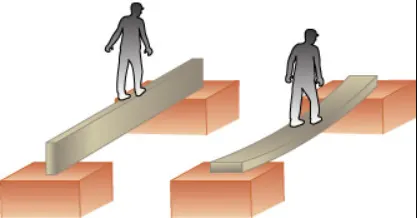
The section modulus of the cross-sectional shape is of significant importance in designing beams. It is a direct measure of the strength of the beam. A beam that has a larger section modulus than another will be stronger and capable of supporting greater loads.
Z=I/Y,
Z- section modulus,
I- Moment of Inertia (Unit mm^4),
y- Distance of outer fiber from the neutral axis (Unit mm).
Moment of Inertia (Second moment of area):
The Second moment of area is also called a moment of inertia. It is directly related to the area of material in the cross-section and the displacement of that area from the centroid. Once the centroid is identified, the important property of shape can be calculated. The axis that determines the centroid is known as the Neutral axis.
The second moment of area is a measure of the efficiency of a shape to resist bending caused by loading. A beam tends to change its shape when loaded. The second moment of area is a measure of a shape's resistance to change.
Section modulus of initial design:
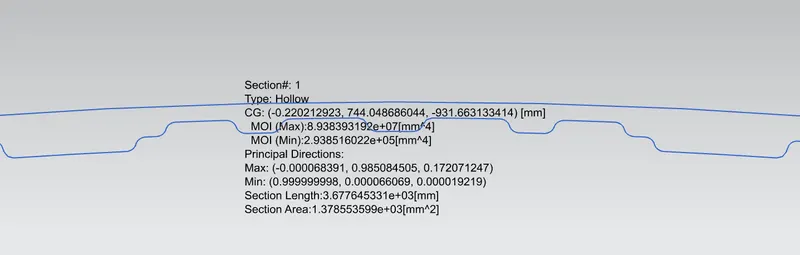
Maximum moment of Inertia= 8.938393192e+07 mm^4
Minimum moment of Inertia= 2.938516022e+05 mm^4
Total length of hood Y=879.57 mm
Distance of neutral axis from outer fiber =Y/2= 879.57/2= 439.785mm
Z=I(min)/Y
Z=2.938516022e+05 mm^4/439.785 mm
Z=668.1710431 mm^3
Modified design:
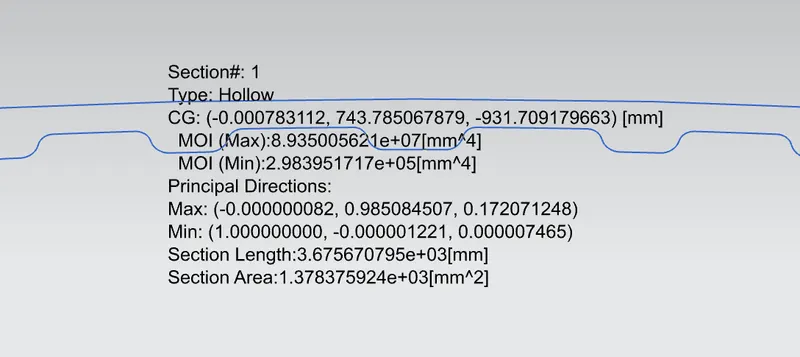
Maximum moment of Inertia= 8.935005621e+07 mm^4
Minimum moment of Inertia= 2.983951717e+05 mm^4
Total length of hood Y=879.57 mm
Distance of neutral axis from outer fiber =Y/2= 879.57/2= 439.785mm
Z=I(min)/Y
Z=2.983951717e+05 mm^4/439.785 mm
Z=678.5023857 mm^3
Conclusion:
Section modulus of Model 1 is Z= 668.1710431 mm^3 and Model 2 is 678.5023857mm^3. Model 2 has higher value than model 1.
The strength of the component is identified by the section modulus value. Section modulus is directly proportional to the moment of inertia. If higher the moment of inertia then the section modulus is higher. Obviously, the strength of the component is also higher.