Section Modulus calculation and optimization
AIM:
- Develop or modify the section modulus value as optimized to withstand more strength and resist to bend.
SECTION MODULUS :
- Section modulus is the ratio of moment of inertia and distance between the neutral axis and extreme end.
Z=I/Y
Z= Section modulus
I= Moment of inertia
Y= Distance between the neutral axis and extreme end.
There are two cases in which the term moment of inertia used
- Area moment of inertia.
- Mass moment of inertia.
AREA MOMENT OF INERTIA:
- Geometric cross-sectional property is also known as the second moment of inertia.
MASS MOMENT OF INERTIA:
- Mass moment of inertia or polar moment of inertia has a resistance of a mass to changes in rotational velocity.
APPLICATION OF AREA MOMENT OF INERTIA:
Here we use Area moment of inertia
- The section modulus and area moment of inertia are closely related as they are both properties of the beams across the sectional area.
- The Area moment of inertia can be used to calculate the stress in a beam due to an applied bending moment at any distance from the neutral axis using the following equation.
σ= My/I
Where σ is the stress in the beam, Y is the distance from the neutral axis passing through the centroid and I is the area moment of inertia.
- Since the stress is greatest at the farthest distance from the neutral axis section modulus combines both area moment of inertia and maximum distance from the neutral axis into one term.
- Section modulus and mass moment of inertia are entirely different properties.
- To increase the section modulus along with the cross-sectional area. Increase the hollow space between the outer panel and the inner panel.
- It unveils that when the moment of inertia increases, the section modulus also increases, and hence more is resistant to bend.
DEVELOPMENT OF SECTION MODULUS:
- Change is made in the design to improve the section modulus by varying the Y. increase the distance between the inner panel and outer panel as the distance increases the section modulus increases.
- If the inertia is increased, The section modulus of the hood panel also increased.
- This makes the hood more strong and more resistive toward a bend.
SECTION MODULUS CALCULATION:
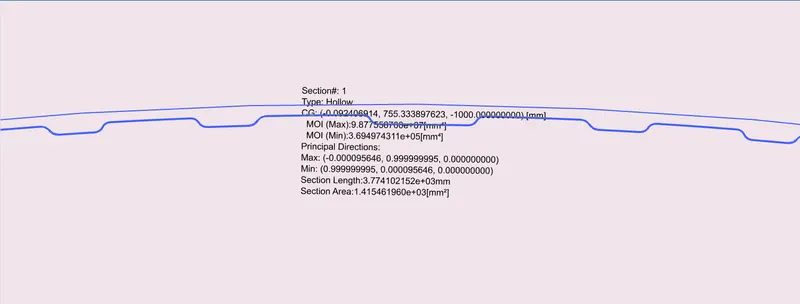
Case (i)
Z= I/Y
MOI(Max)= 9.877558700e^07[mm^4]
MOI(Min)= 3.694974311e^05[mm^4]
We consider the MOI(Min)= 369497.4311[mm^4] while calculating the section modulus.
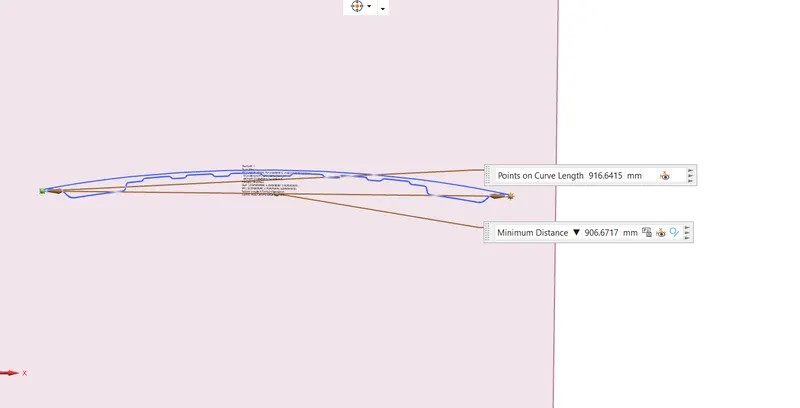
Y= Total distance/2
Total distance= 906.67 mm
Y= 906.67/2
Y= 453.335
Z= 369497.4311/453.35
Z= 815 mm^3
Case(ii)
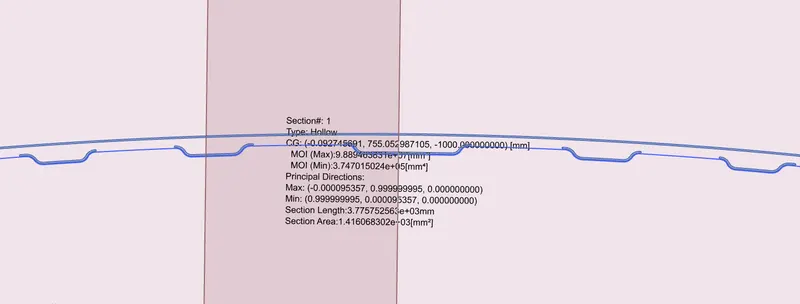
(a) To improve the strength and resistance to bending of the hood. We have made some changes in the hood.
(b) Hood inner panel curve is offset by 0.5 mm to increase the section modulus.
MOI(Max)= 9.889483831e^07 mm^4
MOI(Min)= 3.747015024e^05 mm^4
Consider MOI (Min)= 374701.50 mm^4
Y= Total distance/2
Y= 906.67/2
Y= 453.335
Z= 374701.5024/ 453.335
Z= 826 mm^3
CONCLUSION:
Here when comparing case(i) and case(ii)
- The section modulus value of case (ii) is greater than case (i).
- The main purpose of this analysis was to get the inertia of the hood and study of section modulus are improved it to withstand more loads.