Section Modulus calculation and optimization
Section Modulus Calculation and Optimization
Introduction-: This project is about analysation of section modulus for Hood section and optimization of the section for improving the section modulus to get increased strength of the part/component.
Objective-: To perform case study on section modulus analysis for hood section and perform calculations with optimization in hood section for improved section modulus.
Definitions-:
- Section Modulus-: Section modulus is the geometric property of the given cross-section of any hollow structure or beam structures. It is the direct measure of the strength for the hollow section or beam section. Higher the section modulus of a structure, the more the resistive it becomes to bending and structural failures.
The section modulus can be classified into two types-:
a. Elastic Section modulus – This is analysed where the material behaves elastically when subjected to loading.
b. Plastic Section Modulus – This is analysed where the material has plastic behaviour as a dominant character.
- Annotation-: Section modulus is denoted by ‘S’ & ‘Z’. According to studies North American & Britain/Australian reverse the usage of S & Z. For example, Elastic Section modulus is ‘S’ in North America and ‘Z’ in Britain/Australia, and hence vice versa for plastic section modulus.
- Formulae-: It can be defined as the ratio of the Moment of inertia to the distance between the neutral axis and the extreme end of the object.
S= I/y
Here,
S= Section Modulus (mm^3)
I= Moment of Inertia of the section (mm^4)
Y= Distance b/w the neutral axis and extreme end of object (mm)
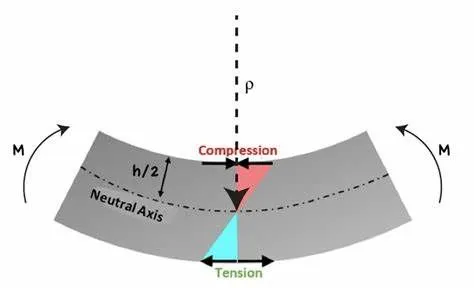
2. Moment of inertia -: Moment of Inertia is denoted by ‘I’. It is term used by engineers to quantify a beam and component ability to resist bending based on its shape.
3. Neutral Axis -: The neutral axis is the line passing through the cross-section of the object (subjected to a bending load) at which the fibres of the object experience zero stress and zero strain.
Calculations-:
- Case 1 – Before optimization.
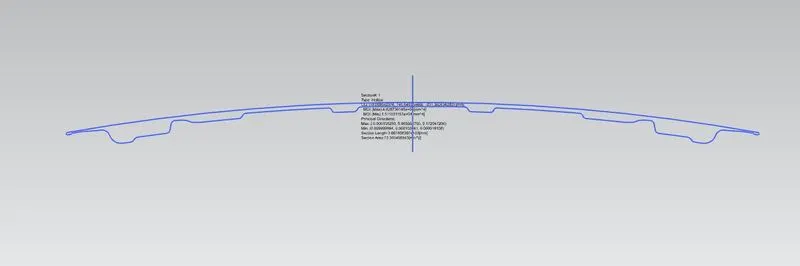
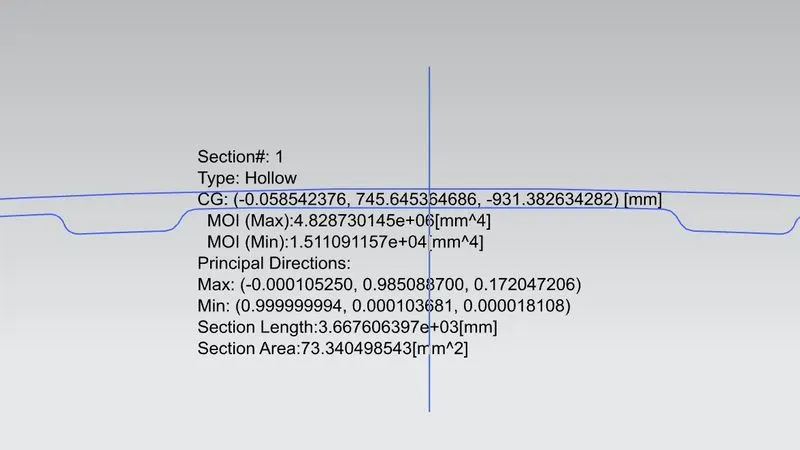
Section Modulus Analysis (S) -:
I(Max) = 4.828730145e+06 (mm^4)
I(Min) = 1.511091157e+04 (mm^4)
I(Min) values is to be considered.
As per the Formulae,
S= I/y
Y= Distance b/w the neutral axis and extreme end of object/2

Y= 875.4611/2
Y= 437.73055 mm.
S = 151109.1157 mm^4 / 437.73055 mm
S= 345.210 mm^3
Hence, the section modulus for this case study is 345.210 mm^3.
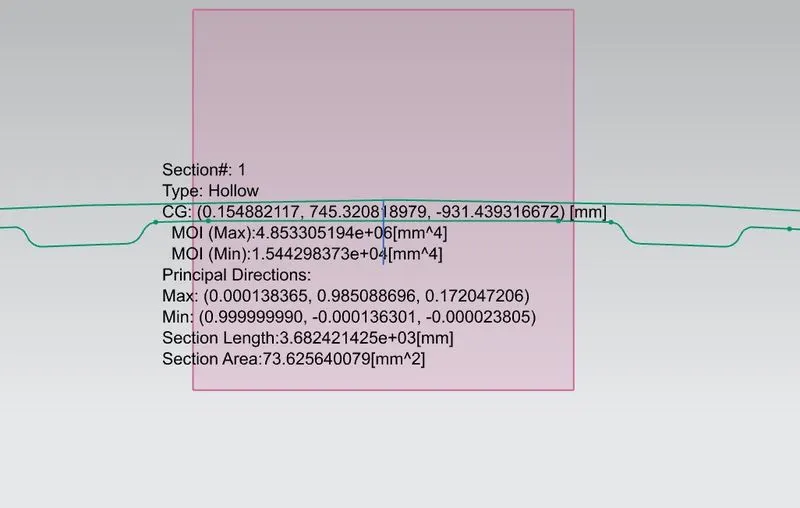
2. Case 2-: After Optimization gaps by 0.5mm.
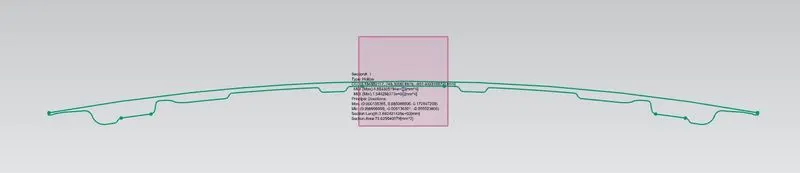
Section Modulus Analysis (S) -:
I(Max) = 4.853305194e+06 (mm^4)
I(Min) = 1.544298373e+04 (mm^4)
I(Min) values is to be considered.
As per the Formulae,
S= I/y
Y= Distance b/w the neutral axis and extreme end of object/2
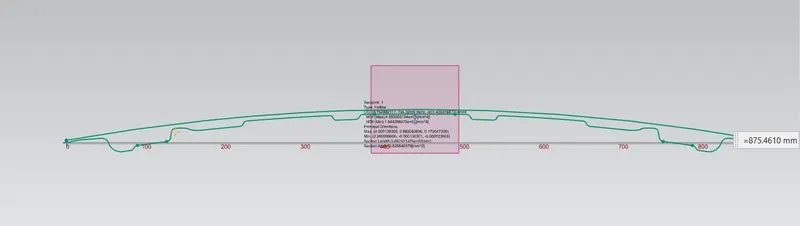
Y= 875.4610/2
Y= 437.73055 mm.
S = 154429.8373 mm^4 / 437.73055 mm
S= 345.210 mm^3
Hence, the section modulus for this case study is 352.796 mm^3.
Conclusion-: Hence by these calculations we learnt that Section modulus is directly proportional to the MOI. To increase MOI, we need to increase section area, and by increasing the gaps by 0.5 mm the MOI has increased and strength of component is optimized.