Section Modulus calculation and optimization
Section Modulus OF THE HOOD
OBJECTIVE:
To find section modulus of the hood and optimisotion to improve the overall section modulus.
Section Modulus
The section modulus is used by engineers to quickly predict the maximum strees a bending moment will cause on a beam. The equation for the maximum absolute value of the stress in a beam subjected to bending.
Take these considerations into account when calculating section modulus and maximum stresses:
- We obtain the bending moment through a static or structural analysis of the beam.
- To get the section modulus, we can use tables for predefined structural members, but this calculator is the best option if you're dealing with custom geometries.
therefore,
S=I/Y
Where,
S = Section Modulus
I = Moment of Inertia
y = distance between the neutral axis and the extreme end of the object
area moment of inertia
The area moment of inertia is a property of a two-dimensional plane shape which characterizes its deflection under loading. It is also known as the second moment of area or second moment of inertia. The area moment of inertia has dimensions of length to the fourth power.
M = bending moment.
I = area moment of inertia
E = youngs modulus
R = radius of gyration
where yiend strength of stainless steel is 520Mpa = 520N/mm^2
calculation:
case 1 : before optimization
the hood which was already created is imported and the section inertia analysis is done.
we have to make sure thet the curve obtained is a single/ closed curve.
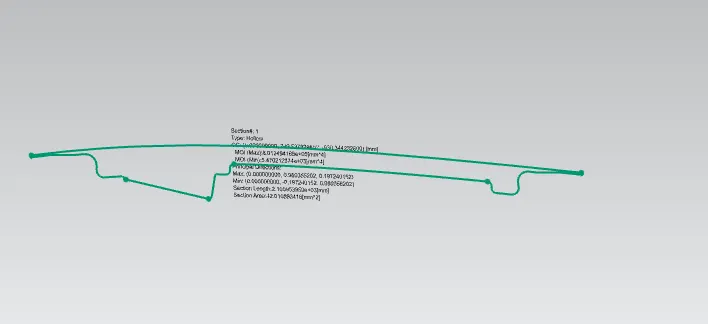
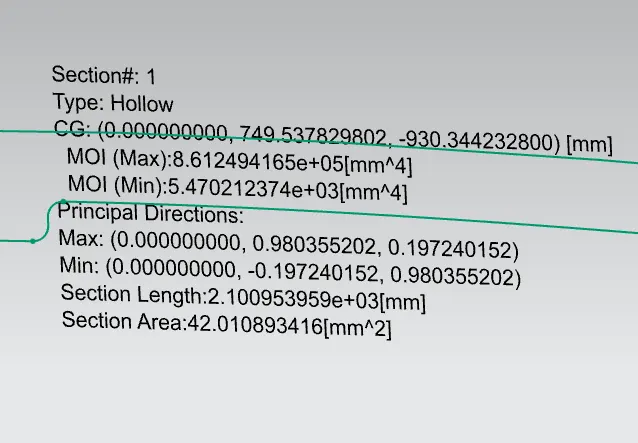
MOI (max) = 8.612494165e+5(mm^4)
MOI (min) = 5.470212374e+3(mm^4)
as per the section modulus equation,
S = I/Y
i = MOl (min) value is considerd
Y = Total distance/2,
= 242.5456116mm,
therefore,S = 22.55(mm^3)
case 2 : after optimization:
the hood inner panel's curve is offset 0.5mm outwards and section inertia analysis is done same as case i for a closed curve.
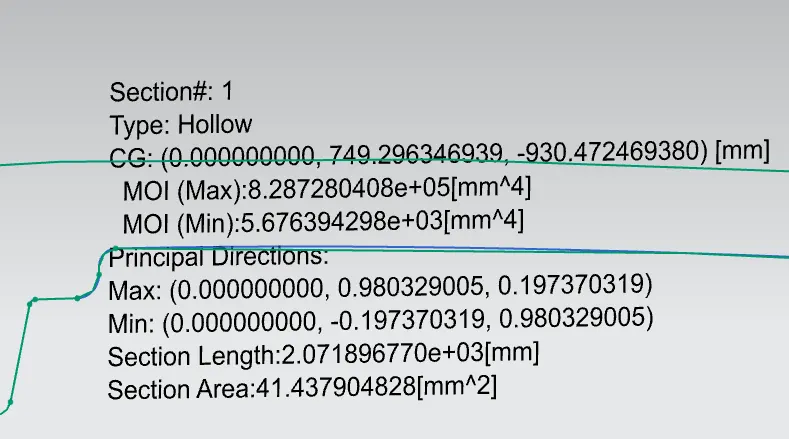
MOI (max) = 8.287280408e+5(mm^4)
MOI (min) = 5.676394298e+3(mm^4)
as per the section modulus equation,
S = I/Y
i = MOl (min) value is considerd
Y = Total distance/2,
= 242.5456116mm,
therefore,S = 23.4034(mm^3)
Conclusion:
- Hence when comparing case 1& case 2,
- The section modulus value of case 2 is higer then the case 1
- As we increase the section area. the moment of inertia & section modulus increases which means strength and load material also increase.