Section Modulus calculation and optimization
Section Modulus calculation and optimization
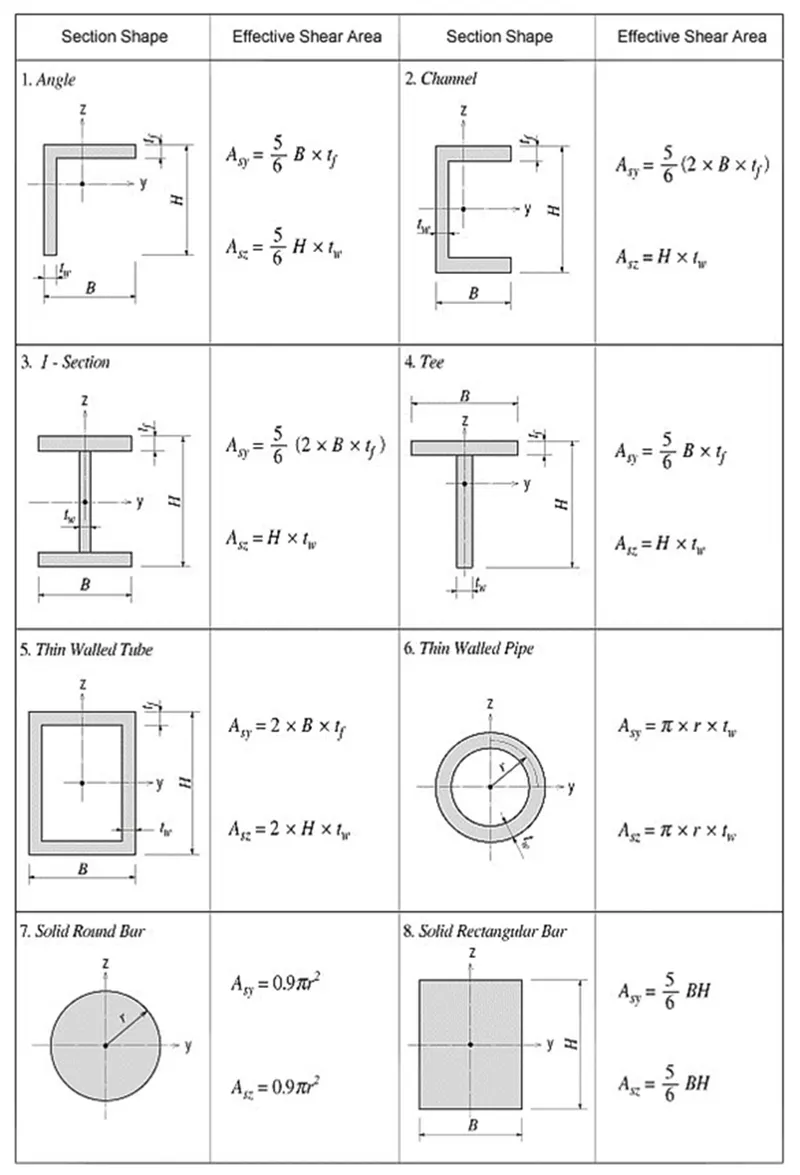
Section modulus
The elastic section modulus is defined as S = I / y, where I is the second moment of area (or moment of inertia) and y is the distance from the neutral axis to any given fibre. It is often reported using y = c, where c is the distance from the neutral axis to the most extreme fibre, as seen in the table below.
Section modulus is a geometric property for a given cross-section used in the design of beams or flexural members. Other geometric properties used in design include area for tension and shear, radius of gyration for compression, and moment of inertia and polar moment of inertia for stiffness. Any relationship between these properties is highly dependent on the shape in question. Equations for the section moduli of common shapes are given below. There are two types of section moduli, the elastic section modulus and the plastic section modulus. The section moduli of different profiles can also be found as numerical values for common profiles in tables listing properties of such.
Moment of inertia
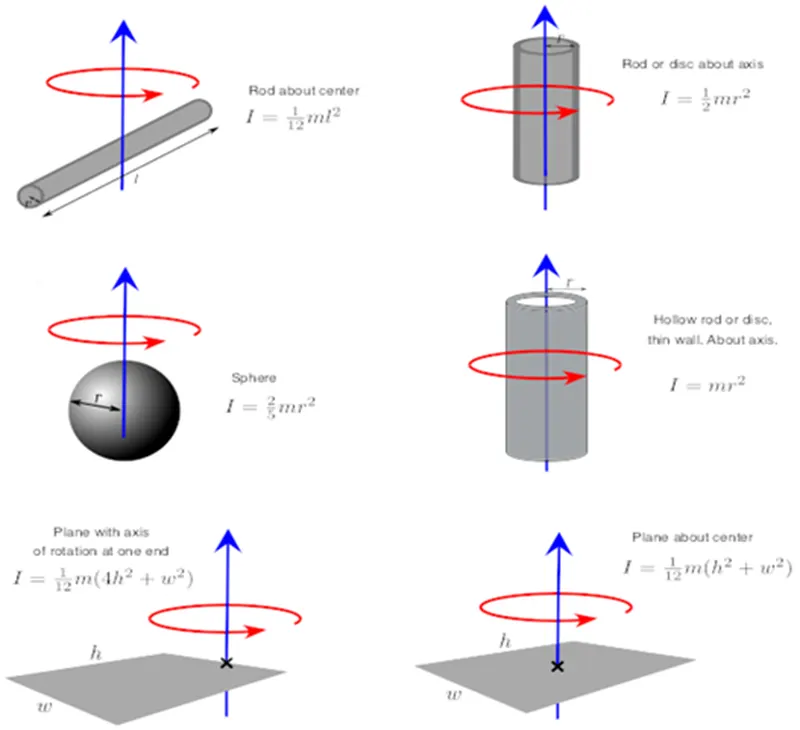
inertia, property of a body by virtue of which it opposes any agency that attempts to put it in motion or, if it is moving, to change the magnitude or direction of its velocity. Inertia is a passive property and does not enable a body to do anything except oppose such active agents as forces and torques. A moving body keeps moving not because of its inertia but only because of the absence of a force to slow it down, change its course, or speed it up.
There are two numerical measures of the inertia of a body: its mass, which governs its resistance to the action of a force, and its moment of inertia about a specified axis, which measures its resistance to the action of a torque about the same axis. See Newton’s laws of motion.
Aim
Use the Section from your Hood design and calculate the Section Modulus using the formula
S = I/y
Where ,
S = Section Modulus
I = Moment of Inertia
y = distance between the neutral axis and the extreme end of the object
Come up with a new section that has an improved Section Modulus compared to the previous one and mention what changes you made which resulted in the increased strength.
Solution
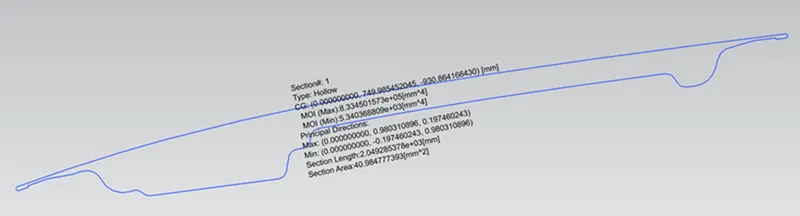
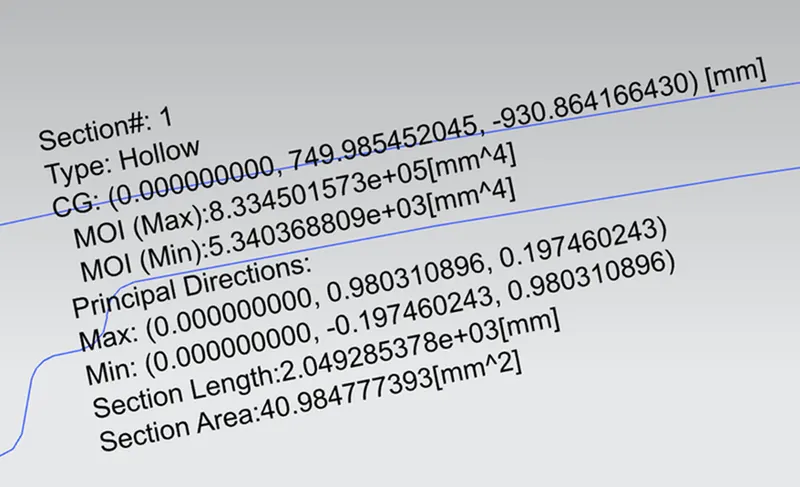
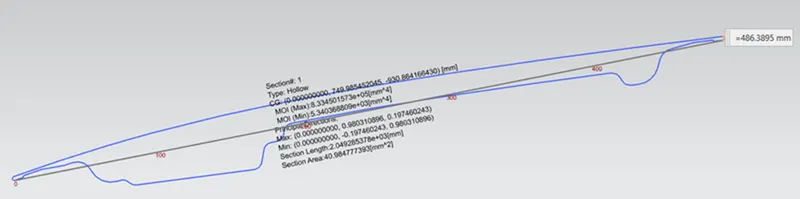
I max = 8.33450 x 10^5 mm^4
I min = 5.34036 x 10^3 mm^4
Y = 486.3895/2= 243.1947 mm
So,
S min = 5.34036x10^3 / 243.1947 => 21.9591 mm^3
Our primary design has a section modulus of 21.9591mm^3
Then, we revise our design to include more moment of inertia and Section Modulus.
Now, one more trail is that, here the inner panel curve offsetting outside & increasing in cross sectional
area the results shown below.
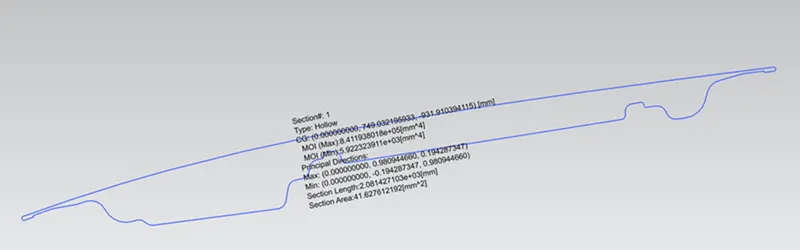
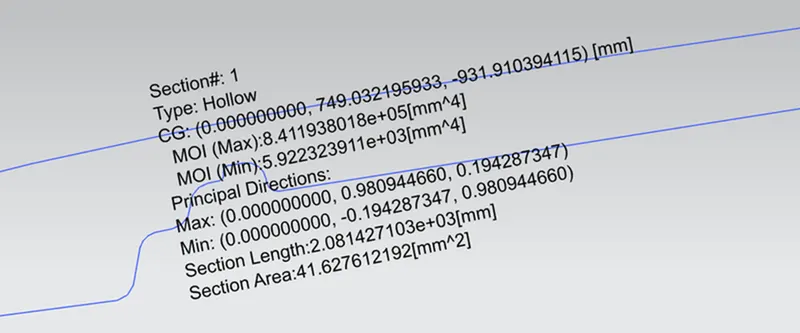
I max = 8.41193 x 10^5 mm^4
I min = 5.92232 x 10^3 mm^4
Y = 486.3895/2= 243.1947 mm
So,
S min = 5.92232x10^3 / 243.1947 => 24.3521 mm^3
revise design has a section modulus of 24.3521 mm^3
So, here when comparing both the hoods there is changes in both MAX and MIN strength values, what i came to
know that when i increased sectional area by 2 mm the value of minimum strength was increased from 21.9591mm^3 to 24.3521 mm^3,Hence with increase in cross sectional area results in increase in strength.
So Newton's first law also explains that if higher the mass, the force required to move the object is also high
due to offering more resistance in order to move the object, This resistance we called it as a MOMENT OF
INERTIA.
In case of hood also same principle will work, i.e when increase in cross sectional area by imm the minimum
load carrying capacity or strength was increased.
The strength of the material also depends upon the composition of material ,thickness and cross sectional area
of an object.
CONCLUSION:-
The strength of the material is directly proportional to the moment of inertia, hence increase in sectional area
there is have increase in overall mass of an object ,hence have increase in strength.