Hood design-Week 2
A detailed report about the Hood Design & its components
What is a Car Hood?
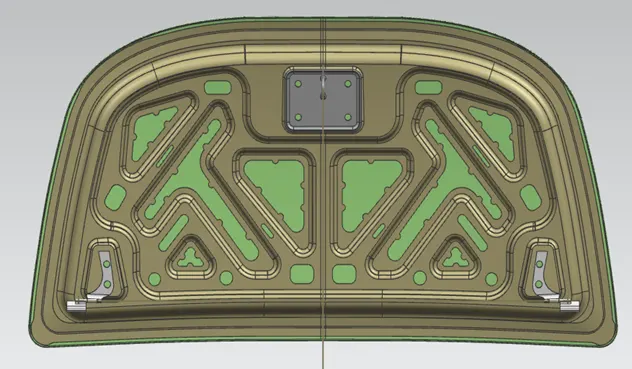
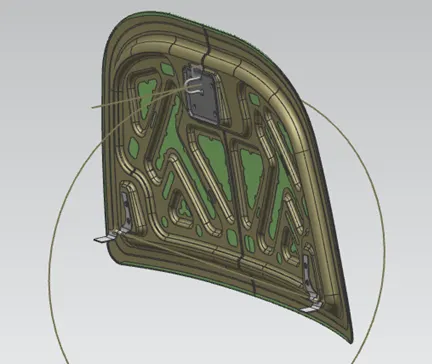
A car hood, also referred to as a bonnet in some other countries, is the hinged cover that rests over the engine of a front-engine vehicle. Its purpose is to provide access to the engine for repair and maintenance. A concealed latch is typically used to hold down the hood. On vehicles with an aftermarket hood and on race cars, hood pins may be used to hold down the car hood. Hoods sometimes also contain a hood scoop, wiper jets, power bulge, and/or hood ornament. Car hoods are typically constructed from steel and sometimes from aluminium. Aftermarket car hoods may be constructed from various other materials, including carbon fibre, fiberglass, or dry carbon.
safety test of Car hood
Pedestrian safety from front collision is also to be considered. The European New Car Assessment Program (Euro NAP) is a European car safety performance assessment program which has developed test.
specification and rating systems for assessing pedestrian injuries during impacts with the front of vehicles such tests include a series of tests using impactors designed to mimic a collision at a speed of 40Kmph. They describe a situation in which pedestrian is situated laterally and a car first hit one of his legs. Tests are conducted on the leg, upper leg and most importantly head, as head trauma is most commonly responsible for casualties.
What is Wrap Around Distance?
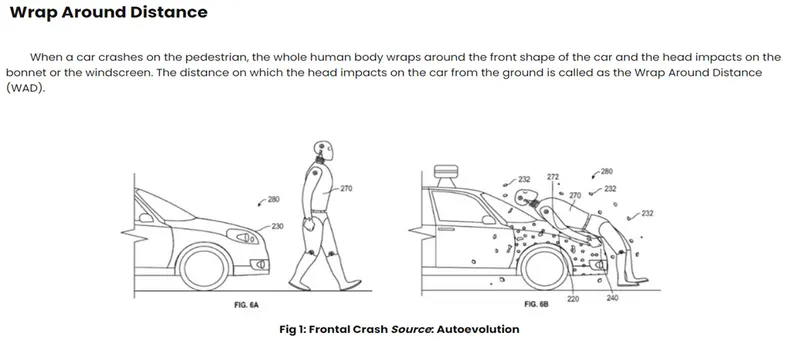
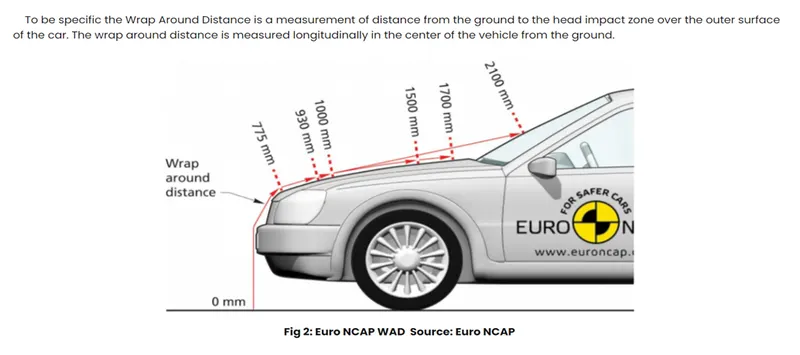
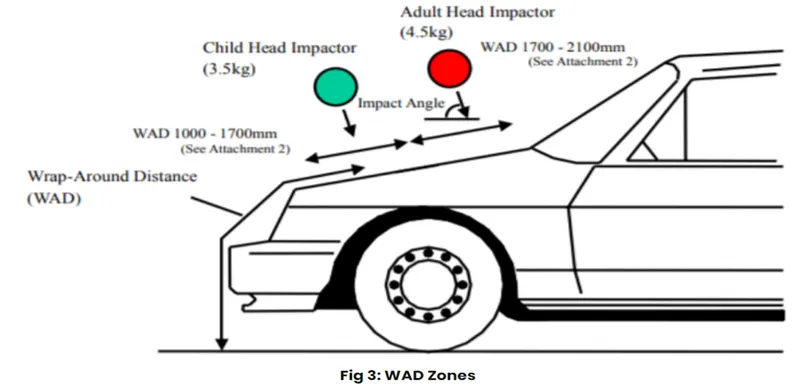
The severity of the injury caused by the frontal crash depends on the type and shape of the vehicle, speed of the vehicle and the movement of the pedestrian relative to the vehicle. In addition to these parameters, the wrap around distance plays a major role in the safety measurement of a pedestrian.
During the crash analysis, based on the Wrap Around Distance (WAD), two test areas will be created namely Child head impact zone and the adult head impact zone. The child head impact zone is between 1000 to 1700 mm WAD and the adult head impact zone ranges between 1700 to 2100 mm WAD
Manufacturing process
Deep Drawing
Deep drawing is one of the most widely used processes in sheet metal forming. Apart from its use in many other
sectors, it is applied in the automotive industry for the manufacturing of car body parts. The deep drawing process isa forming process which occurs under a combination of tensile and compressive conditions.
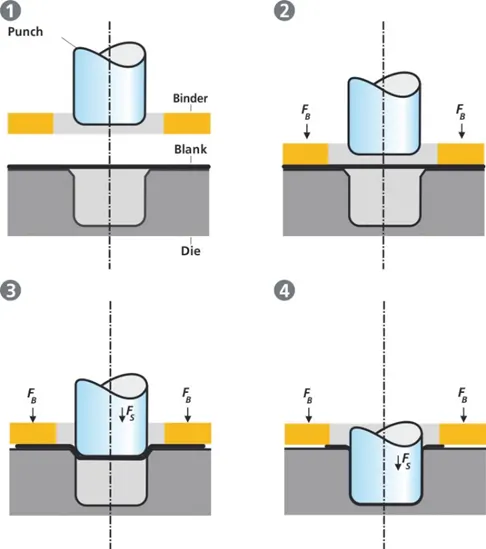
Sheet metal blank is radially drawn into a forming die by the mechanical action of a punch. It is thus a shape transformation process with material retention. The process is considered "deep" drawing when the depth of the drawn part exceeds its diameter. This is achieved by redrawing the part through a series of dies. The flange region (Sheet metal in the die shoulder area) experiences a radial drawing stress and a tangential compressive stress due to the material retention property. These compressive stresses (hoop stresses) result in flange wrinkles. Wrinkles can be prevented by using a blank holder, the function of which is to facilitate controlled material flow into the die radius.
HEMMING
The outer panel & Inner panel can't be joined by the welding process as it will leave a spot on the outer panel and it will spoil the look of a car.
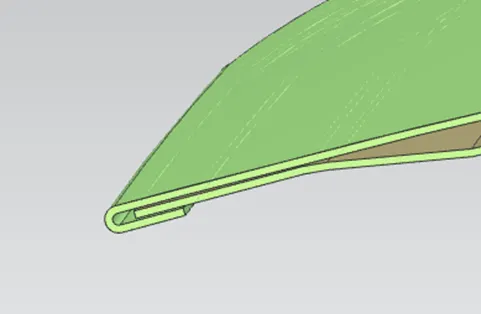
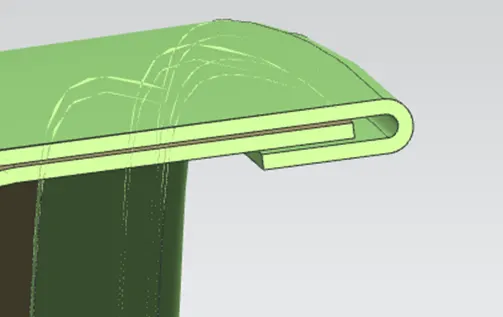
Inner and outer closure panels together we use the Hemming process It is the process of bending/folding the flange of the outer panel over the inner one, the flange of the outer panel is bent over the inner panel in progressive steps by means of the roller harming head.
Mastic Point Data
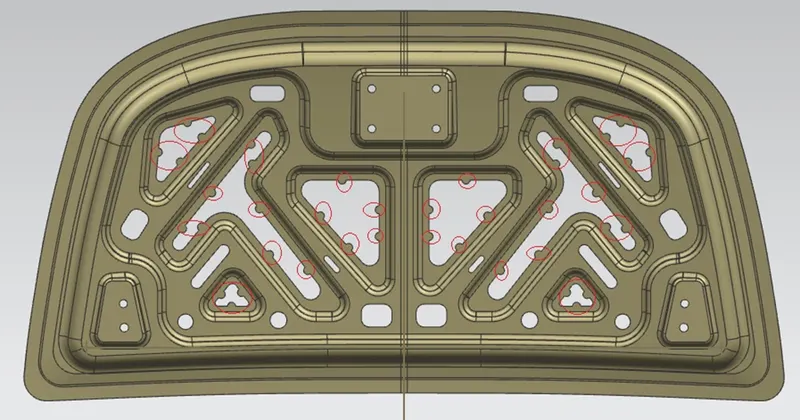
Hood commonly possesses large surface are and hemming can only be provided through its boundary. We cannot use other joining techniques like welding, riveting etc because they leave marks on the outer panel which spoil its aesthetic appearance. So, mastic sealants are used to stick the inner surfaces of outer panel and inner panel. Mastic sealants are elastic compound that behave like rubber. It is applied between the inner and outer panels at specified spots. Each spot of mastic sealants has its effect around a circular region of 80mm diameter. Thus, the mastic points are arranged in such a way that it covers the areas away from the hemming which are more vulnerable to vibrate.
Emboss
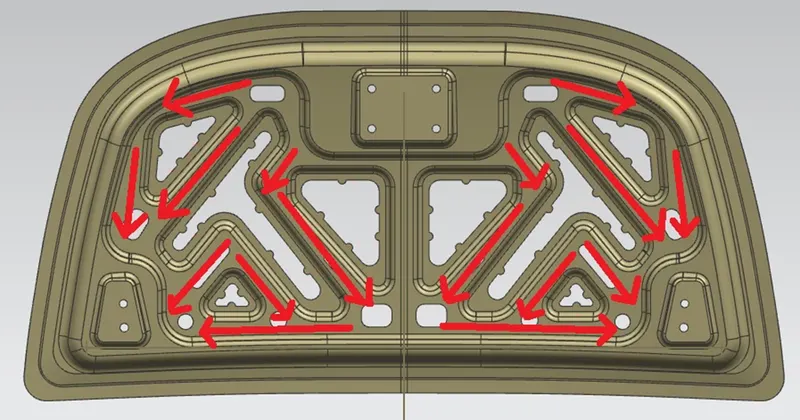
Throughout the inner panel we provide different embosses. We can increase the stiffness of the inner panel through these embosses. The shape and size of the embosses also determines the direction of the force distribution resulted from frontal collision. The force should be always distributed away from the passengers. Here in the figure the embosses are designed in such a way that the force is directed to both sides of the car.
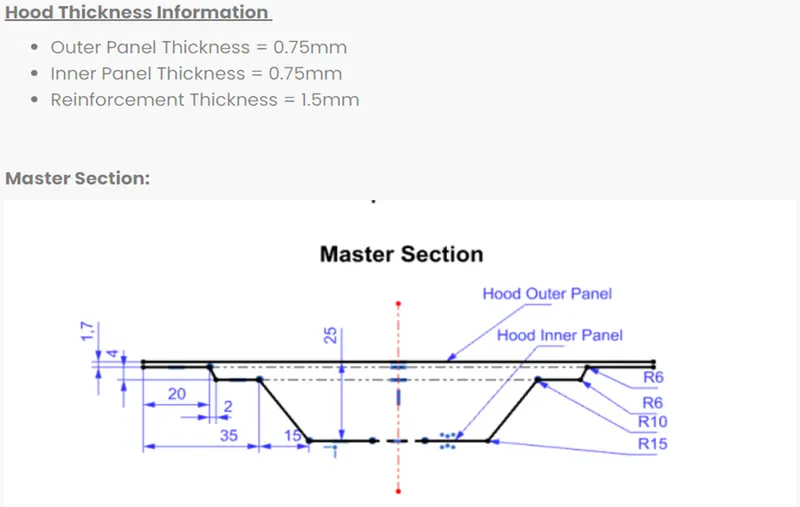
MASTER SECTION OF THE HOOD & GIVEN DATA
TOOLS WE USED IN NX CAD FOR HOOD ASSEMBLY
Trim Body/Trim Sheet. – The main difference is Trim Sheet is limited to trimming away areas of non-solid bodies (a single surface or collection of surfaces sewn into a sheet body) but the objects used to define the trimming boundary isn't limited to only faces or datum planes as is the case with Trim Body.
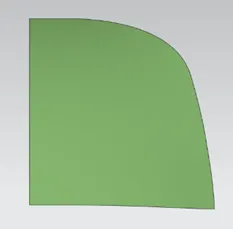
Offset surface. – The offset surface tool is useful way of creating a series of deposit or erosion contact surfaces from a reference mesh. The surface can be offset from the reference mesh by points or by a fixed distance, and additional options for offsetting to points can be adjusted once the surface has been created.
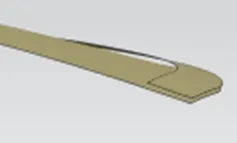
Through Curves. - You can create a sheet body through curves by using the “Through Curves” command. If the curves do not have closed contours, the created body will be a surface body.
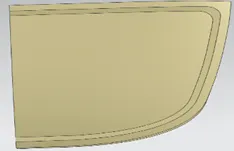
Law Extension. - creates flanges or extensions when a particular direction is important or when it is necessary to reference the existing face. For example, in die design or mold design, draft direction plays an important role in creating parting surfaces.
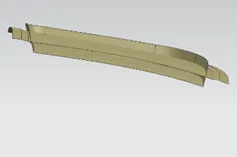
Emboss. – Use the Emboss Sheet command to modify a sheet body by adding faces of a solid body, as if the solid body was pressed into the sheet body.
Sheet metal models are embossed to:
- Increase a metal panels stiffness and rigidity.
- Increase the surface area for heat transfer or acoustic applications.
- Improve traction.
- Enhance the ability of a metal surface to disperse fluids efficiently.
- Reduce friction and static.
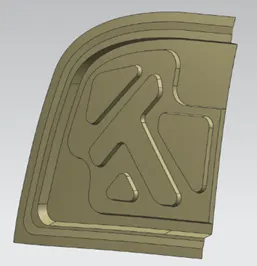
Project curve. - Use the Project Curvecommand to project curves, edges, or points that are external to the sketch, onto the sketch along the normal of the sketch plane.
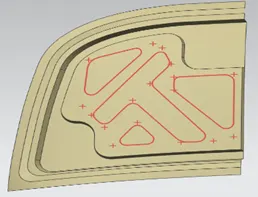
Face blend/Edge blend. - Use the Edge Blendcommand to round sharp edges between faces. / Use the Face Blend command to add tangent blend faces between two or three sets of faces. The cross section of the blend can be circular, conic, or law controlled.
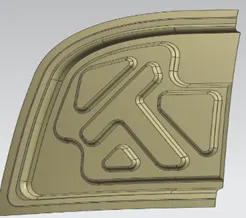
Wave geometry linker. - WAVE Geometry Linker is a means of associatively (or not if desired) linking (copying)geometry from one part into another. These can be bodies, faces, curves, sketches, routing objects etc which can then be used in the receiving part to design from or refer to.
Assembly constraint. - Assembly driven constraints provide you with a way to control the range of motion—both linear and angular—for the components of an assembly. This type of constraint allows you to include more design intent in your models, and you can make an assembly behave just as an actual model would in real life.
Mirror geometry/Mirror assembly. - You can create mirrored symmetric versions of the parts and components (sub-assemblies) in the NX assembly modelling. The “Mirror Assembly” command is used to create mirrored parts and components. / You can mirror solid or surface bodies in the NX. It might be hard to find this command in NX because there are two mirror commands in NX
Sew. - Use the Sewcommand to join two or more sheet bodies into a new single sheet body. If the collection of sheet bodies encloses a volume, a solid body is created. The selected sheet bodies must not have any gaps larger than the specified tolerance, or the resulting body will be a sheet body.
Thicken. - Use the Thicken command to offset one or more connected faces or sheets into a solid body. Thickening occurs by offsetting the selected faces along their face normal, and then creating sidewalls.
HOOD Assembly & components
A car hood, also referred to as a bonnet in some other countries, is the hinged cover that rests over the engine of a front-engine vehicle.
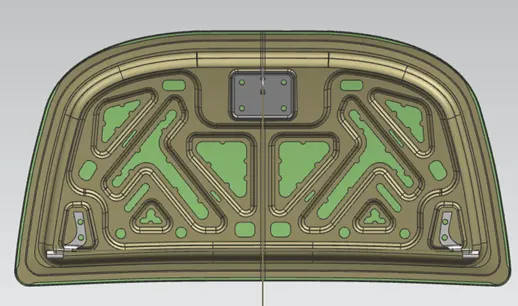
Its purpose is to provide access to the engine for repair and maintenance Hood consists of outer and inner panels.
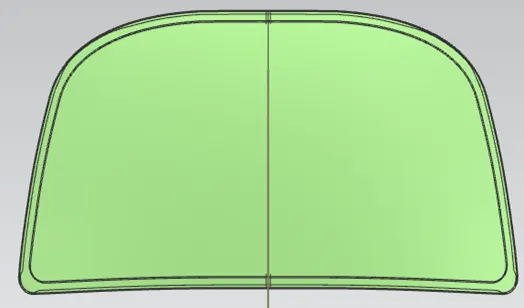
Outer panel is for the aesthetic look of the hood and the inner panel has engineering features to hold the outer panel and help as force distribution when the car is exposed to accident.
LATCH & STRIKER
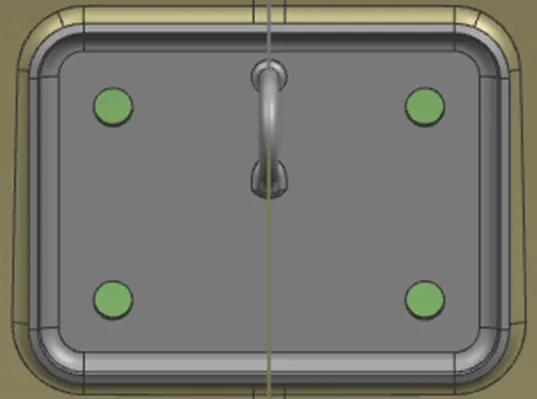
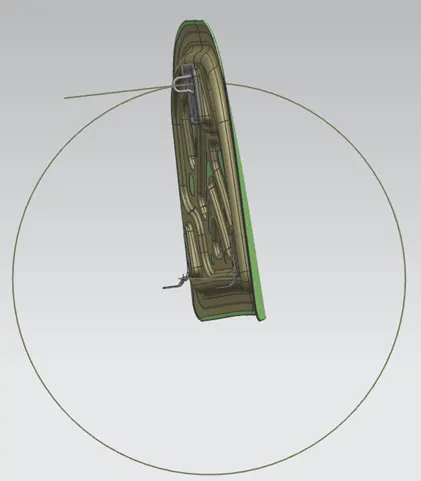
Latch & striker is used for locking the hood with the car. it's usually placed on the space provided on the inner panel.
HINGE
Hinges are used to connect the hood & cowl panel of an automobile; it enables the opening & closing operation of the hood. The hinge should be made strong enough to handle the weight of the hood and also to handle the force action on it during the collision.

CORNER RELIEF ON OUTER PANEL
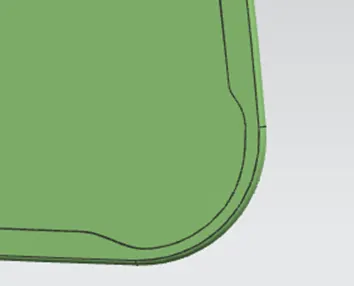
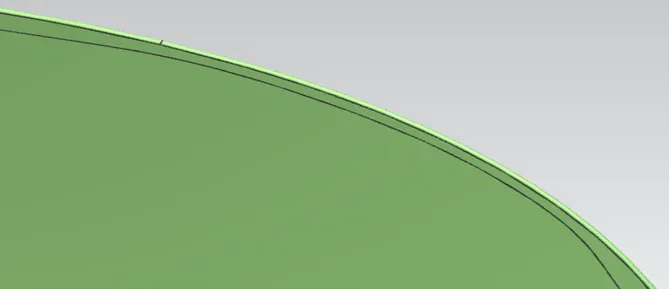
In the hemming process rollers are used. In this process the rollers will be rolling over the edges of the Outer panel to close it with the inner panel.
These rollers will be rolling over 2-3 times for perfect closing.
Force is being used by rollers to all the corners but there are some areas where the roller cannot tighten the part properly as we give some relief to the corners.
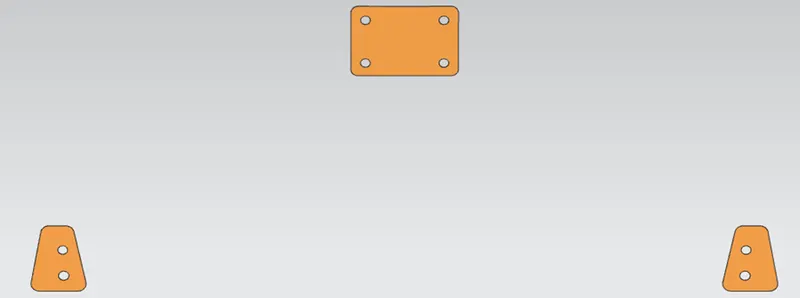
REINFORCEMENT
Improving Performance or Stiffness of the Car Body.
This way sheet metal thickness will be reduced and steel reinforcement plates are unnecessary. It is a contribution to reduce the weight of vehicle and may also avoid creation of vibrations and thus noise and fatigue cracks in the structure.
CONCLUSION:
Thus a Hood is designed in a top- down approach where the intent comes from the top (the assembly) and
moves down (into the parts), which satifies the industry's manufacturing requirements, functional as well as Safety
standards (Euro NCAP) in NX CAD tool.