Section Modulus calculation and optimization
SECTION MODULUS CALCULATION & OPTIMIZATION OF A HOOD
Introduction:
- Section modulus (s) is a geometric property for a given cross-section used in the design of beams or flexural members. Other geometric properties used in the design include an area for tension and shear, the radius of gyration for compression, and moment of inertia, and the polar moment of inertia for stiffness. Any relationship between these properties is highly dependent on the shape in question.
- There are two types of section moduli, the elastic section modulus, and the plastic section modulus. The elastic section modulus is used for the general design, applying up to the yield point for most metals and other common materials.
- The plastic section modulus is used for materials where elastic yielding is acceptable and plastic behavior is assumed to be an acceptable limit. Designs generally strive to ultimately remain below the plastic limit to avoid permanent deformations, often comparing the plastic capacity against amplified forces or stresses.
- The elastic section modulus is defined as S = I / y, where I is the second moment of area and y is the distance from the neutral axis to the outermost fibre.
- Section modulus is also used to determine the yield moment (My) such that My = S × σy, where σy is the yield strength of the material. Yield moment defines the amount of stress-induced in the outermost fibre because of the moment.
SIGNIFICANCE OF SECTION MODULUS:
- Section modulus is the most important factor in the design of beams or flexural members. It shows the tendency of the beam to resist the load for the given cross-section and material.
- Consider the bending equation M/I=σ/y=E/R. From the equation, the section modulus (s) is inversely proportional to the distance between the neutral axis and the outermost fibre. To improve the stress-bearing capacity of that section its moment of inertia (To be specific 'Area moment of inertia') must be more.
PROBLEM STATEMENT:
Use the Section from your Hood design and calculate the section modulus using the formula S = I/y
S = Section Modulus
I = Moment of Inertia
y = distance between the neutral axis and the extreme end of the object
Come up with a new section that has improved the section modulus of the previous section and mention what change you made that has increased the strength.
In this hood example, we will simply change the embossing depth and observe the change in MOI of that section and calculate the corresponding value of section modulus.
SECTION MODULUS CALCULATION:
1. Hood Section 1
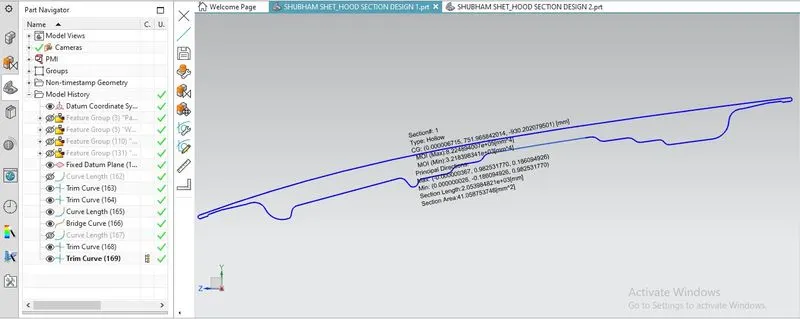
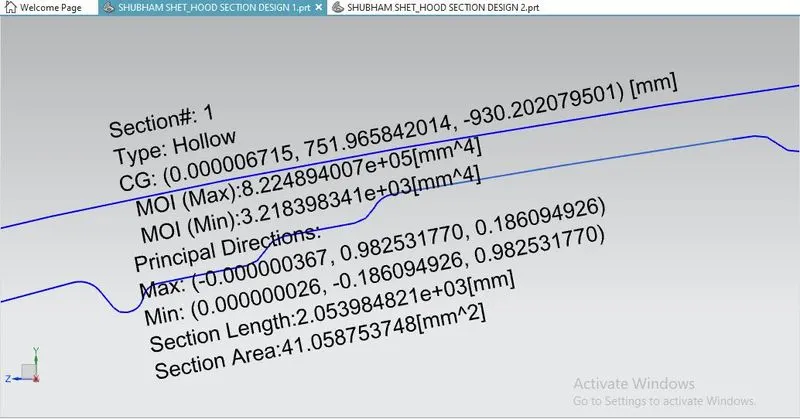
For this hood section,
considering max. MOI which is 8.2248e+05[mm^4].
Material: Stainless Steel AISI-302-cold-rolled
y=486.823mm
Using the formula S = I/y
Therefore, Section modulus (s)= (8.2248*10^5)/486.823
Section Modulus (S) = 1689.485mm^3.
Now, calculating Yield Moment (My) i.e My = S × σy
For the selected material Yield strength = 520 N/mm^2.
Yield Moment (My) = 1689.485 x 520 = 878532.2 N-mm.
1. Hood Section 2
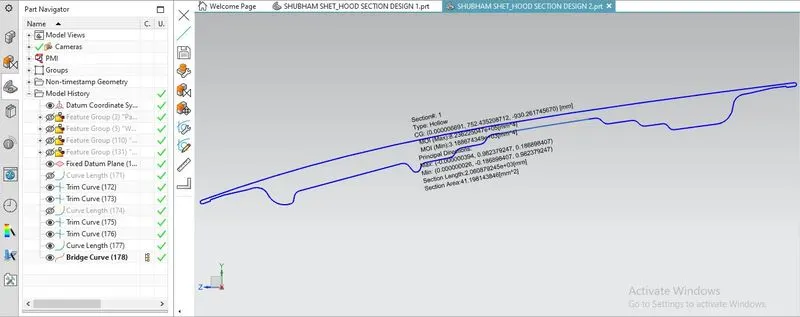
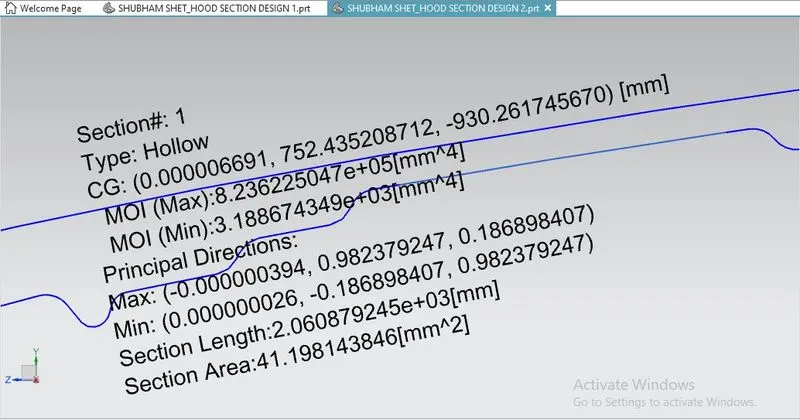
For this hood section,
considering max. MOI which is 8.2362e+05[mm^4].
Material: Stainless Steel AISI-302-cold-rolled
y=486.823mm
Using the formula S = I/y
Therefore, Section modulus (s)= (8.2362*10^5)/486.823
Section Modulus (S) = 1692mm^3.
Now, calculating Yield Moment (My) i.e My = S × σy
For the selected material Yield strength = 520 N/mm^2.
Yield Moment (My) = 1692 x 520 = 879840N-mm.
CONCLUSION:
- A small change in the sectional area (i.e the depth of the emboss) is followed by the change in the value of the moment of inertia and the sectional modulus. Although the difference, in this case, is small, if we modify some of the local areas in the section we will get a higher value of section modulus.
- Here, the section modulus of the 2nd hood section is more than the previous one, hence it will have more strength against the stress-induced.