Section Modulus calculation and optimization
SECTION MODULUS CALCULATION AND OPTIMIZATION
Introduction:
Section Modulus is a geometric property for a given-cross section used in the design of beams or flexural members. It is termed as the ratio of moment of inertia and distance from neutral axis to the extreme edge. Also it is the measure of strength of a given member. The section modulus of the cross-sectional shape is of significant importance in designing. It is denoted by the symbol 'S'.
Importance of section modulus:
- It is significant for beam and flexural member design.
- More the section modulus, more the member is resistant to bending of the beam.
- It is easier to calculate stress in beam and an exact measure of strength of steel 4. Bigger the section modulus, tougher and more the member is tougher and more capable to withstand larger loads.
Calculation of Section Modulus:
To calculate the section modulus of a given section the following formula is applied;
S = I/Y
Here,
S = Section Modulus
I = Moment of Inertia
y = Distance between the neutral axis and the extreme end of the object
Existing Section Modulus:
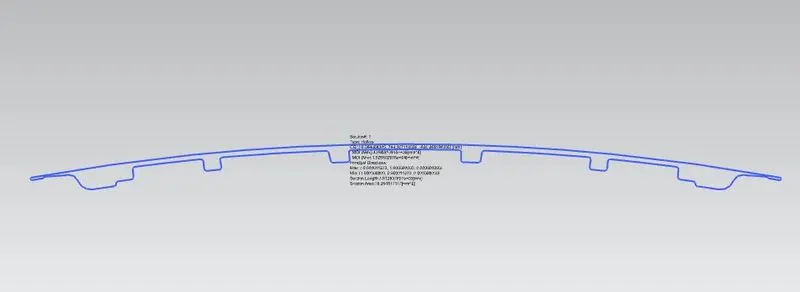
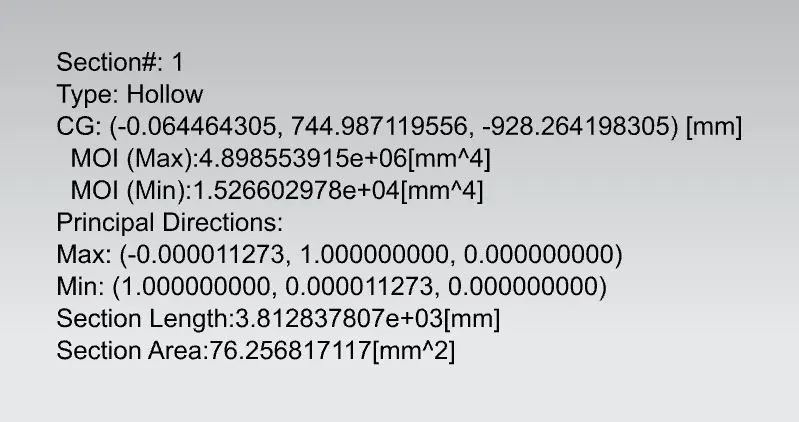
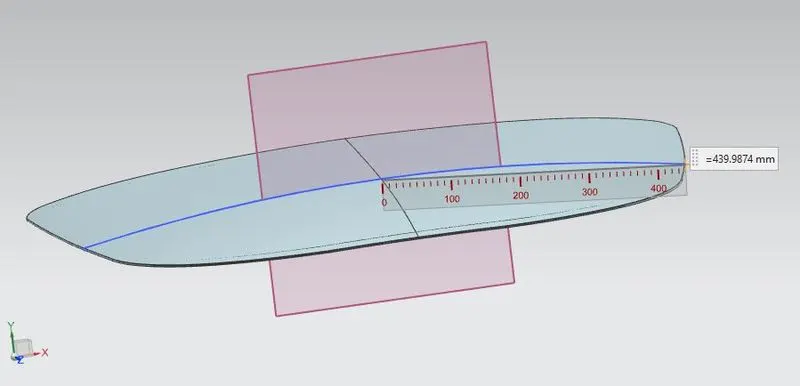
This section has the following:
Max. Moment of Inertia = 4.898553915*10^6 mm^4
Min. Moment of Inertia = 1.526602978*10^4 mm^4
Section Area = 76.256817117 mm^2
S = I/Y = 1.526602978*10^4 / 440
S = 34.6955222 mm^3
Improved Section Modulus:
To improve the section modulus, the geometry of the hood is modified. The distance between the inner and outer hood is increase by an extra gap of 0.75 cm from the existing hood design.
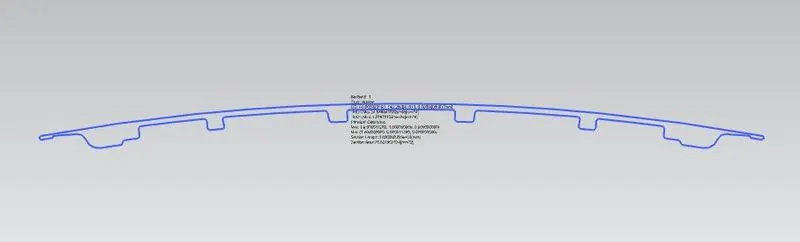
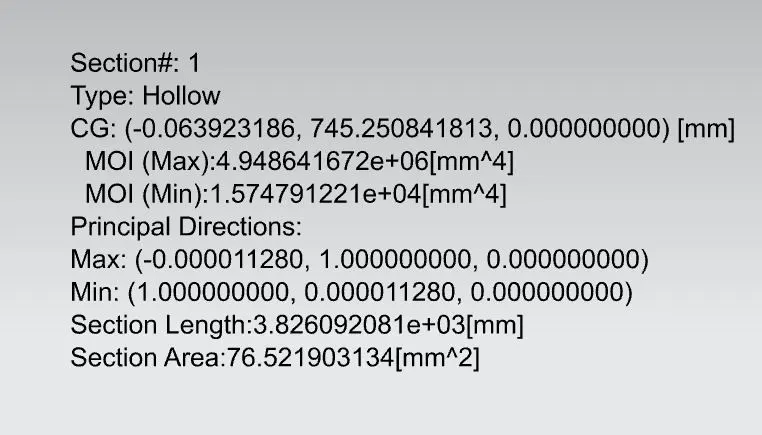
This section has the following:
Max. Moment of Inertia = 4.948641672*10^6 mm^4
Min. Moment of Inertia = 1.574791221*10^4 mm^4
Section Area = 76.521903134 mm^2
S = I/Y = 1.574791221*10^4 / 440
S = 35.7907096 mm^3
Conclusion:
Thus the section modulus of the hood is calculated and improved by varying the distance between the inner and outer panels by an extra 0.75 mm from the existing hood design.