Section Modulus calculation and optimization
SECTION MODULUS WORKBENCH (ON HOOD):-
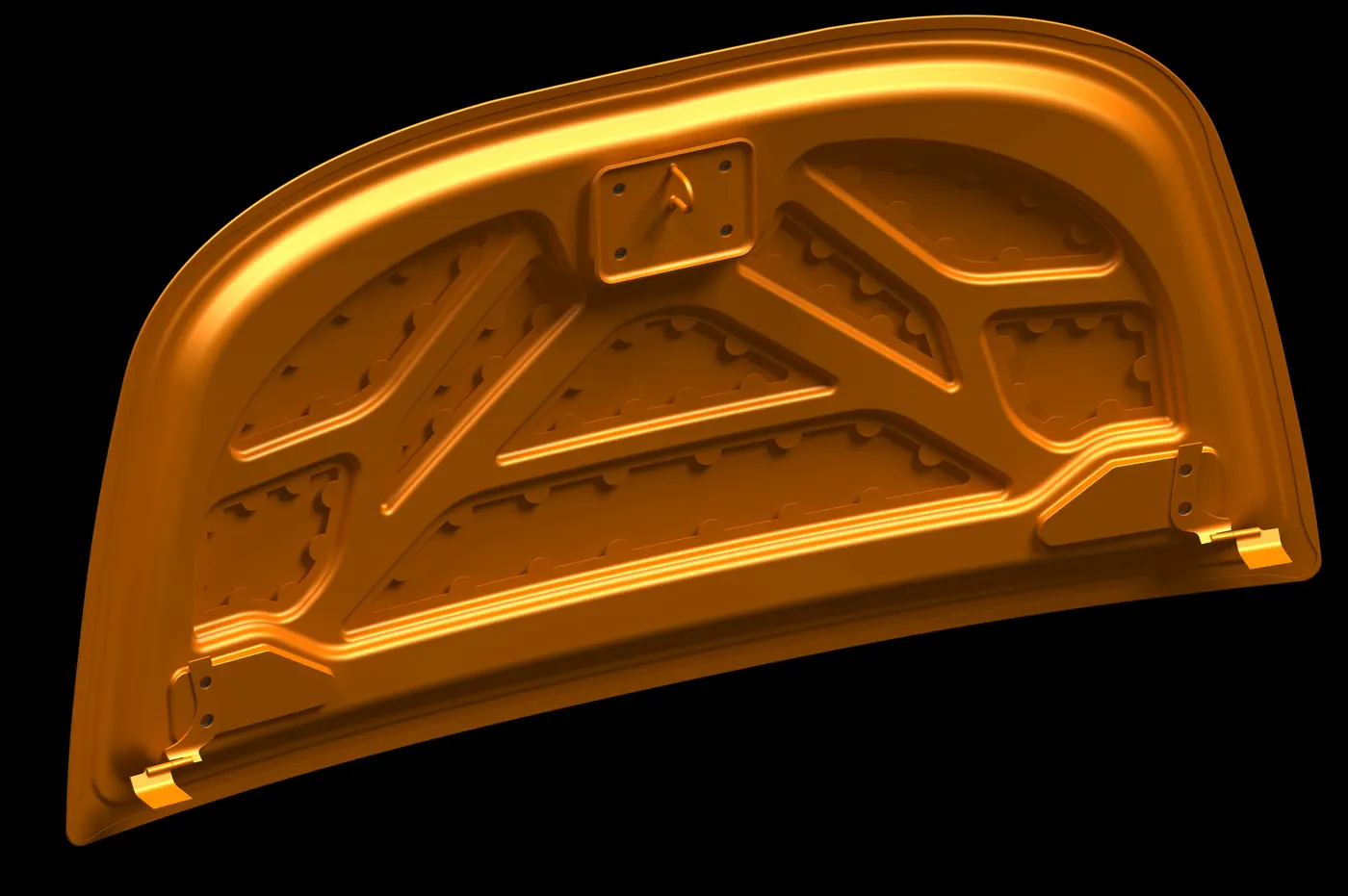
Section modulus is a geometric property for a given cross-section used in the design of beams or flexural members. Other geometric properties used in design include area for tension and shear, radius of gyration for compression, and second moment of area and polar second moment of area for stiffness. Any relationship between these properties is highly dependent on the shape. There are two types of section modulus, the elastic section modulus (S) and the plastic section modulus (Z).
Elastic Section Modulus
For general design, the elastic section modulus is used, applicable up to the yield point for most metals and other common material. The elastic section modulus is defined as S = I / y, where I is the moment of inertia and y is the distance from the neutral axis to the most extreme end of the object.
- It is the ration of moment of inertia and the distance of the topmost or the bottommost object from the neutral axis.
- It represents the strength of the section.
- Greater the value of S, greater will be the strength of the section.
Section Modulus, S = I (Moment of Inertia) / y
Plastic Section Modulus
The plastic section modulus is used for materials where elastic yielding is acceptable and plastic behavior is assumed to be an acceptable limit. Design generally strive to ultimately remain below the plastic limit to avoid permanent deformation, often comparing the plastic capacity against amplified forces or stresses. The plastic section modulus depends on the location of the plastic nuetral axis. The plastic nuetral axis is defined as the axis that splits the cross section such that the compression force from the area in compression equals the tension force from the area in tension. So, for sections with constant, and equal compressive and tensile yielding stress, the area above and below the plastic neutral axis will be equal, but for composite section, this is not necessarily the case.
The plastic section modulus is not the first moment of area. Both relate to the calculation of the centroid, but plastic section modulus is the sum of all areas on both sides of plastc neutral axis and multiplied with the distances from the centroid of the corresponding areas to the centroid of the cross section, while the first moment of area is calculated based on either side of the "considering point" of the cross section and it is different along the cross section and depends on the points of consideration.
IN FIRST ITERATION:-
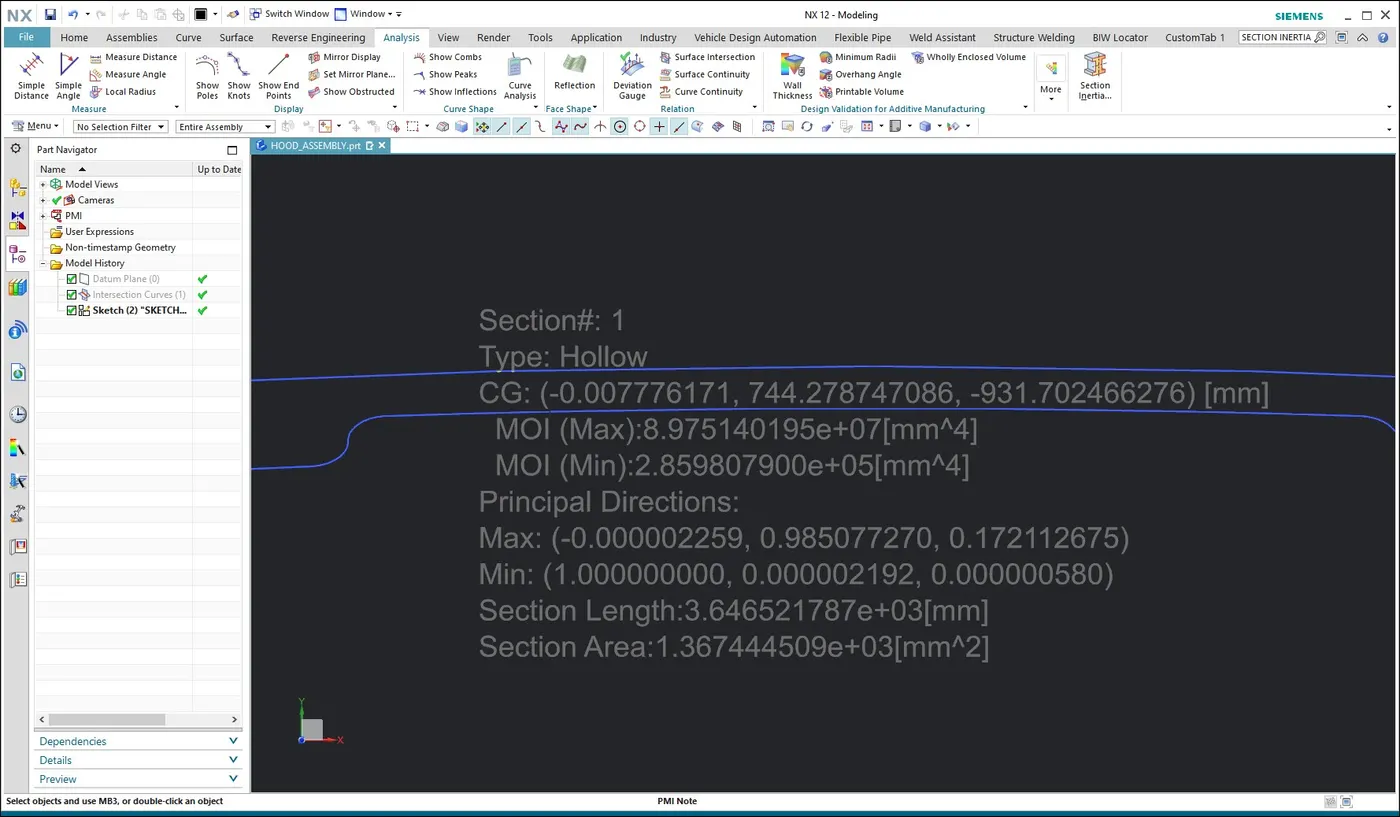
MOI (Max.) = 8.97514019e+07[mm^4]
MOI (Min.) = 2.859807900e+05[mm^4]
Length= 879.7505mm [∴Total length at the cross section area]
Let,
Y= L/2 [∴Distance between the neutral axis and the extreme end of the object]
Y= 879.7505/2
Y= 439.87525mm
As we know that,
Section Modulus, S = I / y
S1 = Imin. / y
S1 = 2.859807900 x 10+05 / 439.87525mm
S1 = (6.501405706 x 10-3) x 10+05
S1 = 0.0065 x 10+05 mm3
IN SECOND ITERATION:-
As we have the information that greater the value of S, greater will be the strength of the section. So, as to obtain the increase in strength of the section, we increase the cross section area and achieved the best result for the section modulus.
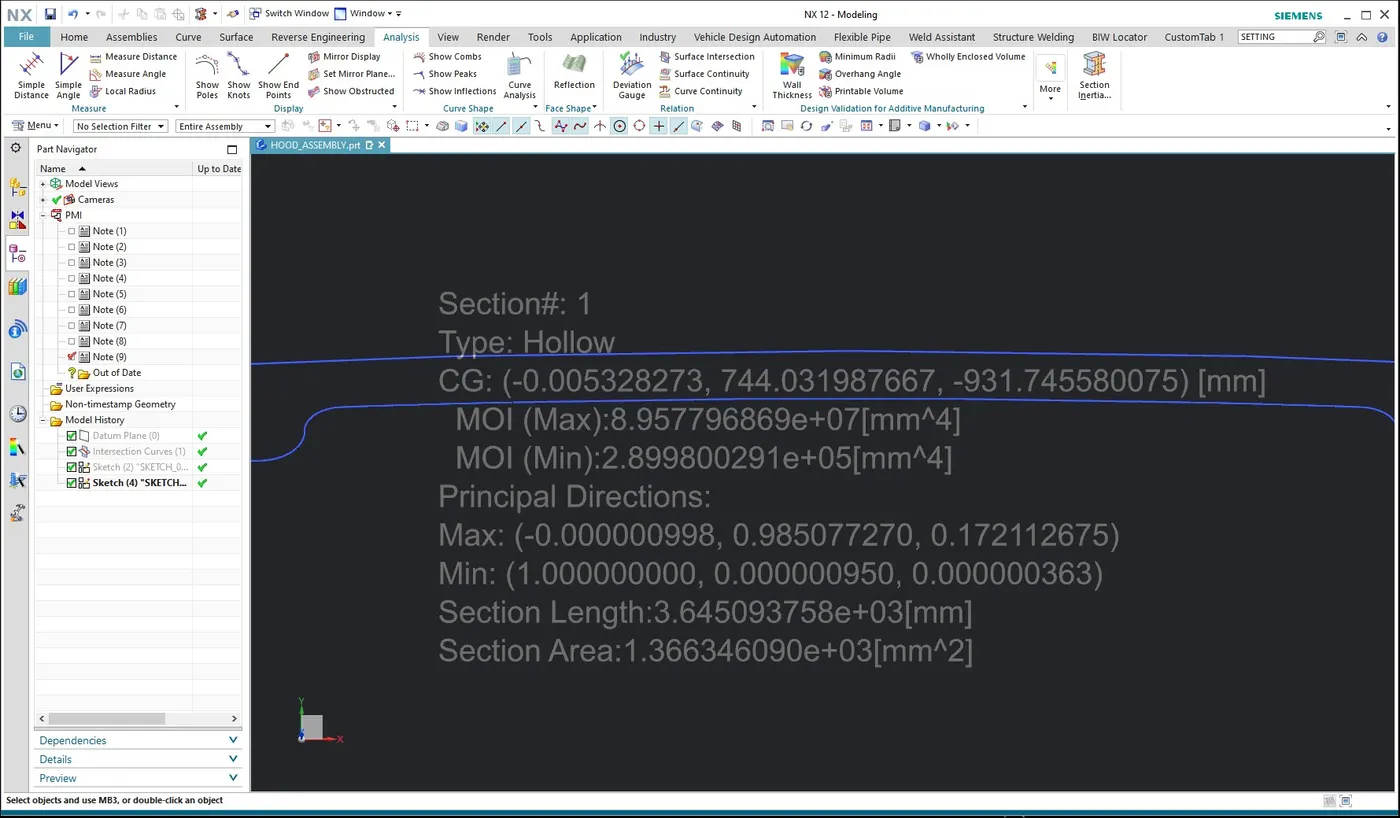
MOI (Max.) = 8.957796869e+07[mm^4]
MOI (Min.) = 2.899800291e+05[mm^4]
Length= 879.7505mm [∴Total length at the cross section area]
Let,
Y= L/2 [∴Distance between the neutral axis and the extreme end of the object]
Y= 879.7505/2
Y= 439.87525mm
As we know that,
Section Modulus, Z = I / y
S2 = Imin. / y
S2 = 2.899800291 x 10+05 / 439.87525mm
S2 = (6.592324281 x 10-3) x 10+05
S2 = 0.0066 x 10+05 mm3
Thus, it verifies that the second iteration has better result than the first iteration. After comparing section modulus of both the iteration’s, it proves that the S2 is greater than S1.
Conclusion:
As the cross-section area is increased by offsetting the curve 0.5mm, then as a result it can be seen that there is an increase in moment of inertia and as moment of inertia increases it increases the value of Section Modulus. Thus strength of the component or part increases. As with the single attempt of analysis, a better result can’t be obtain. After having an end numbers of attempt, analysation and observation on a particular component or part, the satisfying or required result needed in the design of a component is achieved.