Section Modulus calculation and optimization
OBJECTIVE :- Use the Section from your Hood design and calculate the Section Modulus using the formula
Z = I/y
Where,
Z = Section Modulus
I = Moment of Inertia
y = distance between the neutral axis and the extreme end of the object
Come up with a new section that has an improved Section Modulus compared to the previous one and mention what changes you made which resulted in the increased strength.
SECTION MODULUS
The moment carrying capacity of an object is directly dependent on geometrical property (I) and material property (E) of an object,which is collectively termed as flexural rigidity(EI).Geometry of an object plays an important role in load bearing capacity of an object which is indicated by moment of inertia of a section. Therefore section modulus is the predominant factor which evidences the strength of an object and is defined as the ratio of the moment of inertia of the object about its centroidal axis to the distance of the extreme fibers of the object from the neutral axis.
Section modulus is generally denoted by Z.
Z = I/ymax
Mathematically By bending stress equation,
M/I = σmax/ymax
M = σmax × (I/ymax)
M = σmax × Z
Where,
I = Moment of Inertia(m⁴)
y = distance from NA to extreme layer(m)
The unit of section modulus is m³.
Types of Section Modulus
There are two types of section modulus:
- Elastic Section Modulus
- Plastic Section Modulus
Elastic Section Modulus
Elastic section modulus is calculated when we are to use the material behavior till the yield point.
For general design purposes, we use elastic section modulus.
Generally, elastic section modulus is denoted by Zₑ.
So,
Zₑ = I/ymax
Where,
I = Moment of inertia
ymax = Distance from NA to extreme layer
Plastic Section Modulus
The plastic section modulus is used for materials where the elastic yield is acceptable and the plastic behavior is considered to be an acceptable range.
It depends on the location of the plastic neutral axis. The PNA is the axis that bisects the cross-section such that the compressive force from the region in compression is equal to the tension force from the region under tension. So, for sections with a constant yield stress, the area above and below the PNA will be equal, but for mixed sections, this is not necessarily the case.
Mathematically,
The plastic section modulus is the sum of the areas of cross-sections on each side of the plastic neutral axis that may or may not be equal and multiplied by the distance from the local centroid of the two regions to the plastic neutral axis.
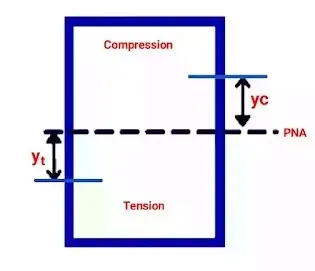
Zₚ = (Ac × yc) + (Aₜ + yₜ)
Where,
Ac = Area of cross-section under compression.
Aₜ = Area of cross-section under tension.
yc = Distance from the plastic neutral axis to the center of gravity of the areas under compression.
yₜ = Distance from the plastic neutral axis to the center of gravity of areas under tension.
Since on the neutral axis, the area under compression is equal to the area under tension.
So,
Ac = Aₜ
And,
yc = yₜ
Significance of section modulus
- Section modulus is the important factor for design of beam and flexural member
- Higher the value of section modulus, higher will be the resistance of member to bending
- It is required to calculate stresses in beams.
- It is used to calculate strength of the steel structure
- More the section modulus, it can withstand more load and it is also considered to be more tougher.
here we are Calculating Elastic section Modulus
By using the Hood design calculate the Hood Section modulus.
Case 1
Take the intersection of the inner panel and outer panel of the model shown below:
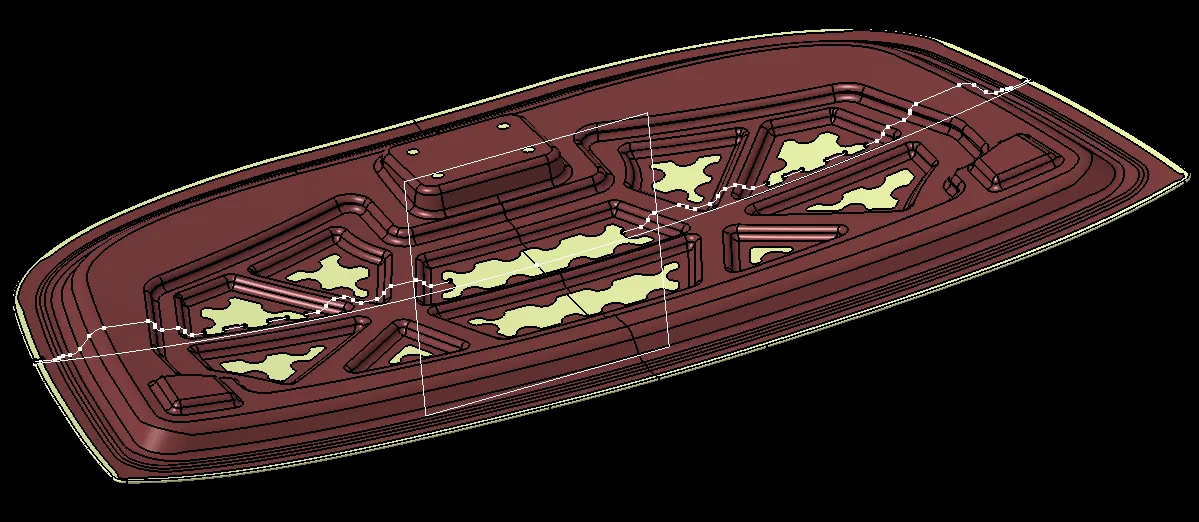
since the intersection is not forming a close curve hence make it a close cuvre by in sketcher workbench
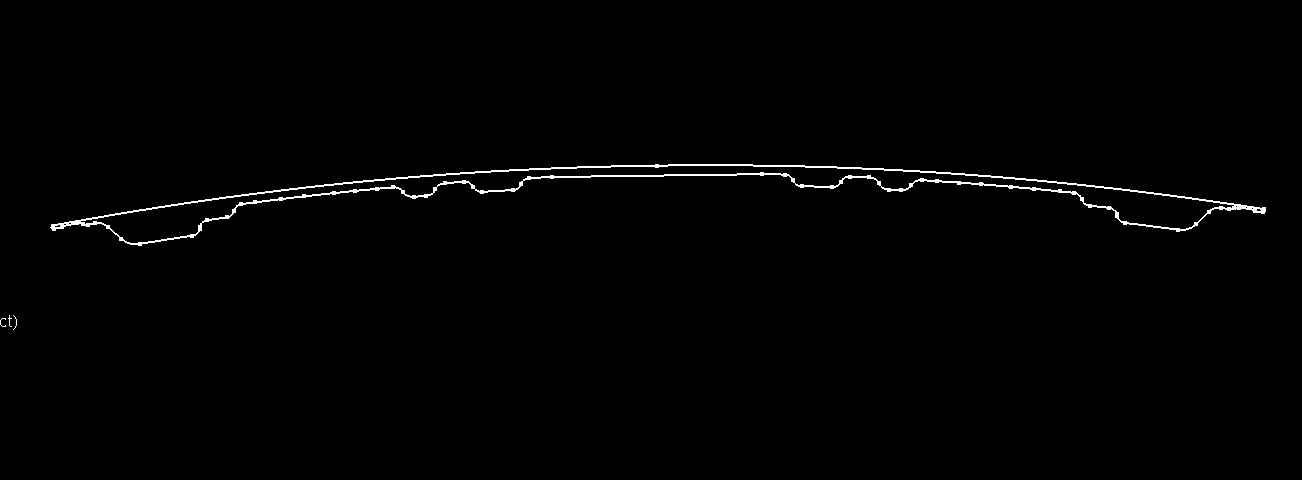
now, by using fill command fill the above close curve and then take moment of inertia of above section

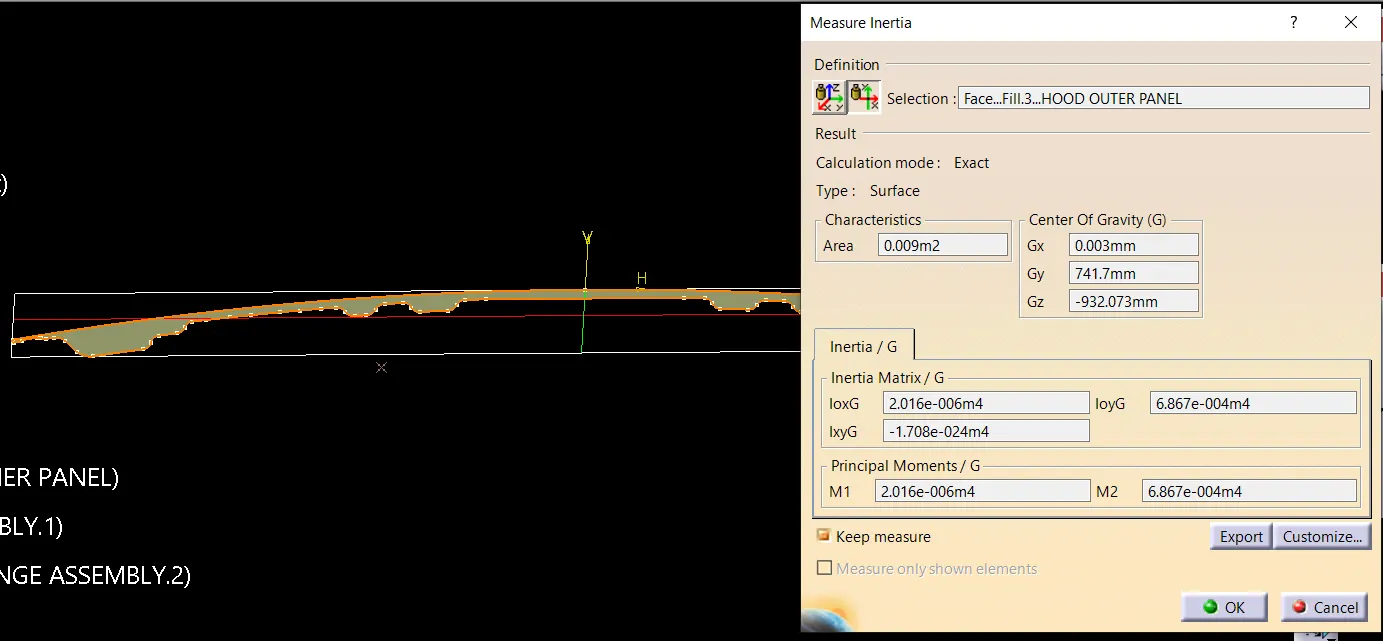
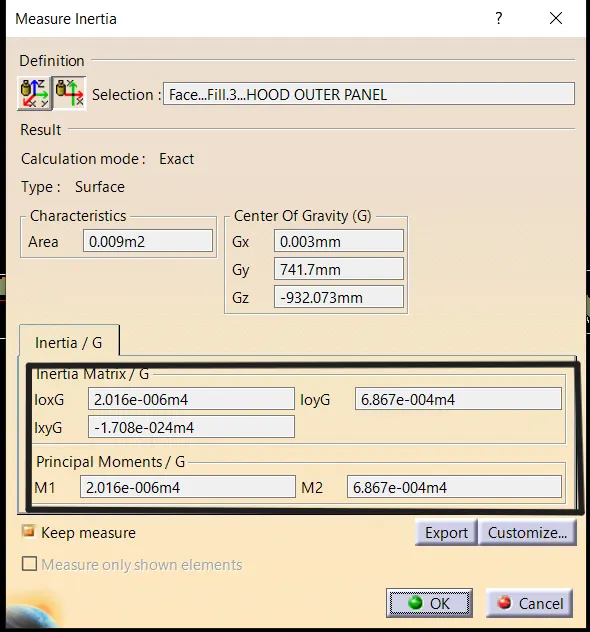
Z=I(min.)/Y
I(min.)=2.016×10^-6 m^4= 2.016×10^6 mm^4
2Y=882.841mm
Y=441.42mm
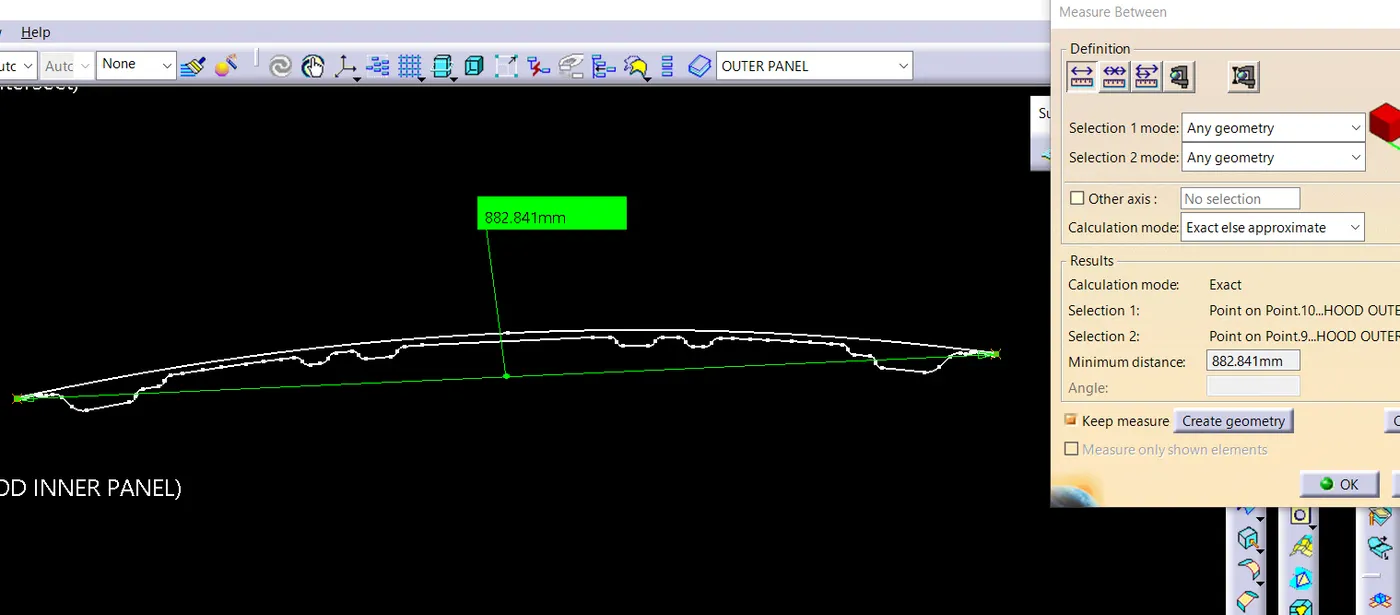
Z=2.016×10^6/441.42=4567.078 mm³
CASE 2
In the Case 2 offset the hood inner panel about 0.5 mm downwards. and follow the same process as above
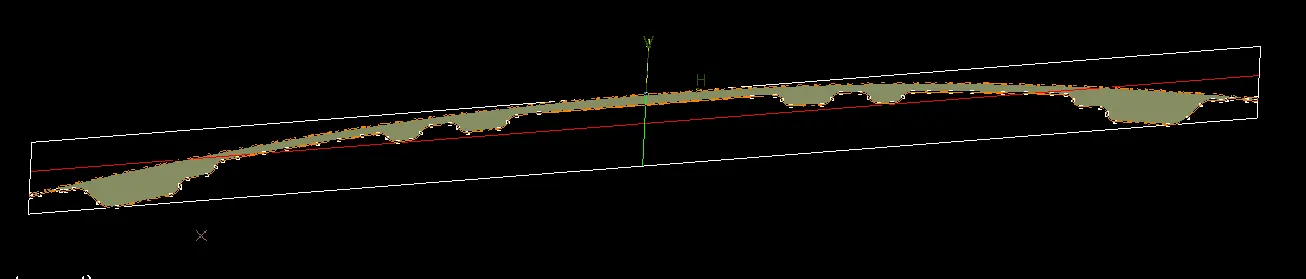
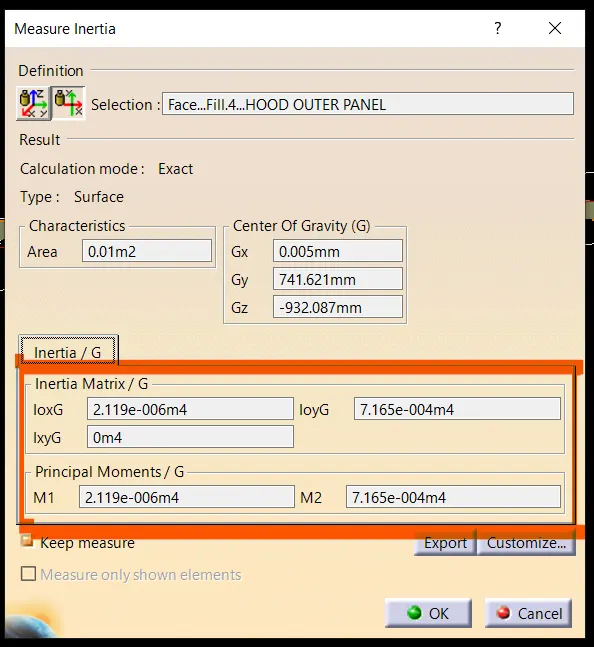
I(min.)=2.119×10^-6 m^4= 2.119×10^6 mm^4
Z=2.119×10^6/441.42=4800.416 mm³
Increasing the gap between outer and inner panel leads to increament in the section modulus hence strength of the hood will also increases
percentage change
Z=(4800.416-4567.078)/4567.078)×100
=5.109%(increase) in the section modulus.