Section Modulus calculation and optimization
Section Modulus calculation and optimization
The section modulus is a property used in structural engineering to assess how well a shape can handle bending and flexural stresses. It's particularly significant when designing beams, columns, and other structural parts.
The formula to find the section modulus (Z) is:
S=I/Y
Here:
S is the section modulus.
I is the moment of inertia of the shape's cross-section.
Y is the distance from the neutral axis to the shape's outermost point.
A larger section modulus means the shape is better at resisting bending stresses. This is crucial for making sure buildings, bridges, machines, and other engineered things stay strong and stable.
Low Section Modulus:
- Flexibility : When something has a low section modulus, it can bend easily when you push or pull on it. It's not very strong against bending forces.
- Not Very Stiff: Objects with low section modulus are like a soft rubber band – they don't stay firm and might change their shape when something pushes on them.
- Limited Load Bearing : Things with a low section modulus can't handle heavy weights or strong pushes without bending a lot. They're not good for supporting big loads.
- Weaker Against Bending : If something with a low section modulus bends too much, it might become weak and might break or lose its shape.
- Reduced Stability : Objects with low section modulus can wobble or become unsteady when they're bent. This can make them unsafe for certain uses.
High Section Modulus:
- Strength Against Bending : When something has a high section modulus, it's like a tough piece of wood – it doesn't bend easily when you try to push or pull on it.
- Stiffness Objects with high section modulus are like a strong ruler – they keep their shape well, even if something tries to bend them.
- Structural Integrity : Things with a high section modulus can handle heavy things and strong pushes without bending too much. They're good for holding up weight.
- Enhanced Stability : If something with a high section modulus bends a little, it doesn't become weak. It can still keep its strength.
- Stays Steady: Objects with high section modulus stay steady even if they're bent a bit. This makes them safe and reliable for different uses.
CASE 1
Considering the thickness of hood outer panel and inner panel as 0.75mm and taking the intersection curve of that section.
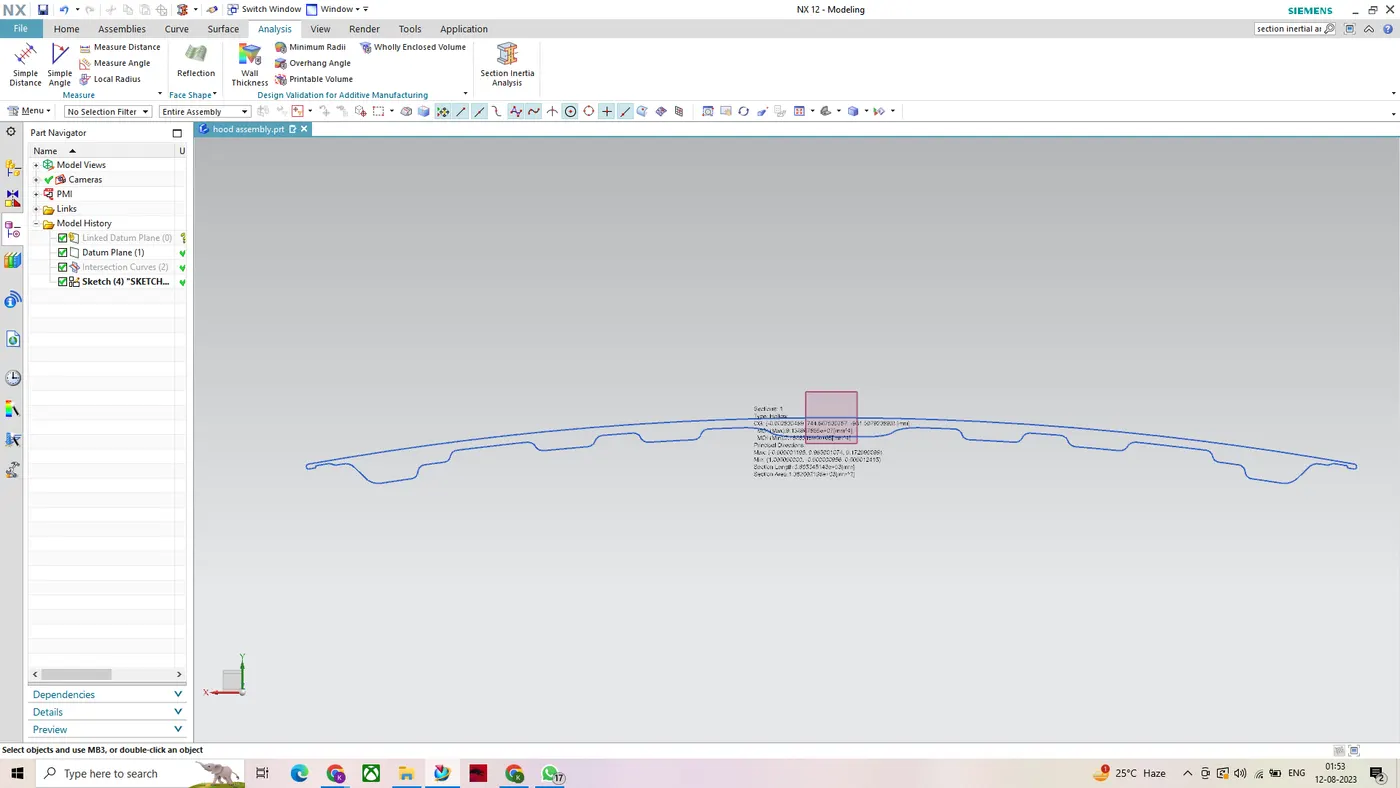
SECTION INERTIA ANALYSIS OF 1ST CASE
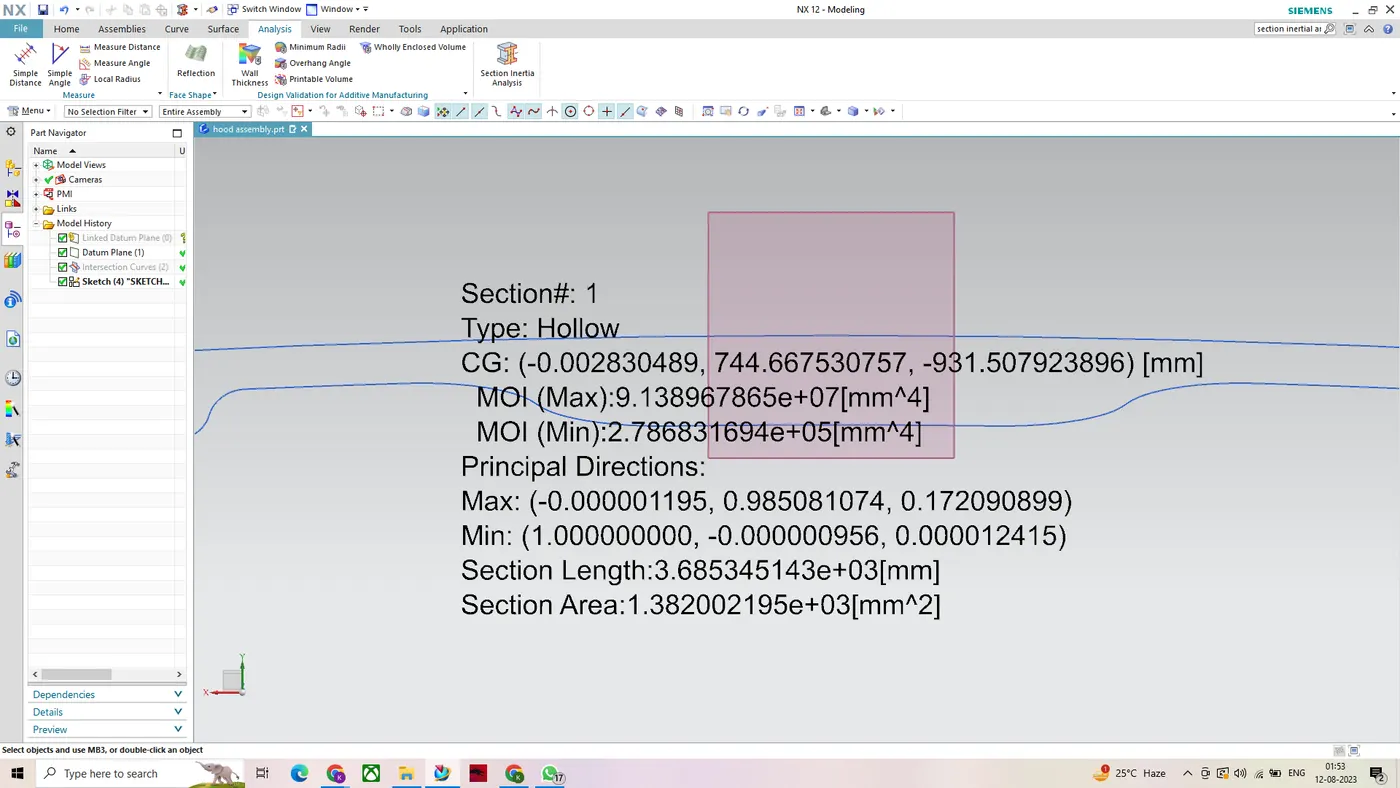
From the above results we can calculate the section modulus using S = I /Y
moment of inertia (I-max) =9.138967865 * 10^7 mm^4
moment of inertia (I-min) = 2.786831694 * 10^5 mm^4
Y = 881.25 / 2 = 440.62 mm
S(max) = I-max / y = 207.411 * 10^3
S(min) = I-min / y = 0.632479 * 10^3
CASE 2
On moving the curve of the inner panel of the hood down by 0.5 mm using offset, we can make the cross-sectional area bigger.
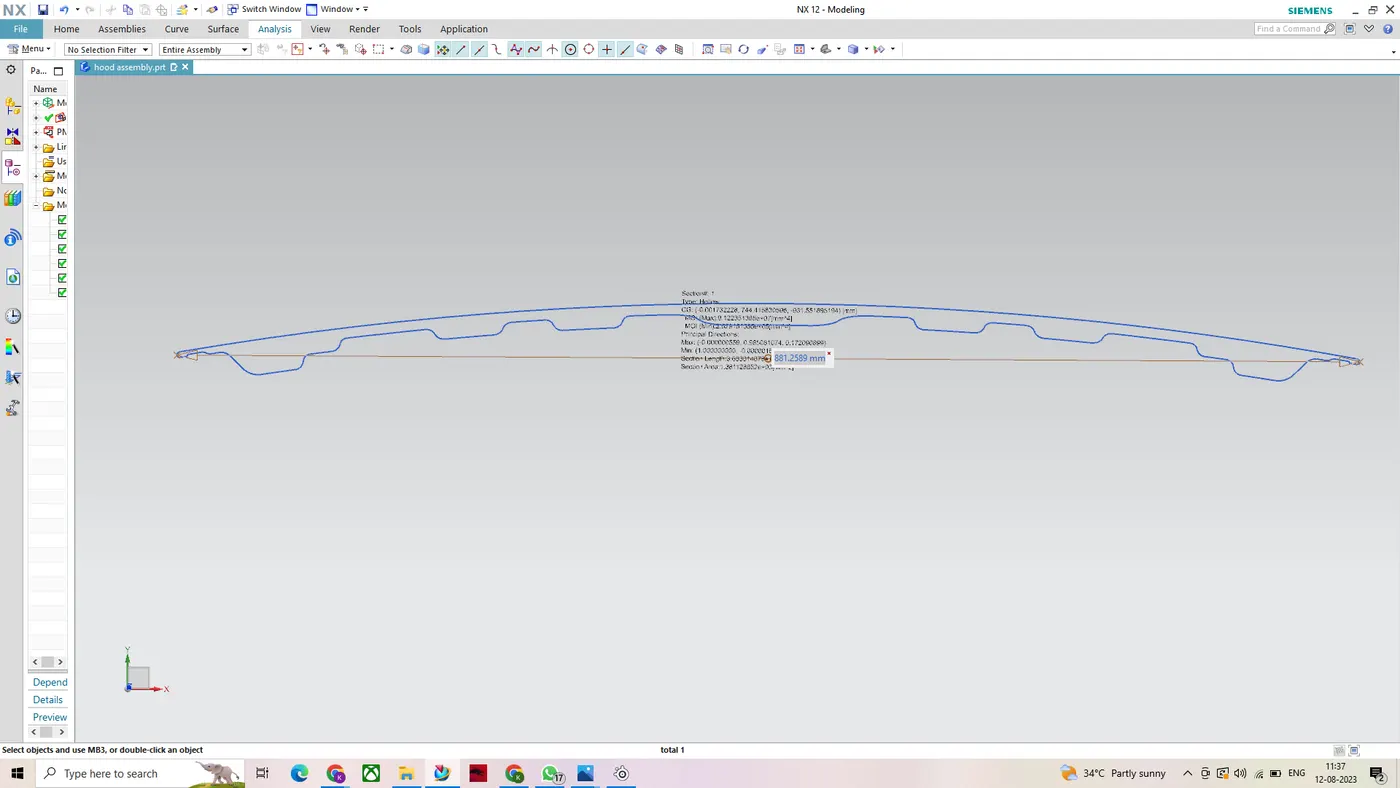
SECTION INERTIA ANALYSIS OF 2nd CASE
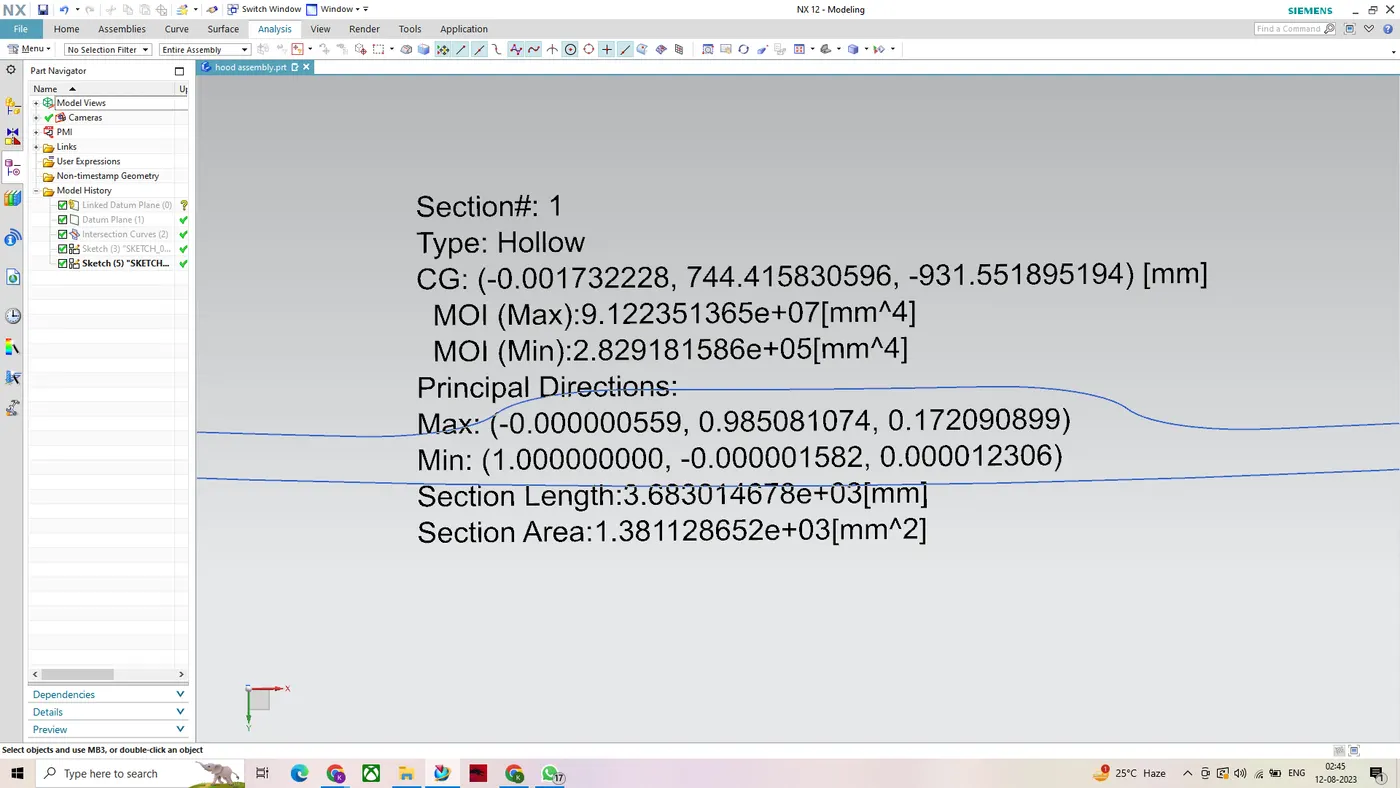
moment of inertia (I-max) =9.122351365 * 10^7 mm^4
moment of inertia (I-min) = 2.829181586 * 10^5 mm^4
Y = 881.25 / 2 = 440.62 mm
S(max) = I-max / y = 207.034 * 10^3
S(min) = I-min / y = 0.642091 * 10^3
CONCLUSION
By this we can conclude as we increasing the area in second case ,it was observed there is a slight increase in section modulus.
Hence more the area distributed across the body higher will be the section modulus.