Section Modulus calculation and optimization
Section Modulus calculation and optimization:
Section Modulus: The section modulus (S) is geometric property of the cross section used for designing beams and flexural members. It does not represent anything physically.
Formula of Section Modulus: It may be defined as the ration of total moment resisted by the section to the stress in the extreme fibre which is equal to yield stress.
Therefore, S = I/Y
Where,
S = Section modulus (mm^3)
I = Moment of Inertia of the section about the bending axis. (mm^4)
Y = Distance between the neutral axis and extreme end of the object (mm)
Area moment of Inertia: The area moment of inertia of a beams cross sectional area measures the beam ability to resist bending. The larger the moment of inertia less will be the bend.
Where,
M = Bending moment
I = Area moment of Inertia
E = Youngs modulus
R = Radius of gyration
Neutral axis: When beam is subjected to pure bending the top most fibres of the beam are subjected to maximum compression, while the bottom most fibres of the beams are subjected to maximum tension.
Calculation:
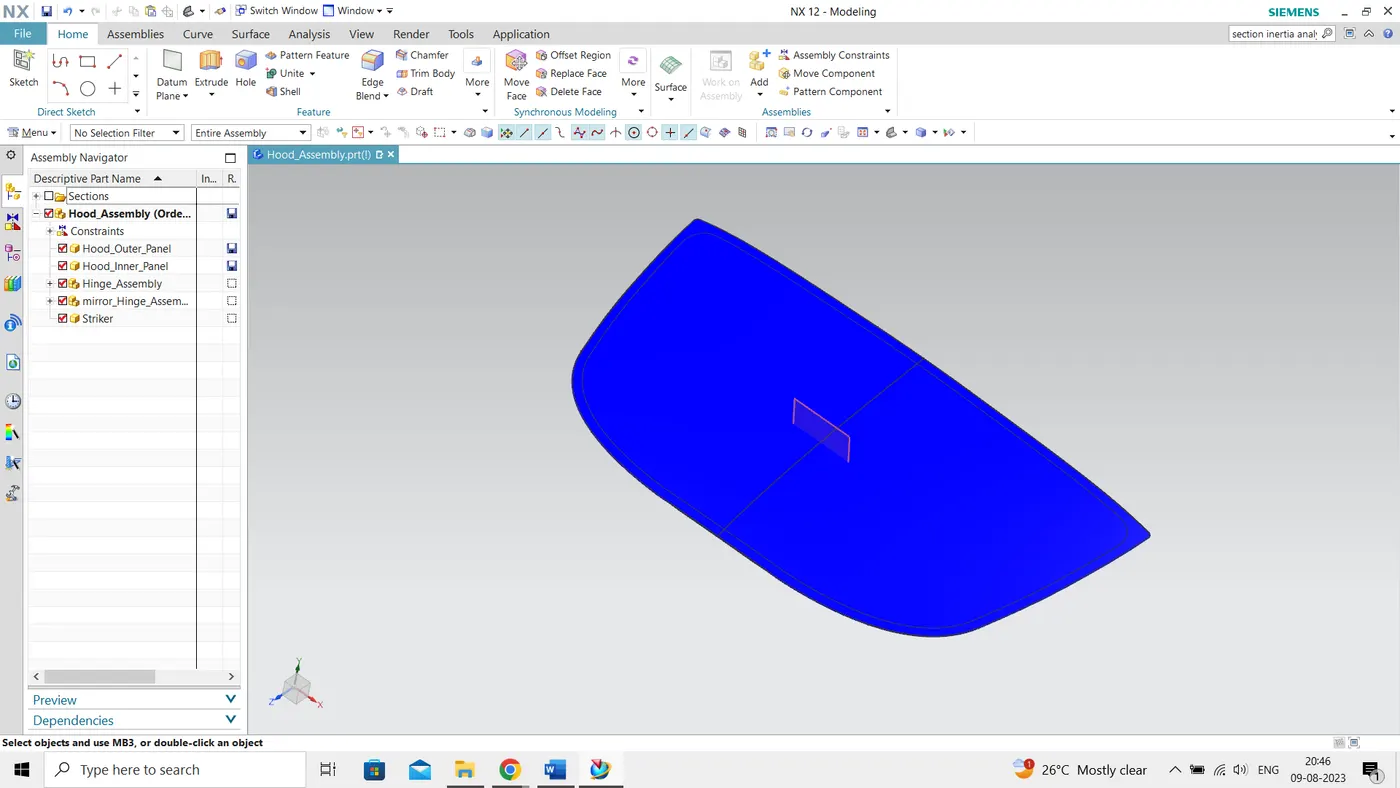
- Creation of datum plane, The Hood which was already created is imported, here taking the front section since we are dealing with the frontal crash. For that create a datum plane on the curve and at a halfway distance of the hood.
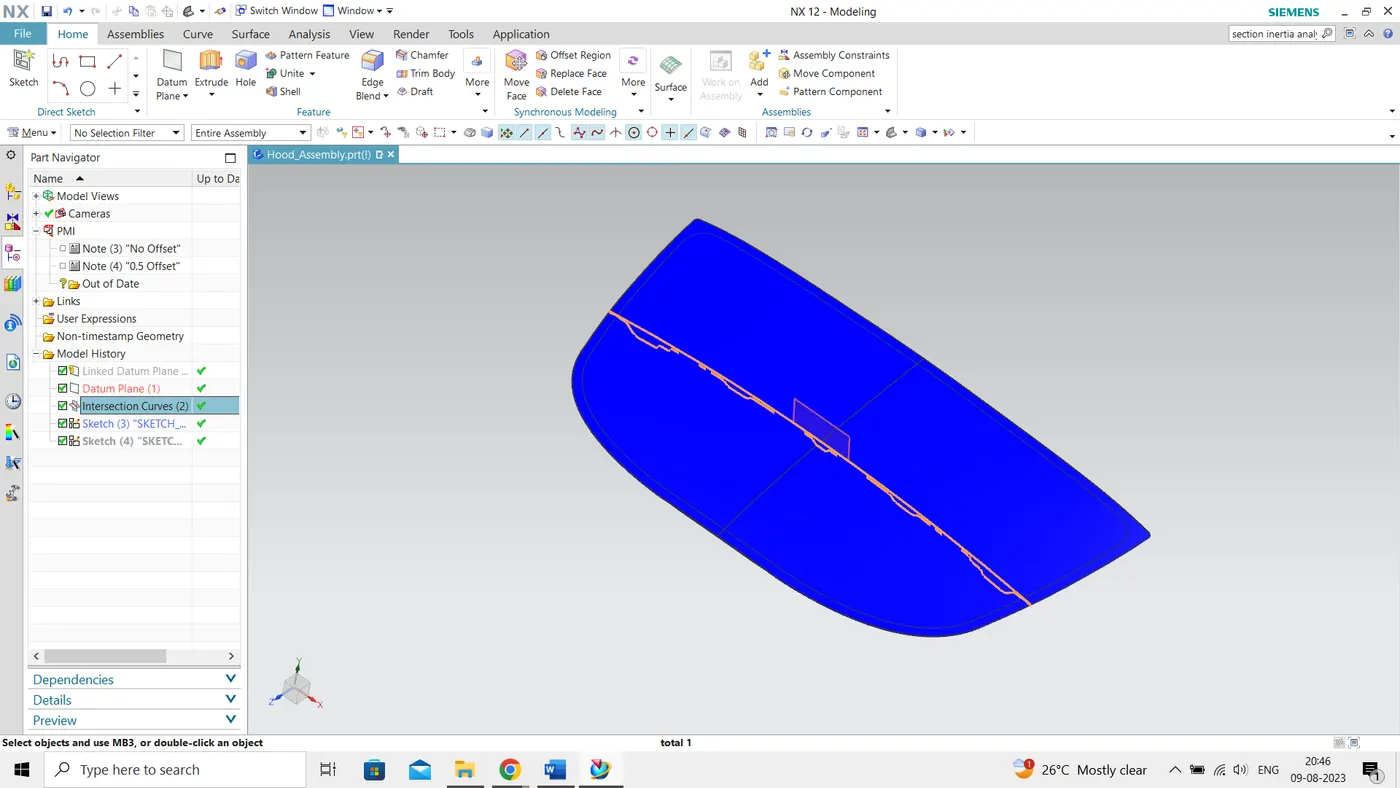
- Creating the intersection curve between the newly created datum plane and the hood.
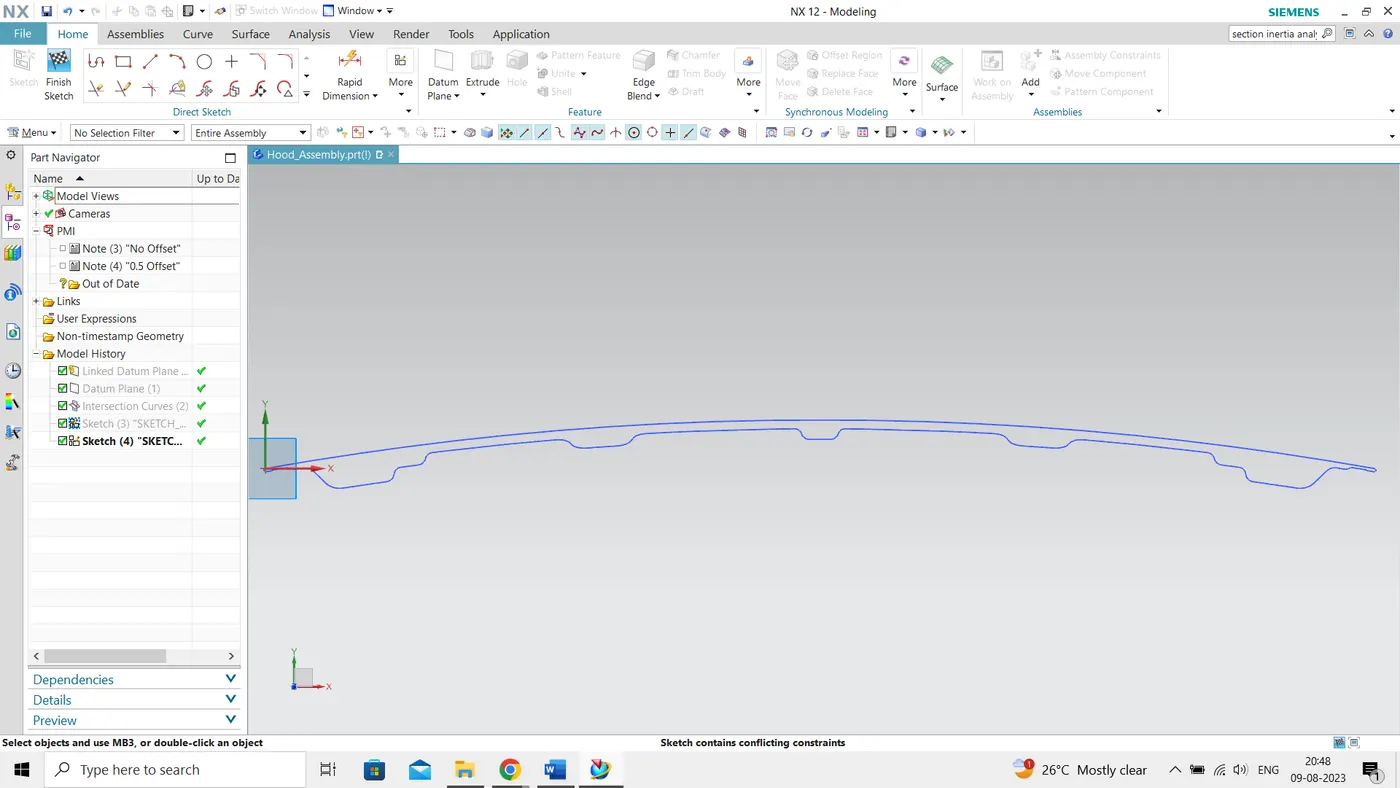
- The Section is to be made a closed section to calculate the section modulus. Take only the outer line of the outer hood and inner panel.
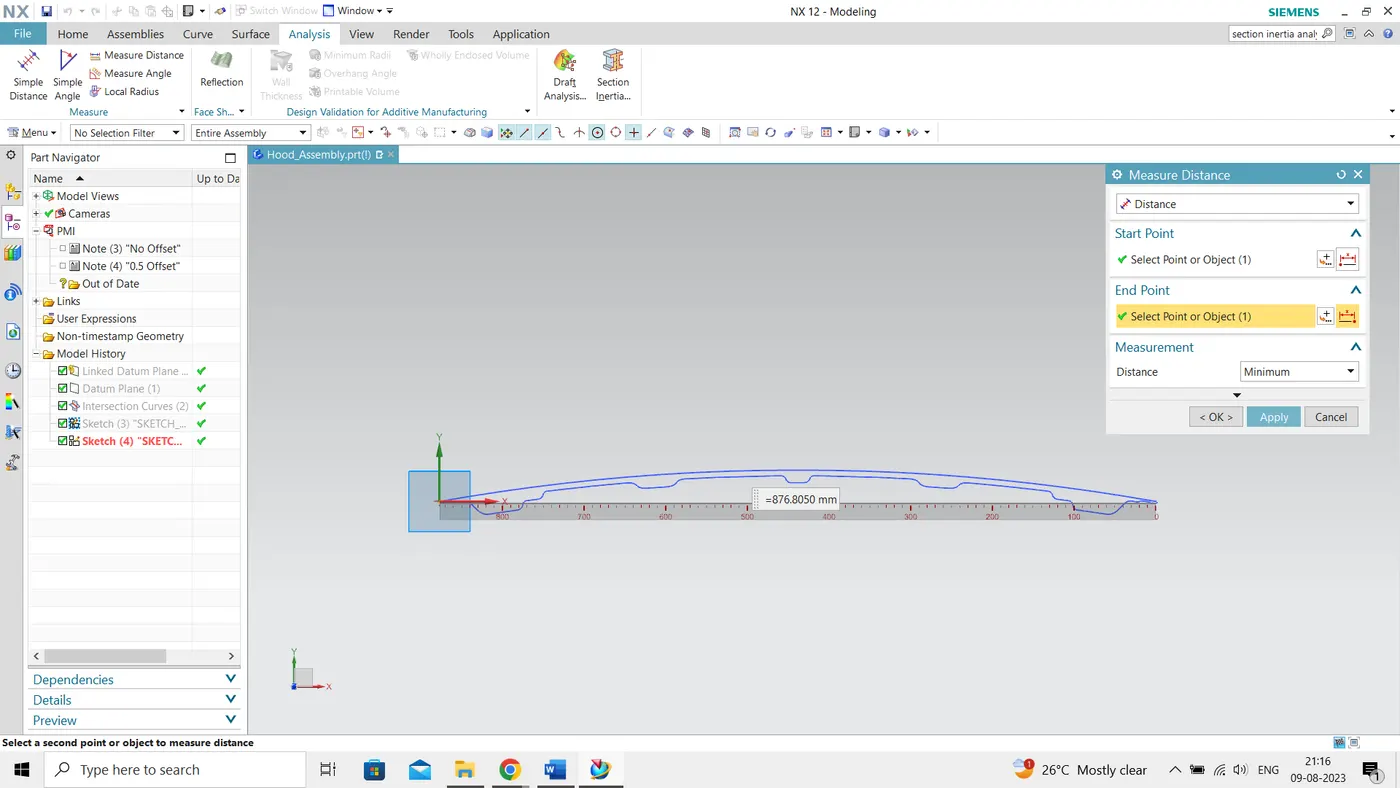
- Take a point at both the extreme side of the hood and draw two vertical reference line to measure the distance between the points where the half of the distance will be y since we are taking the 0-y axis as the neutral axis and measured the distance between the extreme ends of the hood i.e., 876.8050 mm.
CASE 1: Before Optimization
Section inertia analysis is done for the hood i.e., before optimization where the following values are listed below
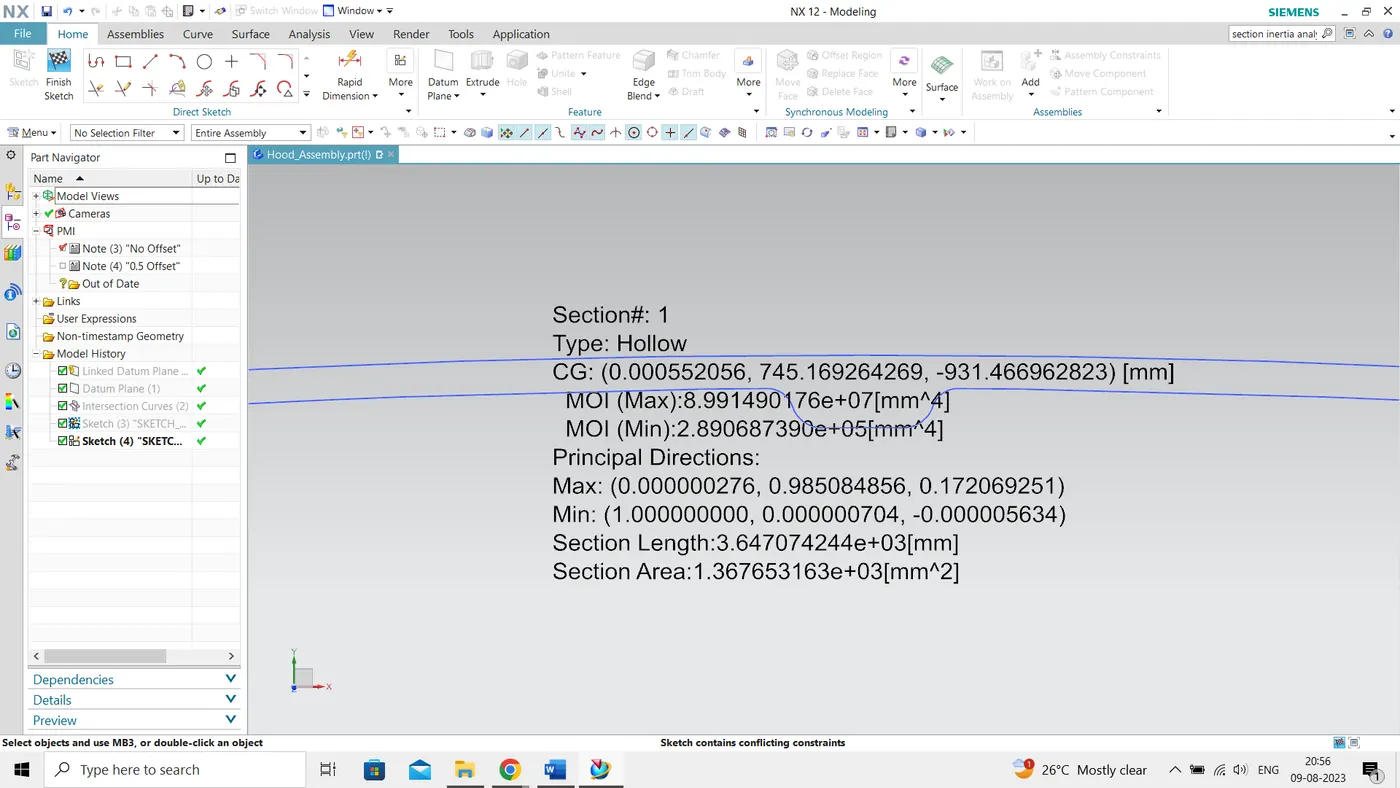
MOI (max) = 8.991490176e+07 (mm^4)
MOI (min) = 2.890687390e+05 (mm^4)
As per the section modulus equation,
S = I/Y
I = MOI (min) value is considered
Y = Total distance /2, Total distance =876.8050 mm
(Y = 876.8050/ 2 = 438.4025 mm)
Therefore, S = 2.890687390 mm^4/438.4025 mm
S1 = 659.3683 mm^3
CASE 2: After Optimization
The hood inner panel’s curve is offset by 0.5mm outwards
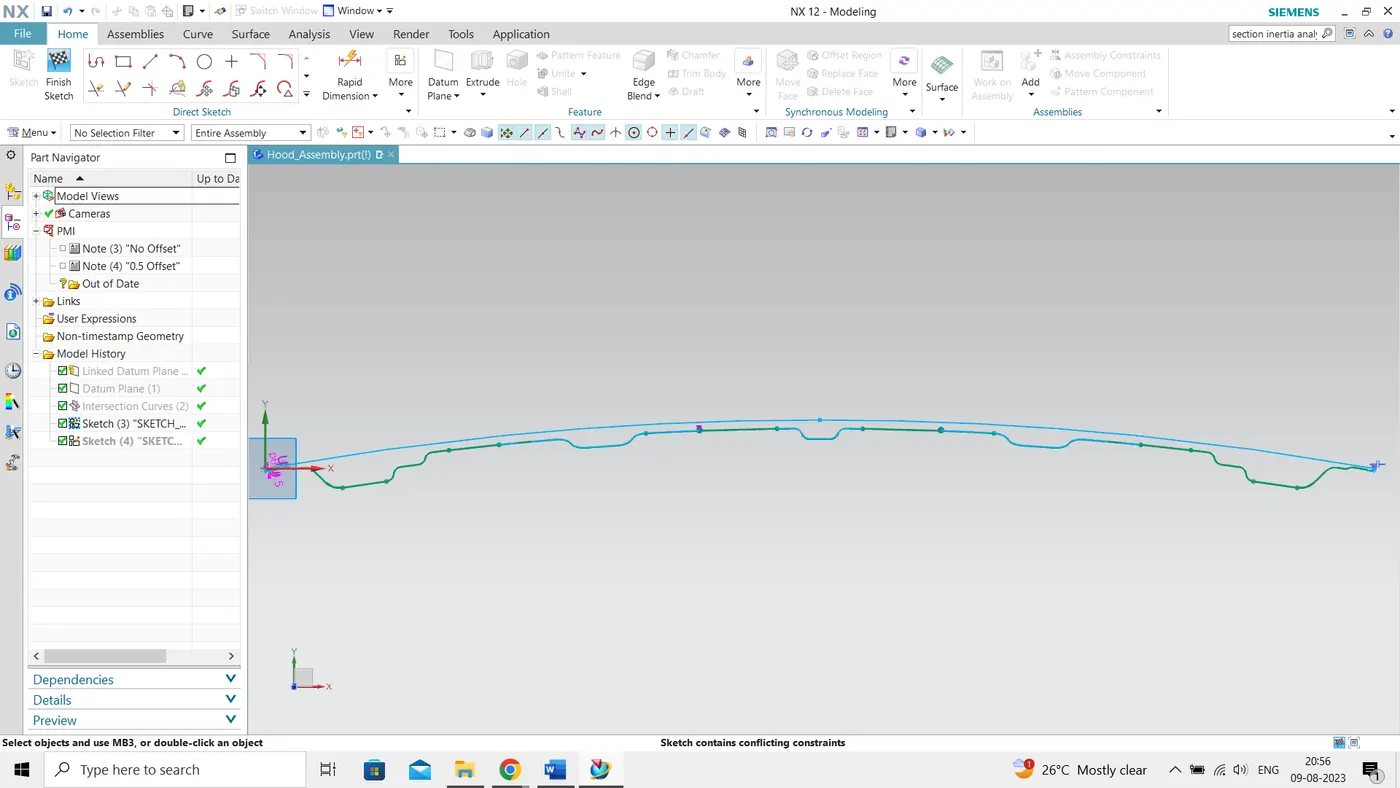
Section inertia analysis is done same as case 1 and the following values are listed below
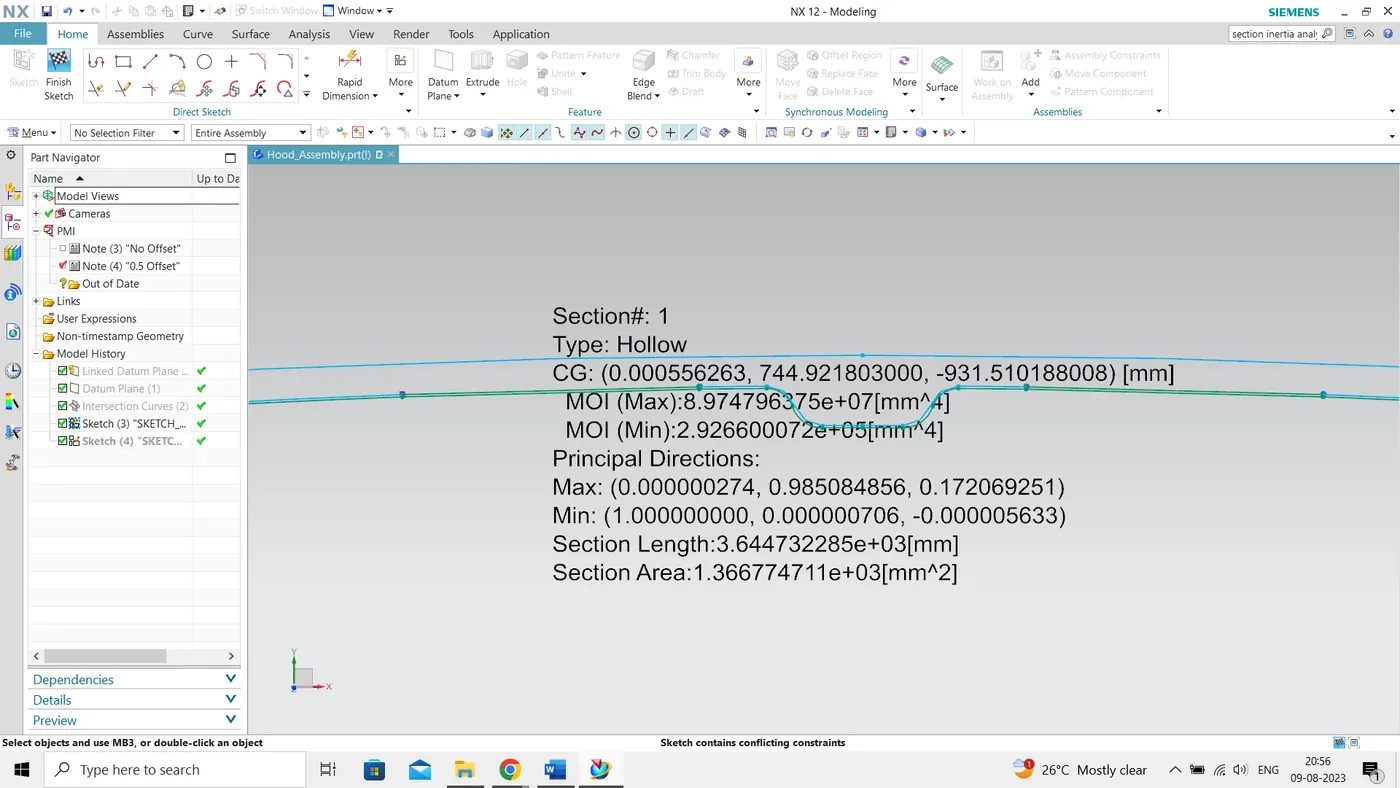
MOI (max) = 8.974796375e+07 (mm^4)
MOI (min) = 2.926600072e+05 (mm^4)
As per the section modulus equation,
S = I/Y
I = MOI (min) value is considered
Y = Total distance /2, Total distance =876.8050 mm
(Y = 876.8050/ 2 = 438.4025 mm)
Therefore, S = 2.926600072 mm^4/438.4025 mm
S2 = 667.5600 mm^3
Conclusion:
Hence when comparing case 1 & case 2, the section modulus value of case 2 is higher than the case 1 i.e., S1
Therefore as we increase the section area, the moment of inertia & section modulus increases which means strength and load material also increase.