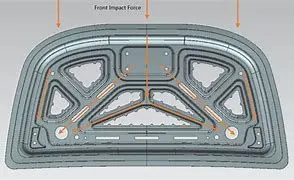
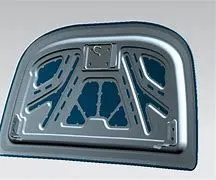
The design of a hood depends on several factors, including the specific application, material selection, and manufacturing constraints. However, I can provide you with a general guideline for hood design.
-
Determine the material: Select a material suitable for the hood's function and aesthetics. Common choices include steel, aluminum, and composite materials.
-
Consider the shape and size: Determine the overall shape and size of the hood based on the design requirements and the space available in the vehicle. Consider factors such as aerodynamics, aesthetics, and compatibility with other components.
-
Structural support: Ensure the hood has adequate structural support to withstand various loads, including static loads (its own weight) and dynamic loads (wind, vibrations, etc.). Reinforcement ribs, gussets, and stiffening features may be incorporated as needed.
-
Hinges and latching mechanism: Design and integrate hinges and latching mechanisms for proper opening and closing of the hood. Consider factors such as durability, ease of use, and safety.
-
Safety features: Incorporate safety features, such as a secondary latch or hood prop, to prevent accidental opening while the vehicle is in motion.
-
Aesthetics: Consider the overall design language of the vehicle and integrate the hood design accordingly. Pay attention to surface finishes, contours, and styling elements.
Calculating Section Modulus:
The section modulus (Z) is a geometric property of a cross-sectional shape that measures its resistance to bending. It is commonly used to evaluate the strength and stiffness of structural members. The formula to calculate the section modulus depends on the shape of the cross-section. Here are the formulas for calculating the section modulus for some common cross-sectional shapes:
-
Rectangular section: Z = (b * h^2) / 6
Where: Z = Section modulus b = Width of the rectangular section h = Height of the rectangular section
-
Circular section: Z = (π * d^3) / 32
Where: Z = Section modulus d = Diameter of the circular section
-
I-shaped section (also known as a "I-beam" section): Z = (b * h^2) / 6 - (b' * h'^2) / 6
Where: Z = Section modulus b = Width of the top flange h = Height of the web b' = Width of the bottom flange h' = Height of the bottom flange
These formulas provide a basic understanding of calculating the section modulus for simple cross-sectional shapes. However, for more complex shapes or composite materials, finite element analysis (FEA) or specialized engineering software may be required for accurate calculations.
3.SECTION MODULUS STUDY PRESENTATION:
A section modulus study involves analyzing the section modulus of a structural member or component to determine its strength and resistance to bending. It is a crucial part of structural engineering and is commonly performed to ensure the structural integrity and safety of various structures.
The section modulus (Z) is a property that relates to the moment of inertia (I) of a cross-section and the distance from the neutral axis to the extreme fibers. It indicates the distribution of material around the neutral axis and provides an understanding of how the section will resist bending.
The formula for calculating the section modulus depends on the shape of the cross-section. Here are the formulas for some common cross-sectional shapes:
-
Rectangular section: Z = (b * h^2) / 6 Where: Z = Section modulus b = Width of the section h = Height of the section
-
Circular section: Z = (π * d^3) / 32 Where: Z = Section modulus d = Diameter of the section
-
I-section (also known as H-beam): Z = (b * h^2) / 6 - 2 * (b - t) * (h - 2 * t)^2 / 6 Where: Z = Section modulus b = Width of the flange h = Height of the section t = Thickness of the flange and web
These formulas provide a basic understanding of how to calculate the section modulus for common cross-sectional shapes. However, it's important to note that more complex shapes may require different formulas or computational methods.
Performing a section modulus study involves determining the appropriate cross-sectional shape, calculating the section modulus based on the given dimensions, and then evaluating the section modulus in relation to the applied loads and design requirements. This analysis helps engineers ensure that the structural member can safely withstand the anticipated bending forces without failure.
It's worth mentioning that a detailed section modulus study would typically involve additional considerations such as material properties, load distribution, and other factors specific to the structural design. Professional structural engineers use specialized software and engineering principles to conduct comprehensive section modulus studies for real-world applications.
4.FEW IMAGES OF SECTION MODULUS: