Section Modulus calculation and optimization
Objective: To calculate and optimize the section modulus for the designed car hood
Section modulus:
Section modulus is a geometric property for a given cross-section used in the design of beams or flexural members. It is termed as the ratio of the second moment of area and distance from N.A (Neutral axis) to the extreme fiber. Also, it is the measure of the strength of a given member. The stress in the outermost section of the beam is computed with the help of section modulus.
The second moment of area Definition:
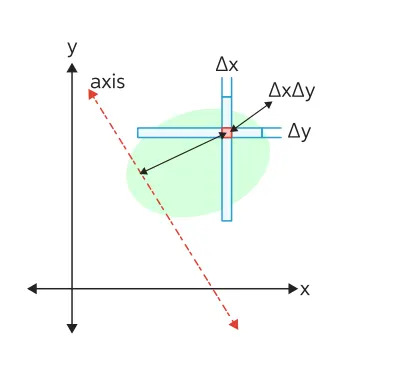
The second moment of area is the moment of inertia of the shape about an axis. It is strictly a function of the shape of the area under consideration and the axis about which it is evaluated.
 `
`
`MI=lim_(Δx→0,Δy→0)(∑_(Totalarea)(ΔxΔy)r ^2 )=∬_(area)r^2dxdy=(A)_(Total)(R^2)_(centroid)`
N.A (Neutral axis) Definition:
The neutral axis is an axis in the cross-section of a beam (a member resisting bending) or shaft along which there are no longitudinal stresses or strains. If the section is symmetric, isotropic, and is not curved before a bend occurs, then the neutral axis is at the geometric centroid.
Section modulus is indicated as follows:
`S=I/y`
Here, ‘I’ is the “moment of inertia” and ‘y’ is the distance from the “neutral axis” to the top or bottom of the fiber. The unit of “section modulus” is in (mm3).
Section modulus depends only on the cross-section shape of the beam. Cross-section shapes like rectangular, square, circular, I section and T, composite section, etc.
Importance of Section modulus:
• It is significant for beam and flexural member design.
• More the section modulus, the more the member is resistant to bending of the beam.
• If two beams are made of the same material and comparing the “section modulus” of two beams, the beam with a bigger section modulus will be tougher and more capable to withstand larger loads.
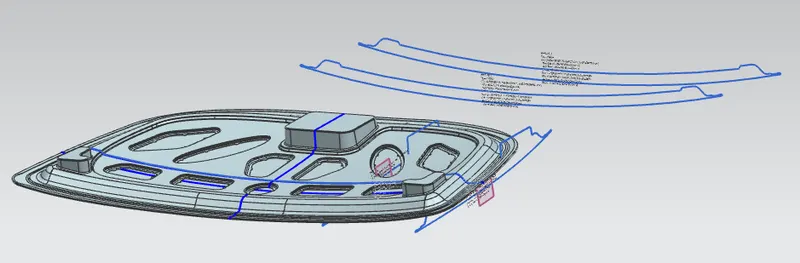
Modeling:
Study1:
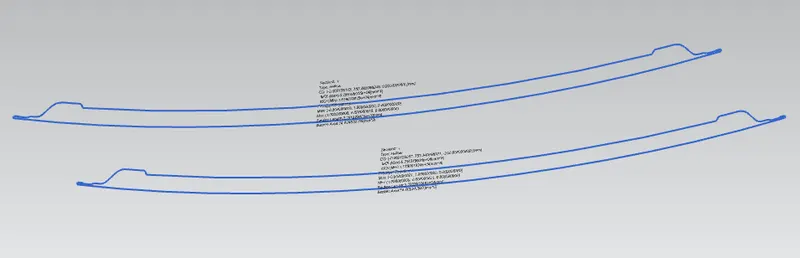
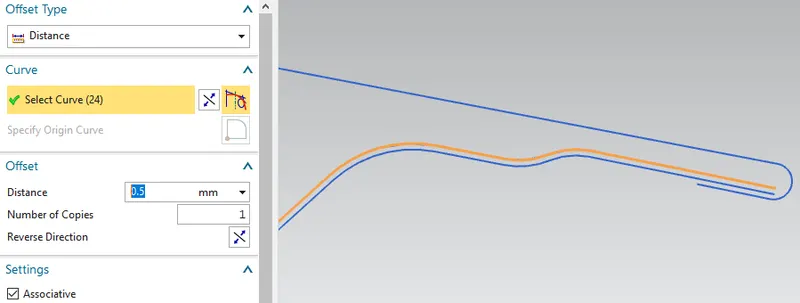
| Before modification | After modification |
 |
 |
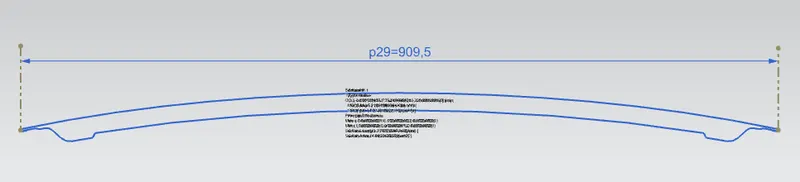
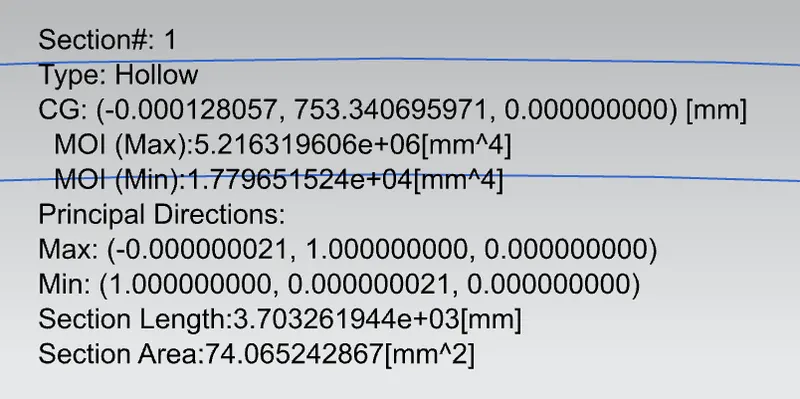
Distance from the neutral axis, y =`909.5/2`=454.75
Before modification,
section modulus, s (max) =`(5.216319606 × 10^6)/454.75`=11470.7413
section modulus, s (min) =`(1.779651524 × 10^4)/454.75`=39.1347
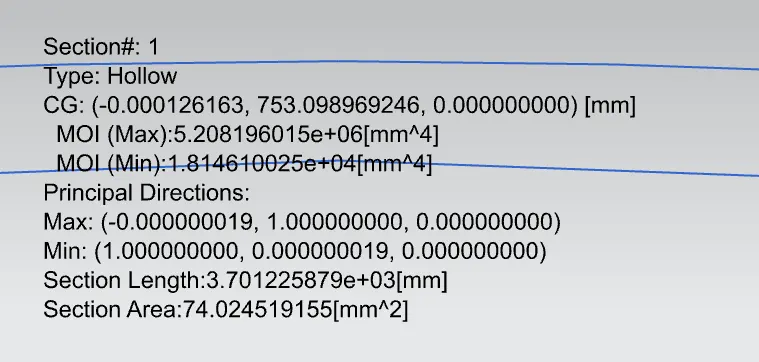
After modification,
section modulus, s (max) =`(5.208196015 × 10^6)/454.75`=11452.8774
section modulus, s (min) =`(1.814610025 × 10^4)/454.75`=39.9034
Study2:
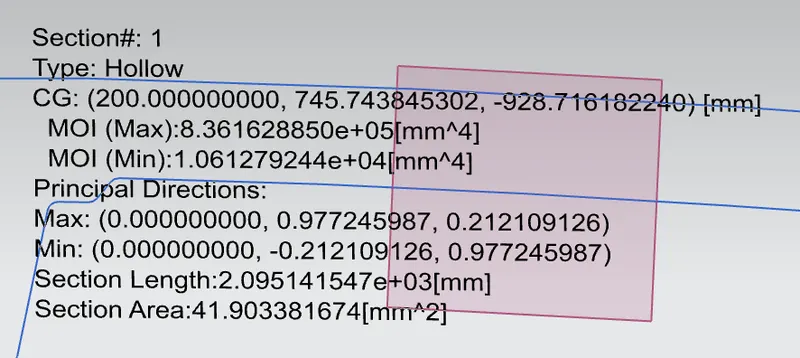
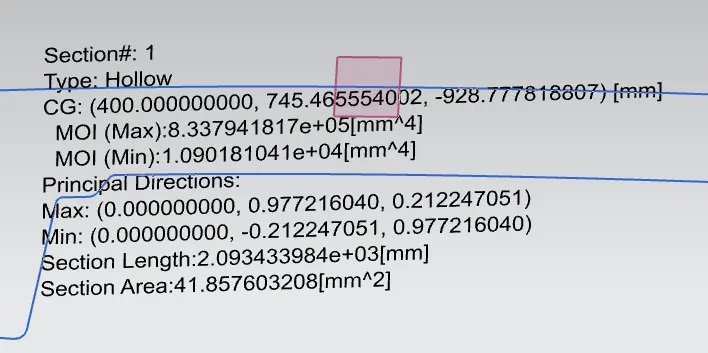
| Before modification | After modification |
 |
 |
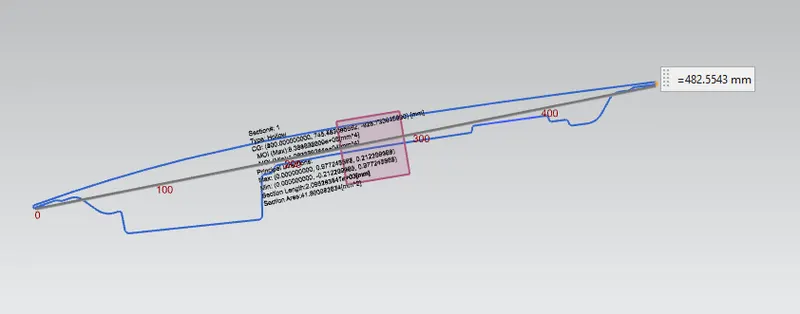
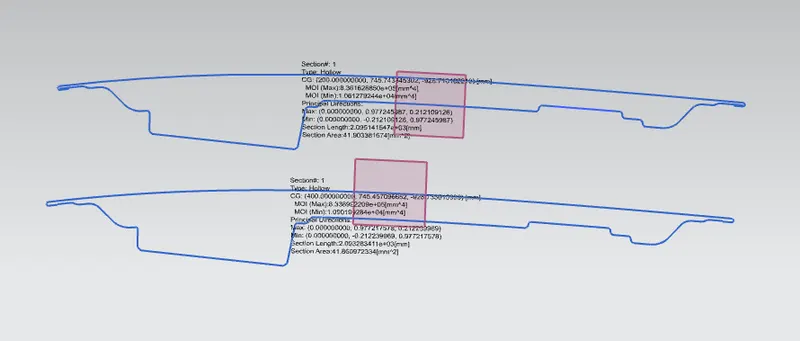
Distance from the neutral axis, y =`482.5543/2`=241.277
Before modification,
section modulus, s (max) =`(8.361628850 × 10^5)/241.277`=3465.5723
section modulus, s (min) =`(1.061279244 × 10^4)/241.277`=43.9859
After modification,
section modulus, s (max) =`(8.337941817 × 10^5)/241.277`=3455.7549
section modulus, s (min) =`(1.090181041 × 10^4)/241.277`=45.1837
Observations:
- From study1, it is observed that the modified section has an improved section modulus(min) while there is only a negligible change on section modulus(max).
- A similar kind of observation can be seen from study2 also.
Conclusion:
- Hereby, from the above studies, it can be concluded that section modulus can be improved by increasing the moment of inertia.
- Mathematically, there is also a direct proportionality between section modulus and the moment of inertia. An increase in the moment of inertia of a section will increase the section modulus.
Link: https://drive.google.com/file/d/1zuLyLxoKoLlfhgBGVfnzX-gwWDjbd4Qe/view?usp=sharing