Section Modulus calculation and optimization
Section Modulus
Section Modulus is a geometric property used to calculate the bending stresses in a structural member.
Mathematically,
It is defined as the ratio of the moment of inertia of a section about its centroidal axis and to the distance of the extreme layer from the neutral axis.
It is denoted by Z.
Z = I/ymax
Mathematically By bending stress equation,
M/I = σmax/ymax
M = σmax × (I/ymax)
M = σmax × Z
Where,
I = Moment of Inertia(m⁴)
y = distance from NA to extreme layer(m)
The unit of section modulus is m³.
Types of Section Modulus
There are two types of section modulus:
- Elastic Section Modulus
- Plastic Section Modulus
Elastic Section Modulus
Elastic section modulus is calculated when we are to use the material behavior till the yield point.
For general design purposes, we use elastic section modulus.
Section modulus - Hood:
This curve is a result of the intersection of the hood design and a plane. The curves are closed using studio spline.
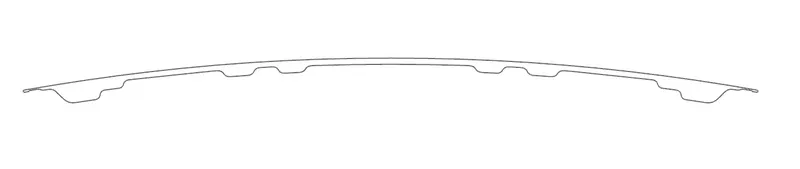
Section inertia analysis:
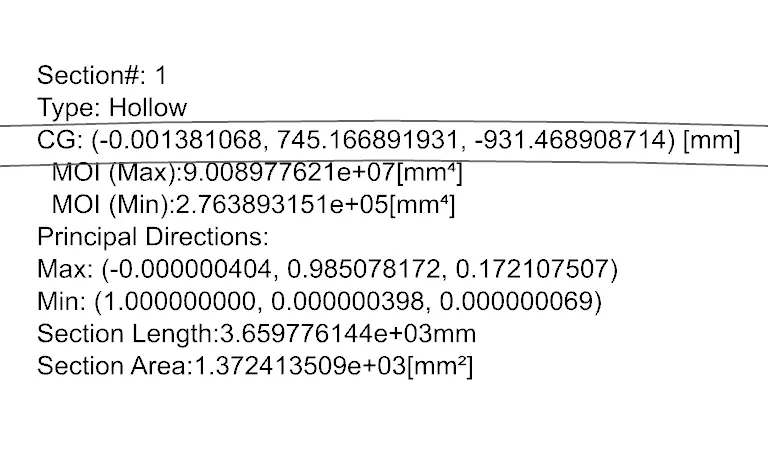
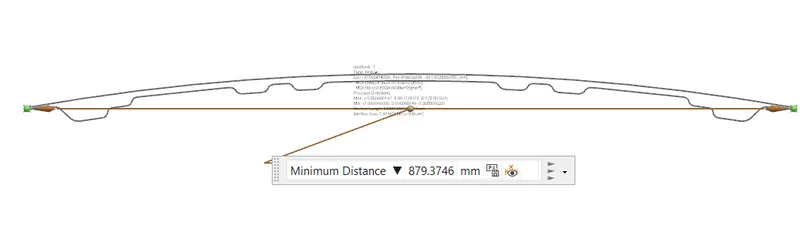
MOI(min), I = 2.7638 e+05 mm4
y = 879.37/2 = 439.685 mm
Section modulus, Z1 = I/y = 2.7638 e+05/439.685 = 628.58 mm3
Design optimization:
The bottom curve is offset by 0.5mm and joined to form a closed curve. Then, section inertia analysis was performed.

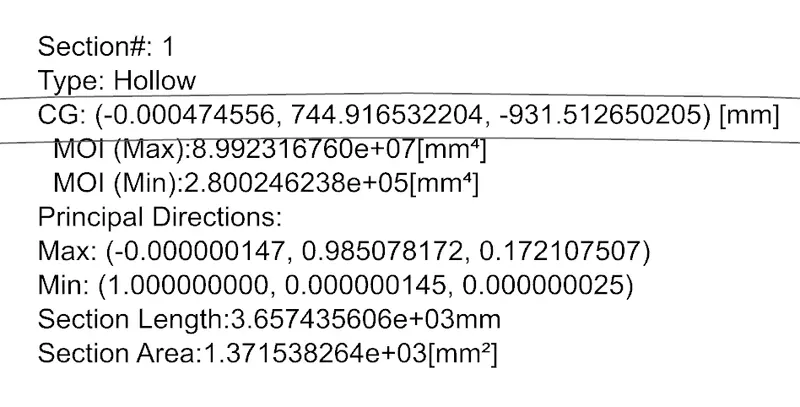
I = 2.8 e+05 mm4
y = 439.685 mm
Section modulus, Z2 = I/y = 2.8 e+05/439.685 = 636.81 mm3
Z1>Z2
Therefore, by optimizing the design the section modulus has been increased.