Section Modulus calculation and optimization
Aim:
To find the section modulus of the hood and optimization to improve the overall section modulus.
Objective:
Use the section from your Hood design and calculate the section modulus using the formula S= I/y.
Section Modulus:
- Ratio of total moment resisted by the section to the stress in the extreme fiber.
- It gives us an idea of how much of a load the given structure can take.
- If the section modulus increases the moment of resistance increases and hence its load-bearing capacity
By using the following formula we can find out the section modulus
S=I/y, Where
S= Section modulus (mm^3)
I = Moment of inertia of the section to the stress at the end of the object (mm^4)
Y= Distance between the neutral axis and end of the object (In this case we will take it from the center to the outer edge of hemmed outer panel mm).
Area Moment of Inertia:
The area moment of inertia of a beam cross-section area measures the beam's ability to resist bending. The larger the moment of inertia less will be the bend.
Neutral Axis: When the beam is subjected to pure bending the topmost fibers of the beam are subjected to maximum compression, while the bottommost fiber of the beam is subjected to maximum tension.
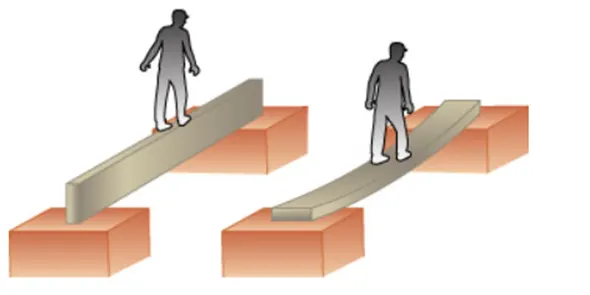
- This picture contains the following scene, a Diagram of a beam on its narrow edge supported at both ends. A man is walking on a straight beam. Diagram of a beam resting on its flat side supported at both ends. A man is walking on a straight beam and it's bending in the middle.
=*=*=*=*=*=*=*=*=*=*=*=*=*=*=*=**=*=*=*=*=*=*=*=*=*=*=*=*=*=*=*=*=*=*=*=*=*=*=*=*=*=*=*=*=*=*=*=*=*=*=*=*=*=*=*=*=*=
Calculation:
Case 1 For Section modulus
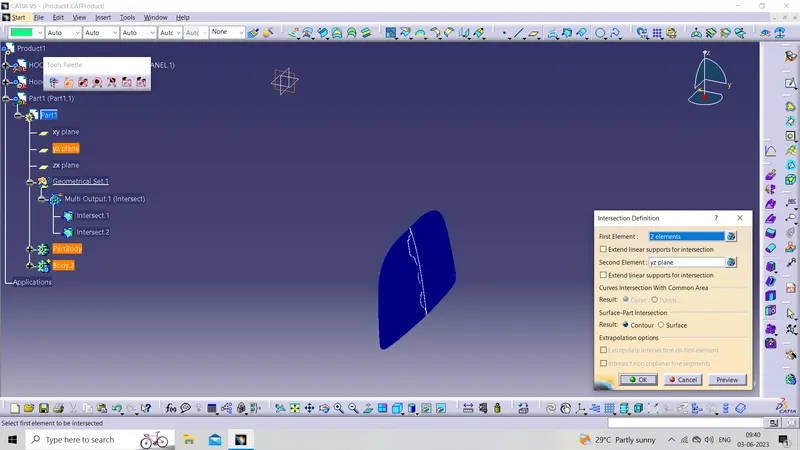
Now taking the intersection between The already-created Hood And the YZ plane here we calculate the section modulus for the side impact
now creating a sketch in which we use the 3d projection command for projecting our intersection then we take the outer lines of the inner And outer Hood Panel then make it a closed body as shown below
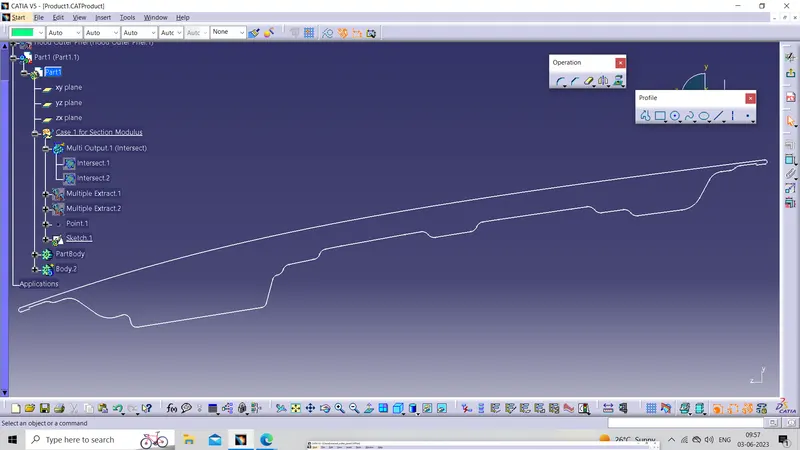
we can't get the inertia for the hollow body we have to fill the surface in between our closed body
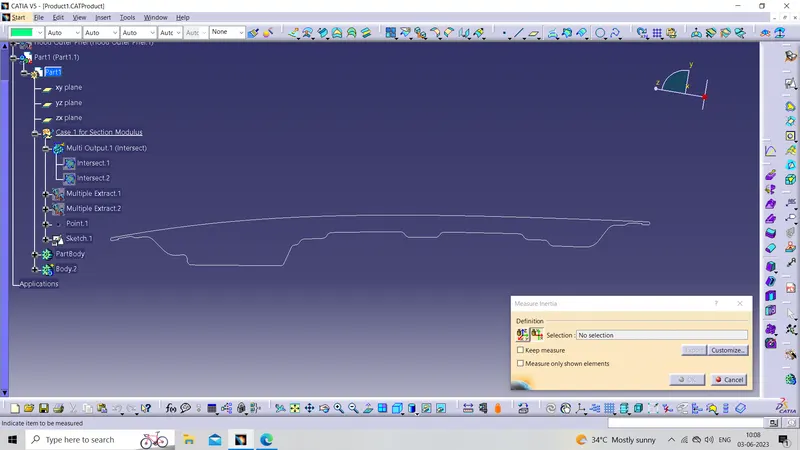
Now use the fill command because our body is closed
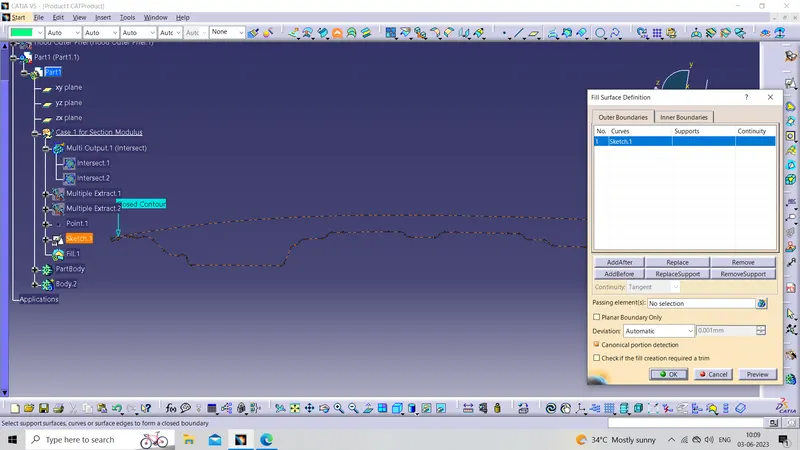
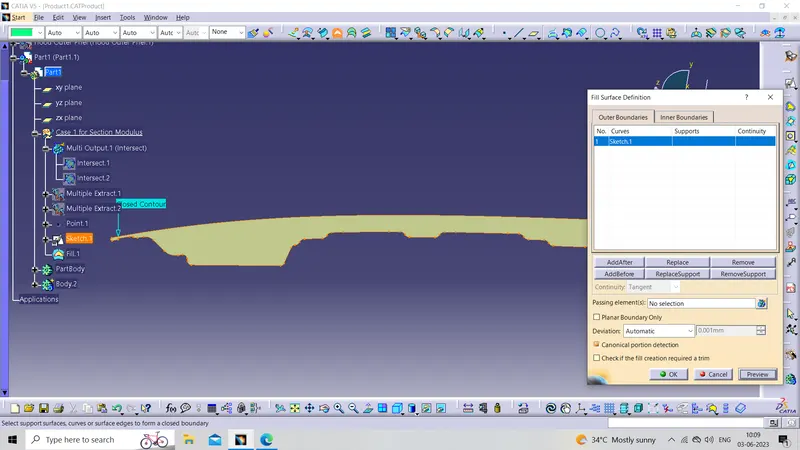
Then click on the Measure inertia command then select the option to measure inertia 2d from the command And then select the above fill surface
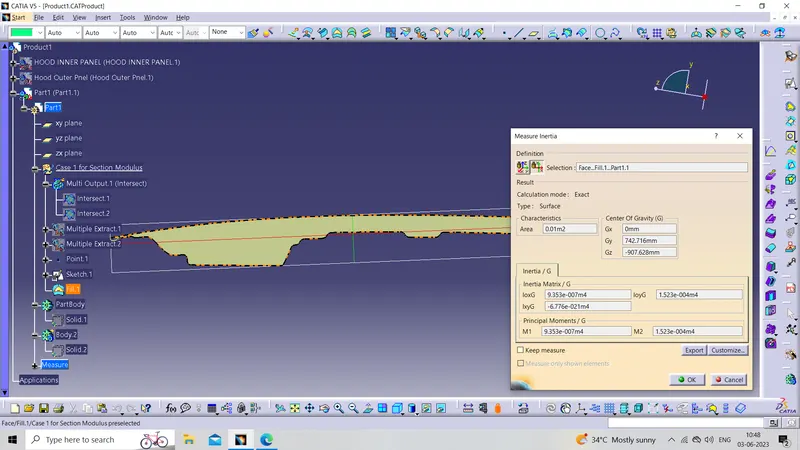
Maximum moment of inertia on the side impact
I (MAX) = 1.523e-004 m4 = 152300000 mm4
Minimum moment of inertia on the side impact
I (MIN) = 9.353e-007 m4 = 935300 mm4
As per the section modulus equation,
S = I/Y
I = MOI (min) Value is considered = 9.353e-007 m4 = 935300 mm4
Y = Total distance / 2, Total distance = 478.011 mm
Y = 478.011 / 2 = 239.0055 mm
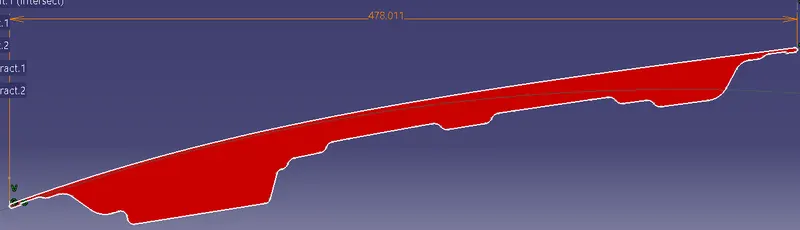
Therefore,
S = 935300 mm4 /239.0055 mm
| (Section modulus for case 1 )S = 3913.290 mm^3 |
=*=*=*=*=*=*=*=*=*=*=*=*=*=*=*=**=*=*=*=*=*=*=*=*=*=*=*=*=*=*=*=*=*=*=*=*=*=*=*=*=*=*=*=*=*=*=*=*=*=*=*=*=*=*=*=*=*=
Case 2: After Optimization
The hood inner panel’s curve is offset by 0.5mm outwards and section inertia analysis is done the same as in case 1 for a closed curve.
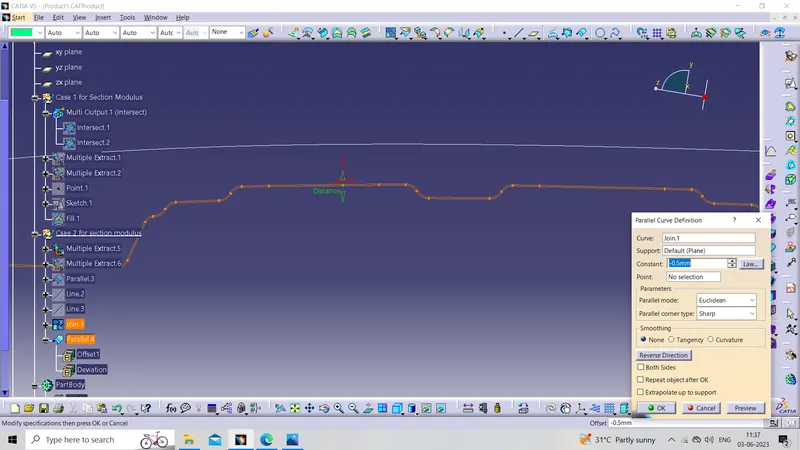
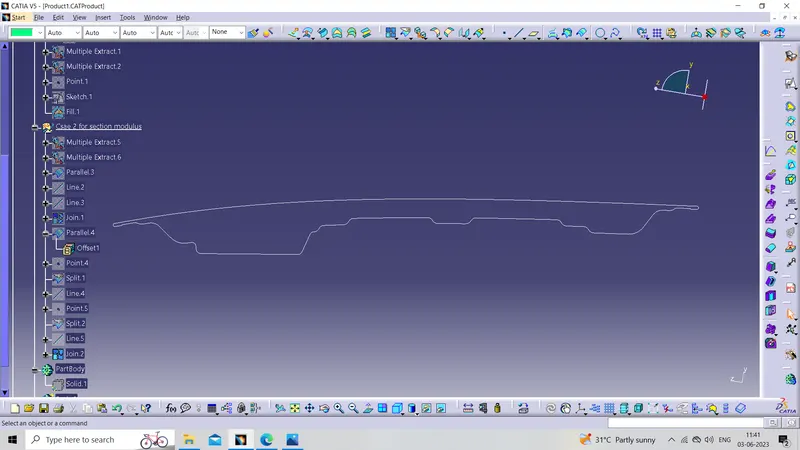
Then click on the Measure inertia command then select the option to measure inertia 2d from the command And then select the above fill surface
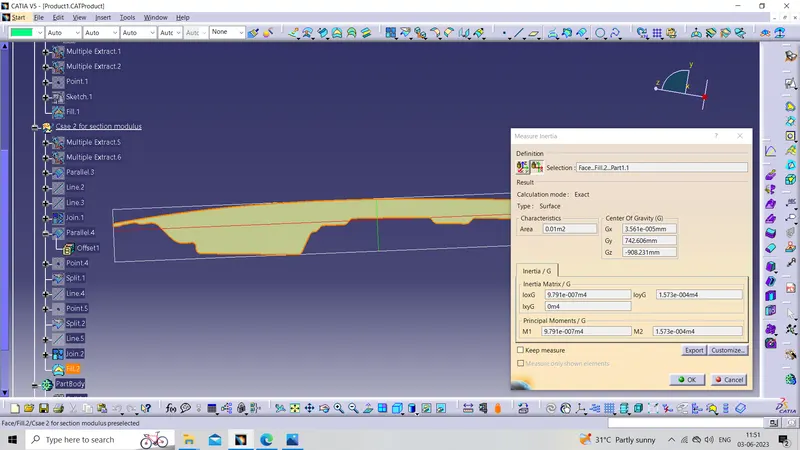
Maximum moment of inertia on the side impact
I (MAX) = 1.573e-004 m4 = 157300000 mm4
Minimum moment of inertia on the side impact
I (MIN) = 9.791e-007 m4 = 979100 mm4
As per the section modulus equation,
S = I/Y
I = MOI (min) Value is considered = 9.791e-007 m4 = 979100 mm4
Y = Total distance / 2, Total distance = 478.011 mm
Y = 478.011 / 2 = 239.0055 mm
Therefore,
S = 979100 mm4 /239.0055 mm
| (Section modulus for case 1 )S = 4096.560 mm^3 |
=*=*=*=*=*=*=*=*=*=*=*=*=*=*=*=**=*=*=*=*=*=*=*=*=*=*=*=*=*=*=*=*=*=*=*=*=*=*=*=*=*=*=*=*=*=*=*=*=*=*=*=*=*=*=*=*=*=
Conclusion:
Resulting by comparing case 1 & case 2,
- The section modulus value of case 2 is higher than case 1
- As we increase the section area, the moment of inertia & section modulus increase which means the strength and load-bearing capacity of the Material also increase. Which is the moment of inertia directly proportional to the strength of the material.