Section Modulus calculation and optimization
Section modulus
Section modulus is a crucial geometric property utilized in the design of beams or flexural members. It plays a vital role in determining the strength and resistance of an object against external forces that tend to cause flexure or bending. The moment-carrying capacity of the object directly relies on its geometric properties and material properties.
In the design process, various geometric properties come into play, including the area for tension and shear, the radius of gyration for compression, and the moment of inertia and polar moment of inertia (stiffness). The relationship between these properties is highly dependent on the shape of the object.
Two types of section moduli are commonly considered: elastic modulus and plastic section modulus. Elastic moduli are typically used in general design, applying up to the yield point for most materials and commonly used substances. Plastic moduli, on the other hand, are employed when elastic yielding is deemed acceptable, assuming that the plastic behavior remains within acceptable limits.
According to mechanics, the section modulus is defined as the ratio of the moment of inertia to the distance from the neutral axis to any specific fiber. It is represented by the equation:
Section Modulus (S) = I/y (units mm³)
Where: I = Moment of inertia (mm⁴) y = Distance between the neutral axis and the extreme end of the fiber
For symmetric sections, the section modulus remains the same above or below the centroid.
For asymmetric sections, two values are determined: the maximum and minimum section moduli.
Case 1:
calculate section modulus for existing geometry. take a cross-sectional view of the model and calculate the moment of inertia.
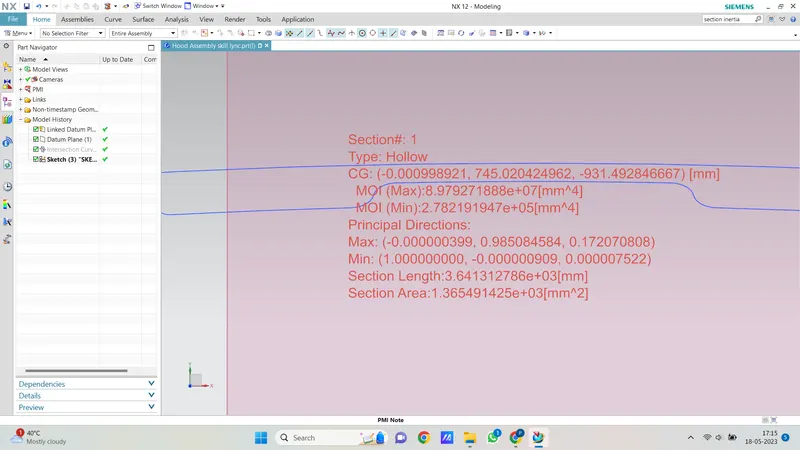
as per the above pic we get two moments of inertia which is as follow.
MOI (Max): 8.979 x 10^7 mm^4
MOI (Min): 2.782 x 10^5 mm^4
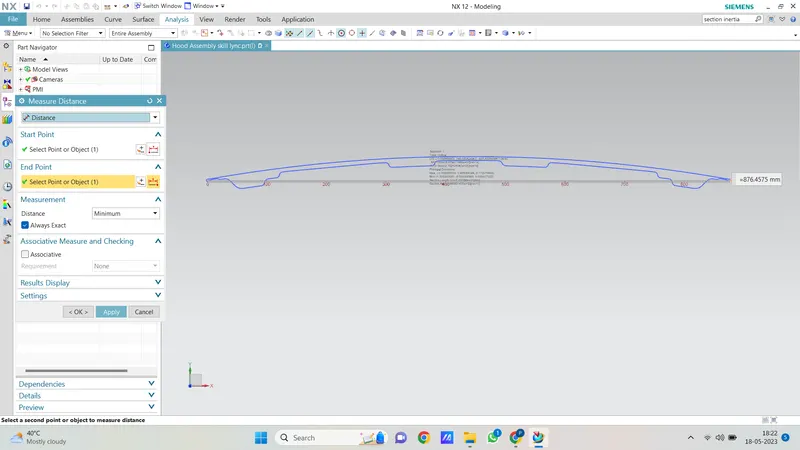
Y= 438.4575mm^3
S(max)= 8.979 x 10^7 / 438.225mm^3
=204894.745mm^3
S(min)= 2.782 x 10^5 / 438.225mm^3
=634.833mm^3
This is the result of the section modulus for initial design of the hood
Case 2:
To improve the section modulus of the hood we wnt to increase inertia. so By offsetting the hood outer panel by 0.5mm we can increase the moment of inertia of the hood section.
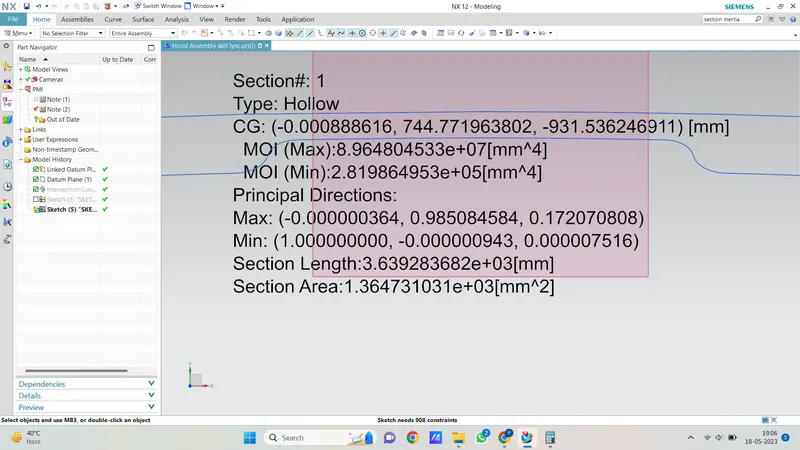
as per above pic the moment of inertia is increase . section modulus is also increase.
MOI(max): 8.964x10^7mm^4
MOI(min): 2.819x10^5mm^4
Y: 438.4575mm^3
S(max)= 8.964x10^7 / 438.4575mm^3
=204444.221mm^3
S(min)= 2.819x10^5 / 438.4575mm^3
=642.936mm^3
Hence the section modulus of our hood has been increased compared to initial hood design section modulus.