Section Modulus calculation and optimization
What is section modulus:
The section modulus is a property used in structural engineering to measure the strength and stiffness of a beam or structural member. It quantifies how resistant a given cross-section is to bending and torsion.
To understand the concept of section modulus, we need to consider the behavior of a beam under bending. When a beam is subjected to a bending moment, it experiences both tension and compression forces along its length. The section modulus helps us determine the maximum bending stress that a beam can withstand without failure.
The section modulus (denoted as "Z") is calculated by dividing the moment of inertia of the beam's cross-section (denoted as "I") by the maximum distance from the neutral axis of the section to the outermost fibers (denoted as "c"). Mathematically, it can be expressed as:
Z = I / c
The moment of inertia represents how the area of the beam is distributed around its neutral axis. A larger moment of inertia indicates a beam with more resistance to bending. The distance "c" is the distance from the neutral axis to the extreme fiber, which is farthest from the neutral axis. It is a measure of the cross-sectional size of the beam.
By calculating the section modulus, engineers can determine the maximum bending stress a beam can handle. The bending stress (denoted as "σ") is calculated by dividing the bending moment (denoted as "M") by the section modulus (Z):
σ = M / Z
A larger section modulus means a beam can withstand higher bending moments and, therefore, higher stresses without failing. It signifies a stiffer and stronger beam.
The section modulus is an important parameter used in structural design and analysis. It helps engineers select the appropriate beam size and shape to ensure the structural integrity and safety of a given application.
Types of section modulus:
-
Elastic section modulus(S)
- Plastic section modulus(Z)
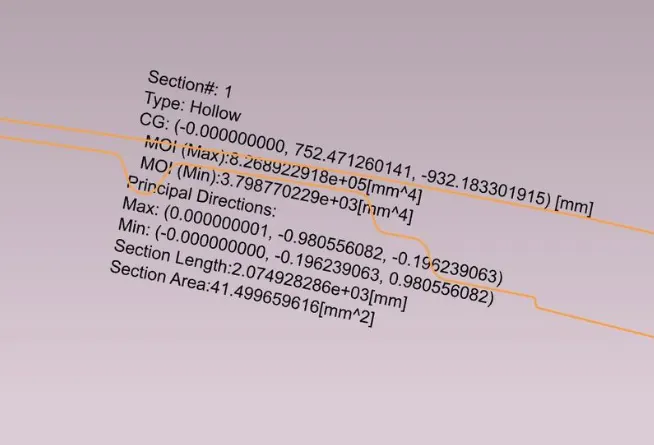
Imax – 8.268922918 x 10^5 (mm^4)
Imin – 3.798770229 x 10^3 (mm^4)
Y = Total length / 2
= 486.13/2
=243.065 mm
section modulus for max. = 8.268922918 x 10^5 / 243.065
= 3.4019 x 10^3
section modulus for min. = 3.798770229 x 10^3 / 243.065
= 0.01562 x 10^3
So for this hood design section modulus range from 3.4019 x 10^3 mm^3 to 0.01562 x 10^3 mm^3
Optimized design :
In order to increase the sectional modulus, cross sectional area has to be increased. So here the optmized design.
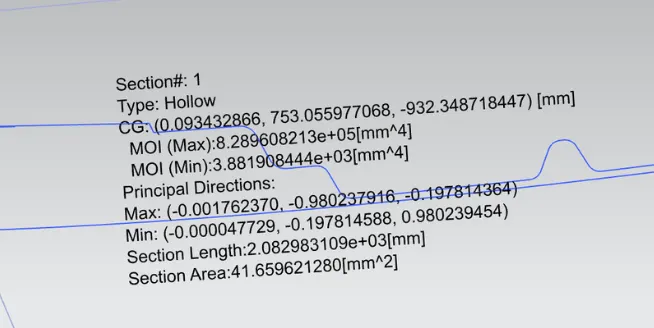
Imax – 8.289608213 x 10^5 (mm^4)
Imin – 3.881908444 x 10^3 (mm^4)
Y = Total length / 2
= 486.13/2
=243.065 mm
section modulus for max. = 8.289608213 x 10^5 / 243.065
= 3.410449 x 10^3
section modulus for min. = 3.881908444 x 10^3 / 243.065
= 0.01597 x 10^3
So for this hood design section modulus range from 3.410449 x 10^3 mm^3 to 0.01597 x 10^3 mm^3
It is evident that if the section modulus is increased from 3.4019 x 10^3 mm^3 to 3.410449 x 10^3 mm^3 by increasing the sectional area.
Conclusion
Strength of material is directly proportional to the moment of interia, thus increasing the sectional area increase the increases strength of component.
Thus sectional modulus for hood design is calculated and optimized design is also done to increase the section modulus of the hood.