Section Modulus calculation and optimization
Section modulus
Section modulus is a geometric property of a cross-sectional shape that measures its ability to resist bending stress. It is defined as the ratio of the moment of inertia of the shape about the neutral axis to the distance from the neutral axis to the outermost fiber of the shape. The section modulus is denoted by the symbol "Z" and has units of length cubed.
In practical engineering applications, the section modulus is a key factor in determining the strength and stiffness of a beam or other structural member. A higher section modulus indicates a greater resistance to bending stress and therefore a stronger and stiffer member.
The section modulus is used in various structural design calculations, including the calculation of bending stress, deflection, and shear stress. It is also an important factor in determining the required size and shape of structural members in order to meet specific design criteria.
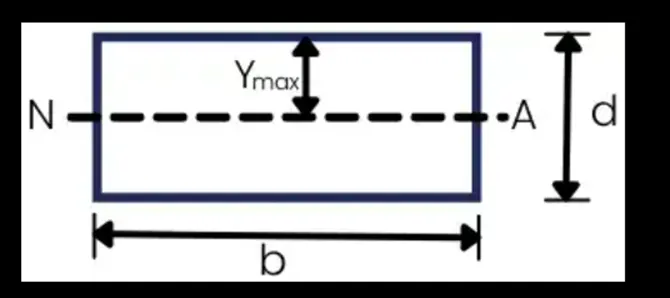
The formula for the section modulus of various section are,
- Rectangular section:
Z = (bh^2)/6
where b is the base of the rectangle and h is the height.
- Circular section:
Z = πr^3/4
where r is the radius of the circle.
- I-shaped section (also known as W or H beam):
Z = 2(Ixx + Ay^2)/d
where Ixx is the moment of inertia of the section about its major axis, A is the area of the section, y is the distance from the centroid of the section to the top or bottom edge, and d is the total depth of the section.
- T-shaped section:
Z = (b1h1^2)/6 + b2(h1 + h2 - d/2)^2
where b1 and h1 are the dimensions of the vertical section, b2 and h2 are the dimensions of the horizontal section, and d is the total depth of the section.
These formulas can be used to calculate the section modulus for different shapes, which is an important factor in
Example:
designing and analyzing structural members.
we have a rectangular beam with a base (b) of 4 inches and a height (h) of 6 inches. The moment of inertia (I) of the section is calculated as:
I = bh^3/12 = (4)(6^3)/12 = 72 in^4
The distance from the neutral axis to the outermost fiber of the section is equal to half of the height, which is 3 inches. Therefore, the section modulus (Z) of the beam is:
Z = I / (3 in) = 72 in^4 / 3 in = 24 in^3
This means that the beam has a section modulus of 24 cubic inches and is able to resist bending stress accordingly. The section modulus can be used in further calculations to determine the beam's strength and stiffness.
the moment of inertia for the hood section is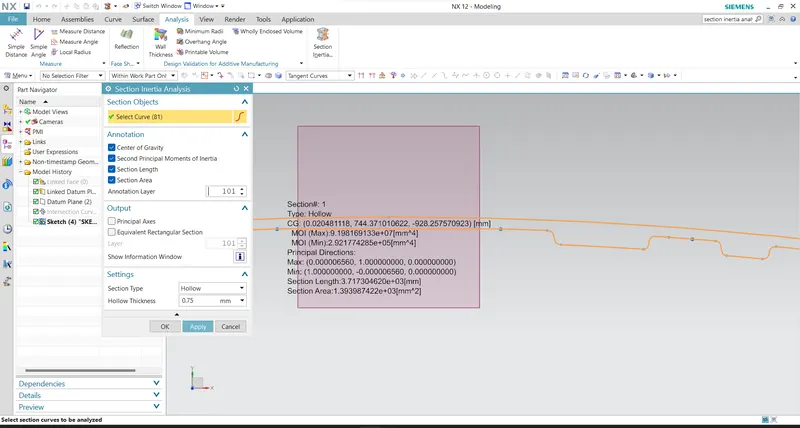
after modify the hood section we get
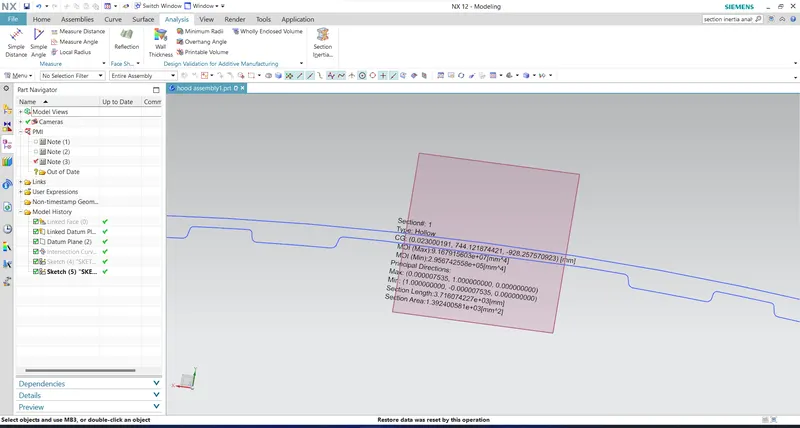
for the modified section we find the section modulus
s=i/y
i=2.95
y=0.36/2
so the moment of inertia is s=16.38cubic mm