Section Modulus calculation and optimization
Section Modulus:
Section Modulus is a geometric property that is used to calculate the bending stresses in beams or flexural member.
Section modulus is defined as the ratio of the moment of inertia of a section about its centroidal axis and to the distance of the extreme layer from the neutral axis.
S = I/y
Where,
S = Section Modulus
I = Moment of Inertia
y = distance between the neutral axis and the extreme end of the object.
Section modulus represents the strength of the section. Greater is the value, greater the strength.
Section modulus is given by the units mm^3.
Section modulus of the hood:
Section modulus of the hood is calculated by taking the outermost edges of the outer panel and inner panel (Cross section).
1. Datum is created and the cross section is obtained by using the intersection curves command.
2. Curves are projected to the datum. The lower curves of the outer panel and the upper curves of the inner panel are trimmed, the corners and the open areas are closed.
3. Section inertia is calculated by using the command Section Interia Analysis.
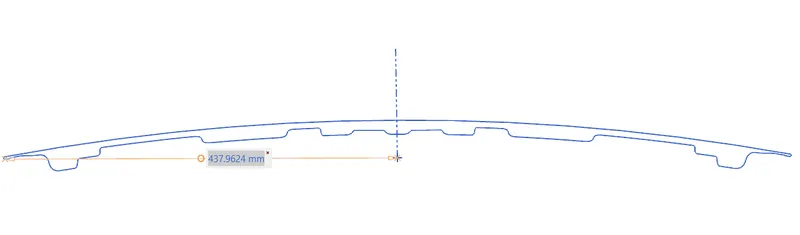
Here, y= 438mm
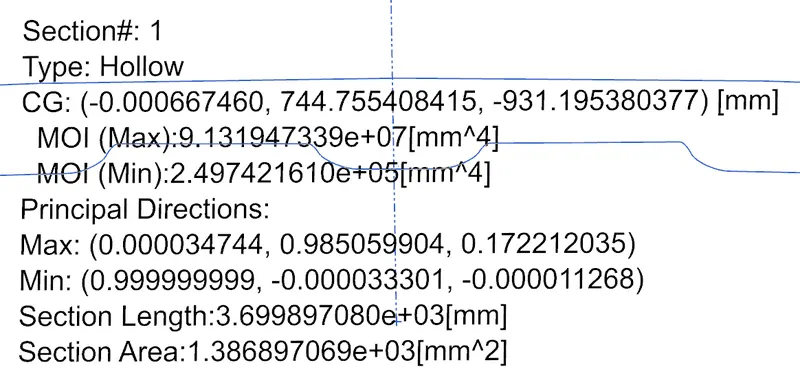
I min = 249742 mm^4
Therefore,
S = I/y = 249742/438 = 570.18 mm^3.
Optimizing the section modulus:
Considering the above section modulus is not sufficient, it has to be improved. Section modulus can be increased by increasing the area of the section. The inner panel curves are offset by 0.5mm indicating the increase in depth of emboss in the inner panel to increase its strength.
The section inertia is calculated,
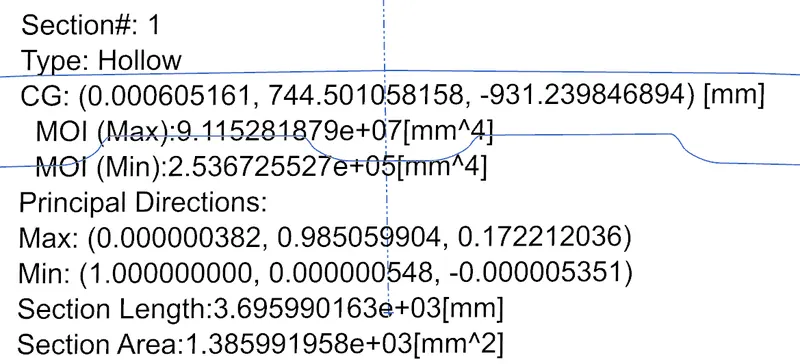
I min has increased to 253672 mm^4
Now the section modulus,
S = 253672/438 = 579.16 mm^3
Section modulus before optimisation : 570.18 mm^3
Section modulus after optimisation = 579.16 mm^3
Conclusion:
Section modulus of the hood is increased by increasing the moment of interia, which is due to the increase in area of the section. It is evident from the values obtained before and after optimisation.