Section Modulus calculation and optimization
AIM : To Calculate the Section Modulus of Hood Design by taking the section and taking up another section that has an improved Section Modulus resulting in the improvement in strength .
Section Modulus (S ) :
Section Modulus is defined as the ratio of moment of Inertia of a section about the neutral axis to the distance of the outermost layer from the neutral axis.
It is denoted by S or Z .
Mathematically , S = I /y(max)
According to Bending equation ,
σ/y = M/I = E/R
the stress and strain in any layer is directly proportional to the distance of the layer from the neutral axis (y).
All the layers below the neutral layer are subjected to tensile stresses whereas the layers above neutral layers are subjected to compressive stresses .
If ' M ' is the Maximum Bending Moment ( or moment of resistance offered by the section ) then
M = Maximum Bending Stress * Section Modulus
Hence , moment of resistance offered by the section is Maximum when Section Modulus is maximum .
- Hence Section Modulus represent the " strength of the section " .
- The higher value of Section Modulus for a cross-section of a particular shape, the higher is the bending moment carrying capacity of the beam which it can withstand for a given maximum bending stress.
PROPERTIES OF SOME SPECIFIC CROSSECTIONAL SHAPES :
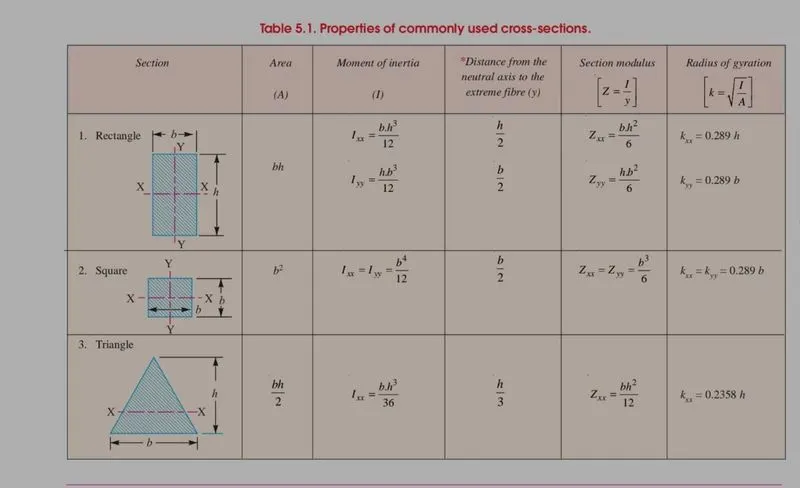
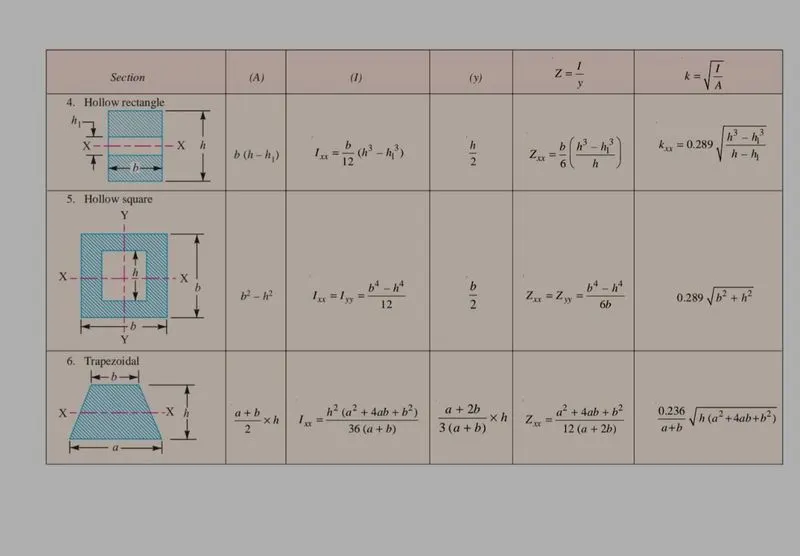
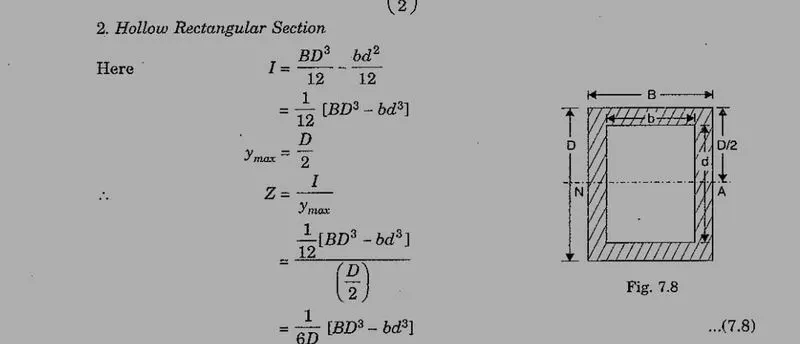
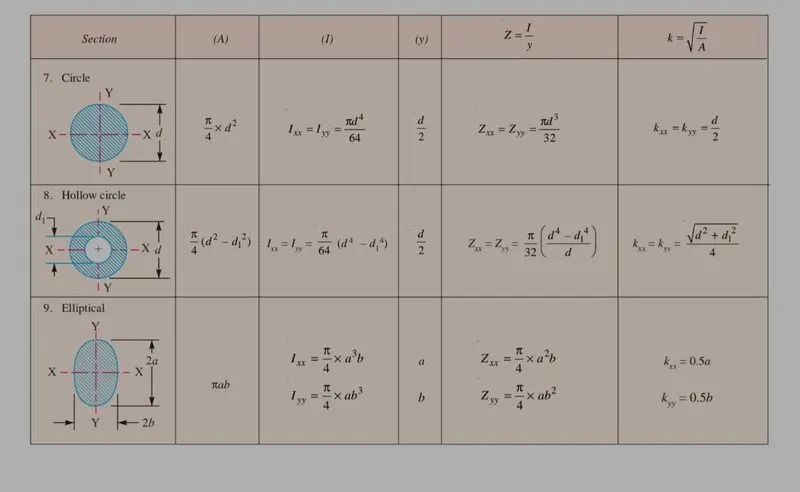
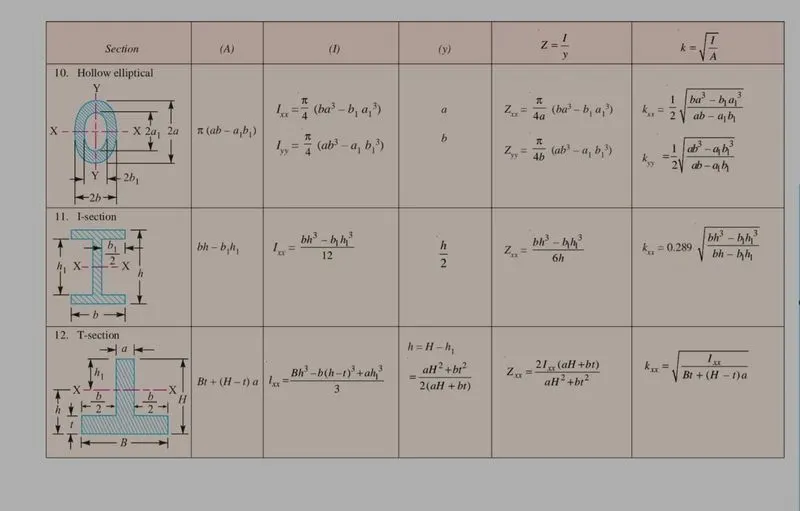
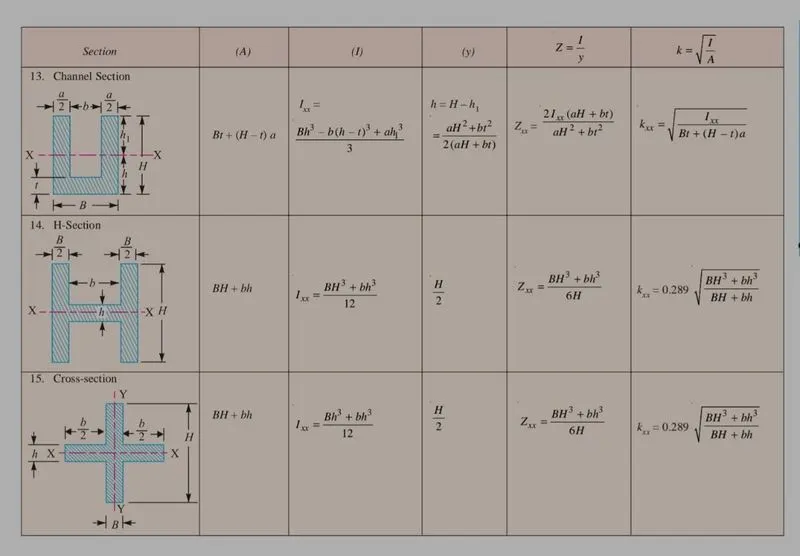
Note :
1.The neutral axis of a section always passes through its centroid.
2. In case of symmetrical sections such as circular, square or rectangular, the neutral axis passes through its geometrical centre and the distance of extreme fibre from the neutral axis is y = d / 2, where d
is the diameter in case of circular section or depth in case of square or rectangular section.
3. In case of unsymmetrical sections such as L-section or T- section, the neutral axis does not pass through its geometrical centre. In such cases, first of all the centroid
of the section is calculated and then the distance of the extreme fibres for both lower and upper side of the section is obtained. Out of these two values, the bigger value is used in bending stress equation
CALCULATION & OPTIMIZATION OF SECTION MODULUS :
Case 1 : Before Optimization
Taking the section of Hood design and then performing Section Inertial Analysis
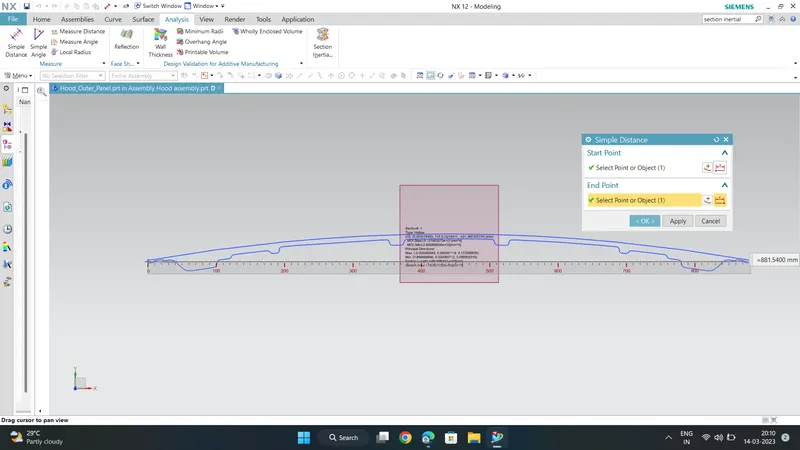
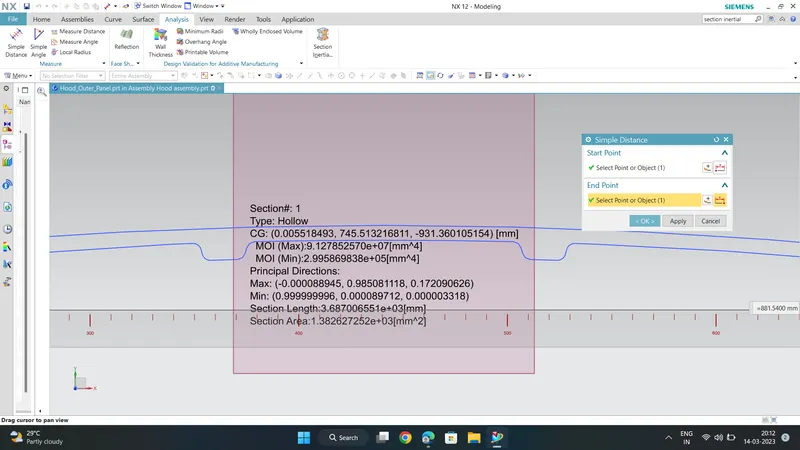
For the given particular section ,
Maximum Moment of Inertia (MOI) = 9.1278525*10^7 mm^4
Minimum MOI = 2.995869838*10^5 mm^4
Distance between neutral axis to a layer (y) = Total Distance / 2 = 881.54 /2 = 440.77 mm
Considering only minimum MOI ,
i.e I(min) = 2.995869838*10^5 mm^4
Now We Know that Section Modulus (S ) = I(min) / y = 2.995869838*10^5 /440.77 = 679.69 mm^3
Therefore S = 679.69 mm^3 .
Case 2 : After Optimization
By increasing the depth of the inner pannel through offset by 0.5mm .
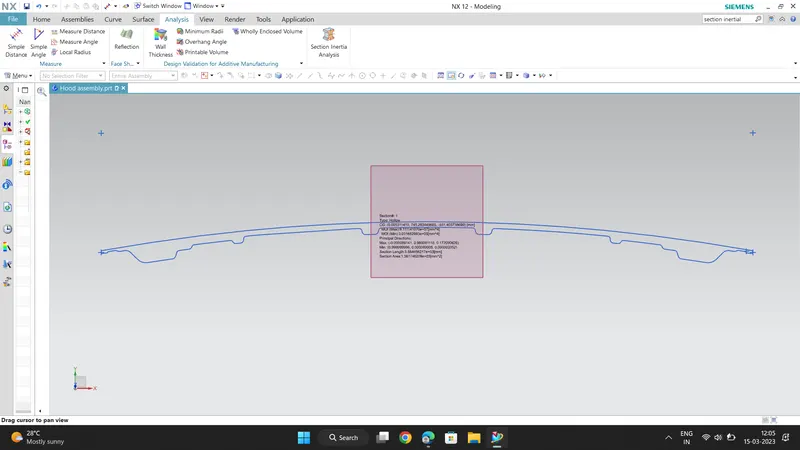
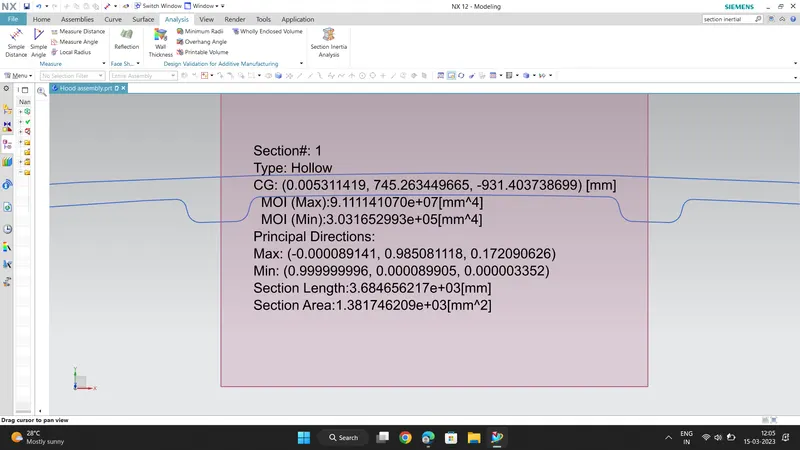
For the given particular section ,
Maximum Moment of Inertia (MOI) = 9.111141070 *10^7 mm^4
Minimum MOI = 3.031652993 *10^5 mm^4
Distance between neutral axis to a layer (y) = Total Distance / 2 = 881.54 /2 = 440.77 mm
Considering only minimum MOI ,
i.e I(min) = 3.031652993 *10^5 mm^4
Now We Know that Section Modulus (S ) = I(min) / y = 3.031652993 *10^5 / 440.77 =687.8083792 mm^3
Therefore S = 687.8083792 mm^3 .
CONCLUSION :
On comparison between case 1 and case 2 ,we observe that
- The section modulus value of Case 2 is higher than the Case 1
- As we increase the depth of hood i.e section area, the moment of inertia & section modulus increases which means strength and load Material also increase Which means the moment of inertia is also directly proportional to the strength of the material.