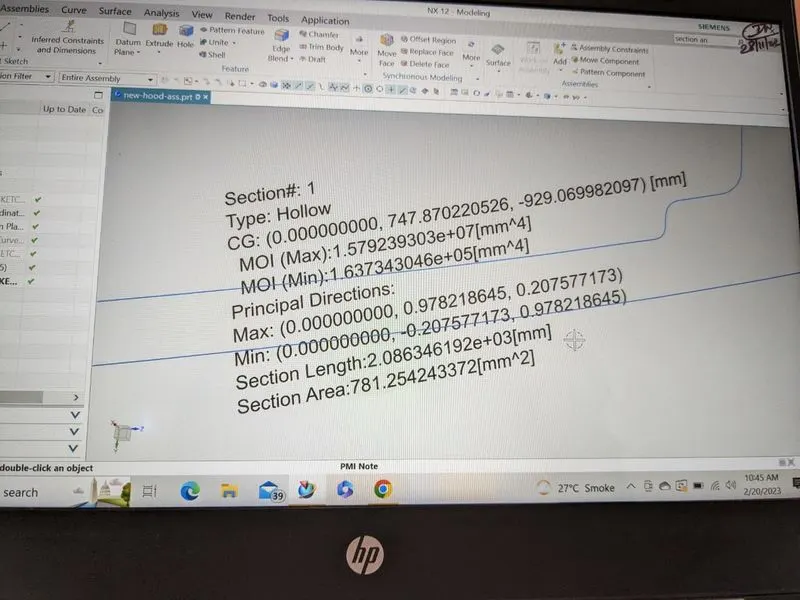
Section Modulus calculation and optimization
Section modulus is a geometric property of a structural member, such as a beam or column, that describes its resistance to bending. It is defined as the ratio of the moment of inertia of the cross-sectional area of the member to the distance of the outermost fibers from the neutral axis of the member.
Mathematically, the section modulus (Z) is given by the formula:
Z = I / y
where I is the moment of inertia of the cross-sectional area and y is the distance from the neutral axis to the outermost fibers of the section.
The section modulus is an important factor in the design of structural members, as it determines the member's bending strength and stiffness. The larger the section modulus, the greater the member's resistance to bending and the greater its ability to carry loads.
In practical terms, engineers use section modulus to compare the strength of different cross-sectional shapes of a beam or column with the same material and length. By selecting the beam or column with the appropriate section modulus for the given application, engineers can ensure that the member can withstand the loads it will be subjected to without cfailing.