Section Modulus calculation and optimization
Aim:-
To calculate the section modulus of the previously designed hood and optimize the design of the hood.
Section Modulus:-
Section Modulus is a geometric property used to calculate the bending stresses in a structural member. Mathematically, It is defined as the ratio of the moment of inertia of a section about its centroidal axis and to the distance of the extreme end from the neutral axis.
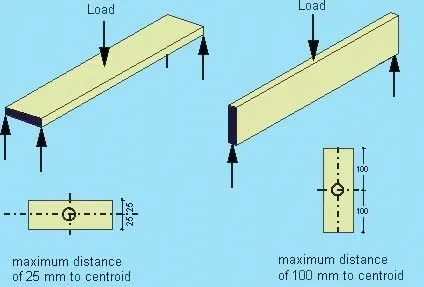
Fig. 1: Different maximum distances from the centroid in different loading conditions.
`S=I/Y`
Where,
S = Section modulus
I = Moment of Inertia
Y = Distance from the neutral axis to the extreme end of the object.
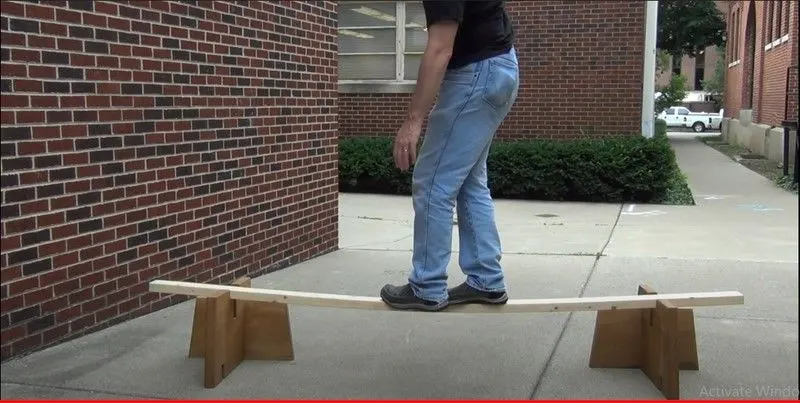
Fig. 2: Bending of the beam during horizontal cross-section loading condition.
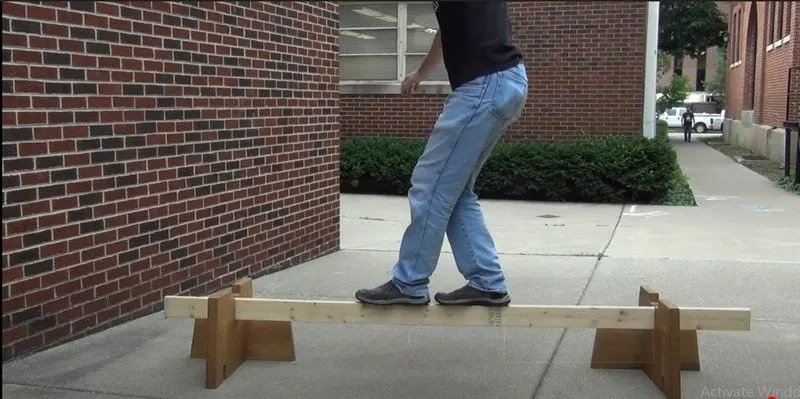
Fig. 3: Bending of the beam during vertical cross-section loading condition.
Changing the position can show the difference in bending which is because of the centroid distance from the extreme end of the object. Basically, in the position where there is more material from the axis to the specific direction, the load makes less bend in that direction and improves the strength.
Types of Section Modulus:-
There are two types of section modulus,
- Elastic Section Modulus:
Elastic section modulus is calculated when we have to use the material behavior till the yield point. For general design purposes, we use elastic section modulus. - Plastic Section Modulus:
The plastic section modulus is used for materials where the elastic yield is acceptable and the plastic behavior is considered to be in an acceptable range.
Calculation of Section Modulus:-
Case - 1: Before Optimization:
The Section Inertia Analysis is done on the existing hood.

Fig. 4: Cross-section of the hood before optimizing.
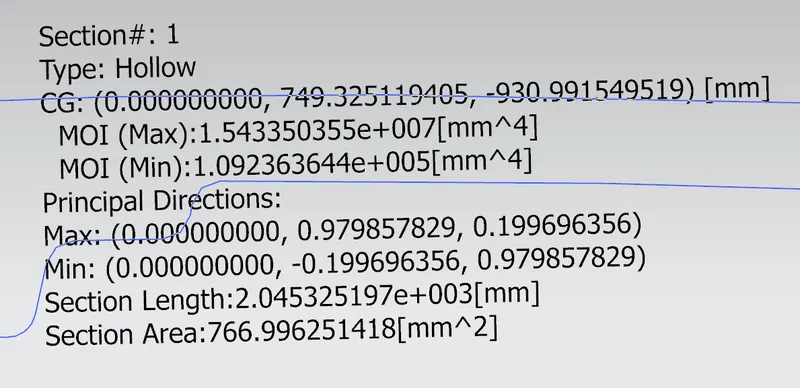
Fig. 5: Section inertia analysis data of hood before optimizing.
From the above data we found,
I = MOI (Min)
= 109236.364 mm^2
Y = Total Distance between extreme ends/2
= 487.3963/2
= 243.698 mm
Therefore,
S = I/Y
= 109236.364/243.698
= 448.245 mm^3
Section Modulus (S) = 448.245 mm^3
Case - 2: After Optimization:
To optimize the result the hood inner panel was offset outwards by 2 mm and then Section Inertia Analysis was done.

Fig. 6: Cross-section of the hood after optimizing.
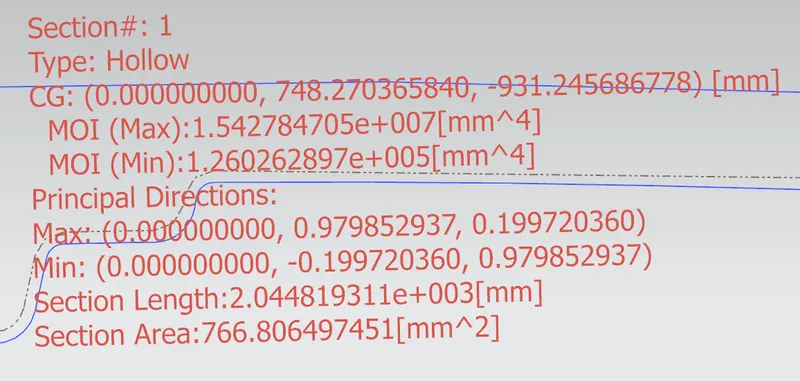
Fig. 7: Section inertia analysis data of hood after optimizing.
From the above data we found,
I = MOI (Min)
= 126026.289 mm^2
Y = Total Distance between extreme ends/2
= 487.3963/2
= 243.698 mm
Therefore,
S = I/Y
= 126026.289/243.698
= 517.141 mm^3
Section Modulus (S) = 517.141 mm^3
Conclusion:-
After comparing the results of case - 1 and case - 2, we found that the section modulus value of case - 2 is higher than that of case - 1.
So, we conclude that by increasing the cross-section area of the hood, the moment of inertia and the section modulus also increases which results in increase in the strength of the hood.