Section Modulus calculation and optimization
SECTION MODULUS CALCULATION AND OPTIMIZATION
AIM :
To calculate the Section modulus for the given hood model for two iterations and analyze which will the better to be considered.
SECTION MODULUS :
Section Modulus is also referred to as the Polar Modulus or the Torsional Sectional Modulus. It is denoted by Zp.
Section Modulus is the geometric property of the given cross-section of any shaft or beam structures. It is the direct measure of the strength of the shaft section or the beam section. Higher the section modulus of a structure, the more the resistive it becomes to bending.
The second moment of area is also known as the moment of inertia of a shape. It is directly related to the area of material in the cross-section and the displacement of that area from the centroid. Once the centroid is located, the more important structural properties of the shape can be calculated. The axis that determines the centroid is also known as the neutral axis (N/A).
The second moment of area is a measure of the 'efficiency' of a shape to resist bending caused by loading. A beam tends to change its shape when loaded. The second moment of area is a measure of a shape's resistance to change.
Use the formula: where b = breadth (width) and d = depth (height) to calculate the moment of inertia about the x-x axis for beams A and B using information from the diagram.
Section modulus is defined as the ratio of polar moment of inertia to the radius of the shaft or the distance from the neutral axis to the outer fibres.
For a beam which has been bent, the maximum stress σmax will occur at the maximum distance ymax from the neutral axis.
Thus:
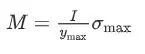
The quantity I/ymax is a purely geometric function and is termed the section modulus Z. Thus we can write:
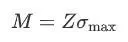
Therefore :
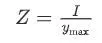
Z = Section modulus.
I = Moment of Inertia.
Ymax = distance between the neutral axis and the extreme end of the object.
Use the formula: where b = breadth (width) and d = depth (height) to calculate the moment of inertia about the x-x axis for beams A and B using information from the diagram.
Section modulus is defined as the ratio of polar moment of inertia to the radius of the shaft or the distance from the neutral axis to the outer fibres.
For a beam which has been bent, the maximum stress σmax will occur at the maximum distance ymax from the neutral axis.
Elastic section modulus of different sections:-
SECTION MODULUS CALCULATION OF HOOD DESIGN
STEPS ;-
1. Take a deseried Hood Inner pannel and Outer pannel
2. to Take a datum plane at middle of the Hood Section
3. To project the curve and join the curves
4. Select the section inertia analysis and select the cueve and to get reqired values .
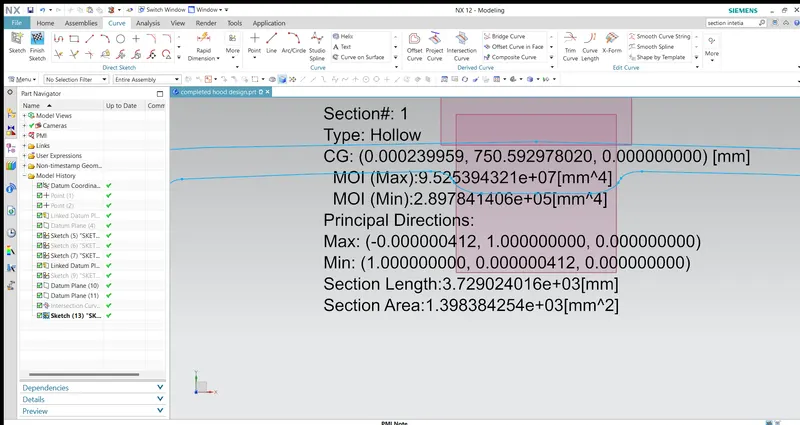
Section1 calculation;
MOI ( MIN)
I= 2.897841406 +05[mm^4]
Y=890/2
=445
S=2.897841106 MM ^4/445 MM
=65.12m3
FOR MODIFIED SECTION
In this case i have added the embosses & increased the offset value of inner panel 0.5MM to outer panel.
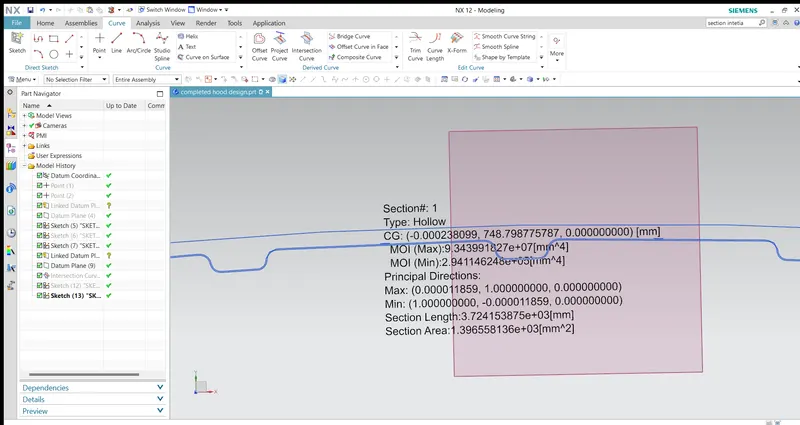
Section 2 calculation;
MOI ( MIN)
I= 2.9411406 +05[mm^4]
Y=890/2
=445
S=2.941146248 MM ^4/445 MM
=66.093 m3
Conclusion:
Resulting by comparing Section 1 & Section 2,
- The section modulus value of Section 2 is higher than the Section 1
- As we increase the section area, the moment of inertia & section modulus increase which means strength and load material also increase. Which the moment of inertia directly proportional to the strength of the material.