Hood design-Week 2
HOOD DESIGN
Introduction
Hood or bonnet is the hinged cover over the engine of the motor vehicles that is used to access the engine compartment. Hood assembly consist of different parts that combine to be used in a vehicle. Various parts of the hood are:
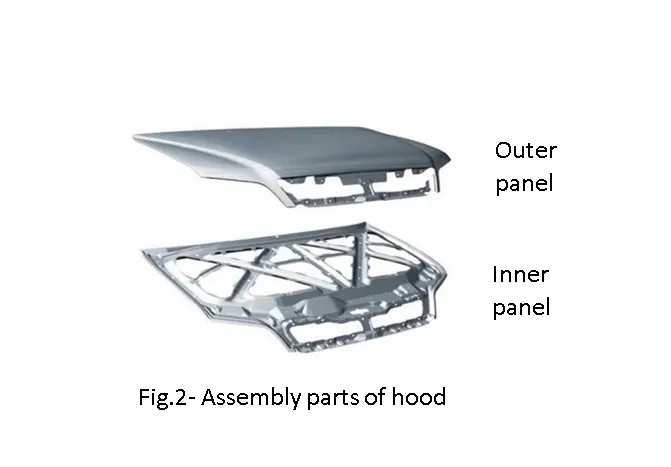
- Hood outer panel
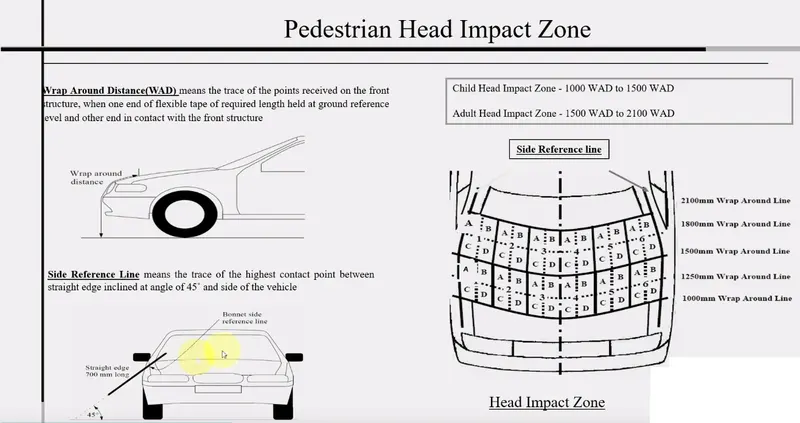
Outer panels are the aesthetic elements of a car. It is the styling team who provides the skin for the outer panel. The shape, position, and size of the hood should satisfy the safety norms. So while designing the hood we should give more importance to pedestrian safety. The outer panel is attached to the inner panel by hemming. So, it is necessary to provide the required hemming flange and reliefs for the hemming operation. We also provide mastic sealants between the outer panel and inner panel to reduce vibration
- Hood inner panel
The inner panel is the part that gives strength and rigidity to the outer panel. The master section represents the initial emboss shape and size. Then we provide the emboss for the latch and hinge elements after fixing the location
- HINGE
hinge is a mechanical bearing that connects two solid objects, typically allowing only a limited angle of rotation between them. Two objects connected by an ideal hinge rotate relative to each other about a fixed axis of rotation: all other translations or rotations being prevented, and thus a hinge has one degree of freedom. Hinges may be made of flexible material or of moving components. In biology, many joints function as hinges like the elbow joint.
- striker and Latch:
The purpose of these latches is to keep your hood closed, protecting you from getting injured by flying parts if there are any accidents while driving.
Hood latches are a safety mechanism that keeps your car’s hood closed. It is important to inspect them regularly for wear and tear.
In this report we will discuss the various design consideration used for designing various parts of the hood inner panel
Master Sketch
The master sketch utilised for designing the hood is shown below.
Hood Thickness Information
- Outer Panel Thickness = 0.75mm
- Inner Panel Thickness = 0.75mm
- Reinforcement Thickness = 1.5mm
Procedure:
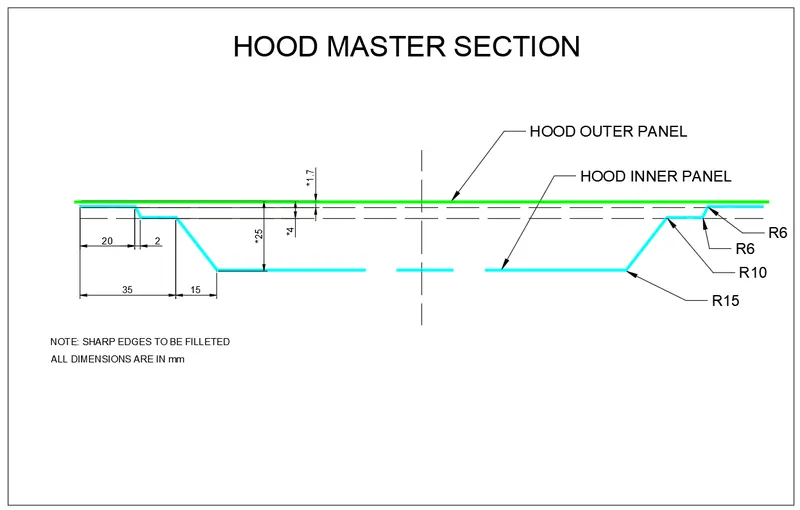
1. Master section creation:
The master section is created based on the requirements received from the marketability team and the manufacturing requirements that we saw before. Below is the image of the master section used for the design.
2.Embosses
Various embosses were made in the hood inner panel by keeping in mind the following design considerations
- Pedestrian safety during the frontal crash.
- To improve the strength and stiffness of the body.
- the embosses were designed in such a way that the distance between the hood inner panel and the outer panel was kept 5 mm from the points it had to be attached to each other.
- Hinge emboss was done keeping in mind the striker and hinge axis correlation.
-
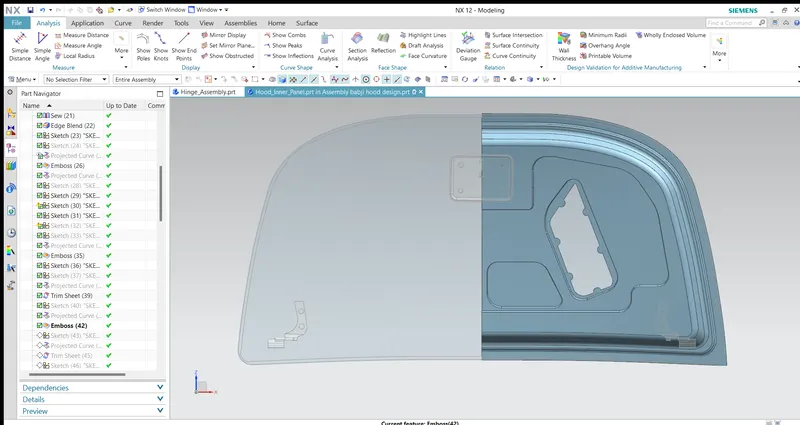
HOW TO CREATE EMBOSS
- use sketch to create a design on the outer panel then use project curve to project that design on the inner panel
- then use emboss comand to create the first emboss.
- then again use sketch to create a design on the 1st emboss then use project curve to project that design on the inner panel .
- then use emboss comand to create the 2nd emboss.
- then use sketch comand to create sketch for mastic data stick then use project curve to project that design on the inner panel .
- use trimm sheet command to get that trimmed region.
3 .Mastic Data
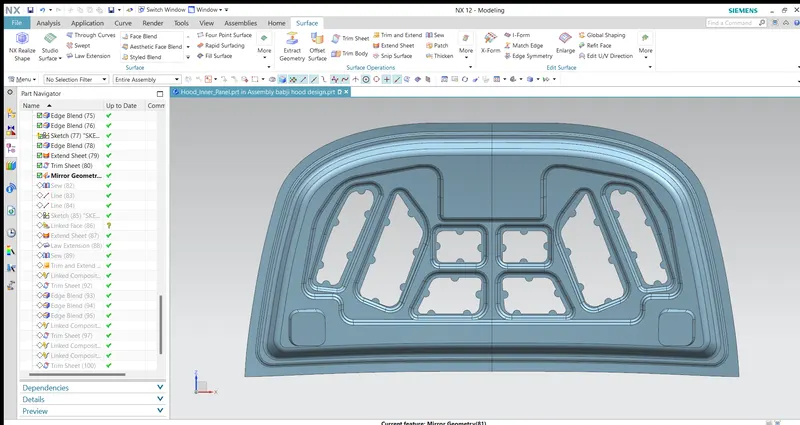
Mastic points are those points of the hood inner panel which are in contact with the hood outer panel with the help of sealants so as to minimise the effect of the vibrations produced by the engine.
- The distance between two mastic points was kept in such a way so as to minimise the vibrational effects
- .
-
-
4. Latch trajectory
-
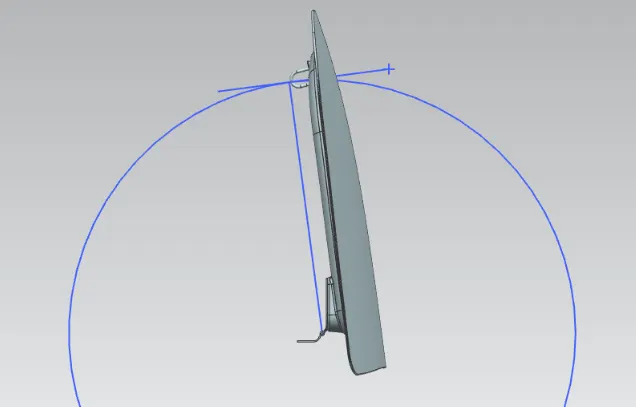
Latch trajectory is given by the circle drawn from the hinge axis point. The hinge axis point is the center point of the hinge axis. First, we can fix either the latch or the hinge. If we have fixed the hinge position then we should plot the Trajectory circle for the latch. For proper mating conditions, the striker axis through the tip of the striker should be tangential to the latch trajectory.
5.Deep Drawing
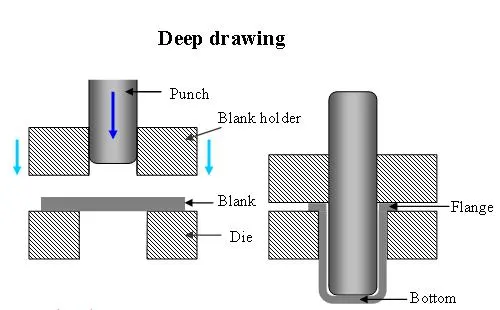
Deep drawing is one of the most widely used processes in sheet metal forming. Apart from its use in many other sectors, it is applied in the automotive industry for the manufacturing of car body parts. The deep drawing process is a forming process which occurs under a combination of tensile and compressive conditions.
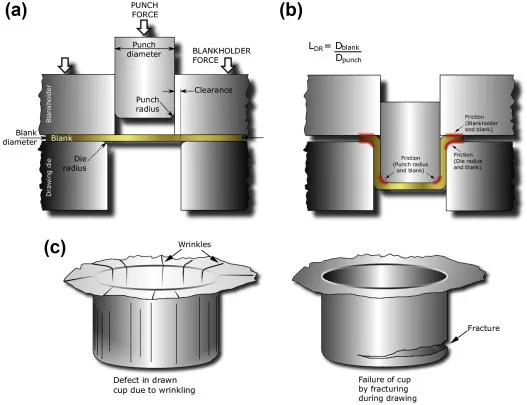
Sheet metal blank is radially drawn into a forming die by the mechanical action of a punch. It is thus a shape transformation process with material retention. The process is considered "deep" drawing when the depth of the drawn part exceeds its diameter. This is achieved by redrawing the part through a series of dies. The flange region (sheet metal in the die shoulder area) experiences a radial drawing stress and a tangential compressive stress due to the material retention property. These compressive stresses (hoop stresses) result in flange wrinkles. Wrinkles can be prevented by using a blank holder, the function of which is to facilitate controlled material flow into the die radius.
6.Hemming
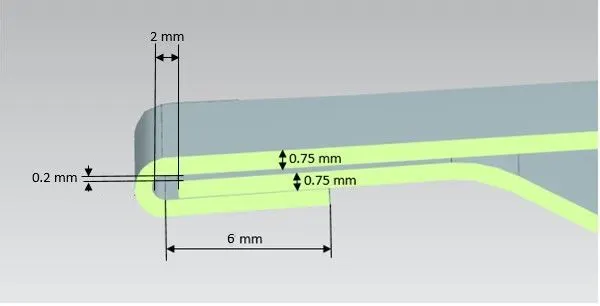
Hemming is the process of joining the hood inner panel and the hood outer panel. Due to the styling finish of the vehicle both the panels cannot be joined using the welded joints so in order to avoid these joints hemming is used.
Roll hemming - In roller hemming process, a robot guides a small roller across the flange to fold a sheet onto itself or onto another sheet. The process is oriented to low volume automotive applications, providing a distinct advantage in manufacturing closures and subassemblies with developed flanges.
6. complete hood
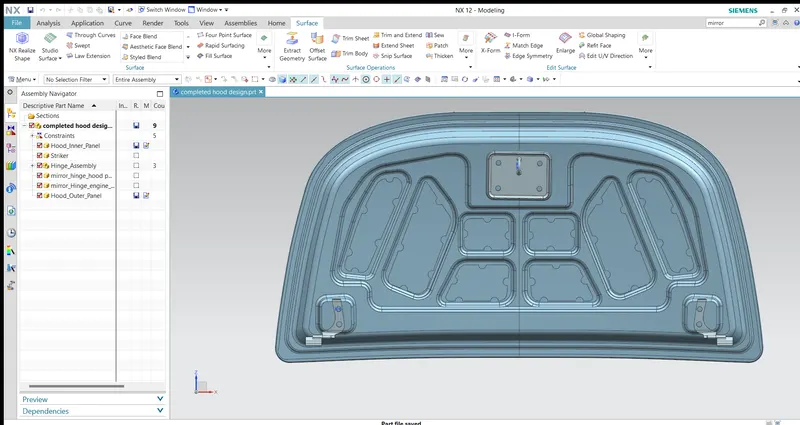
CONCLUSION:The design of reinforcement and hemming of hood using master sketch.
NCAP Crash Test
Euro NCAP, or the European New Car Assessment Programme to give it its full name, is an independent crash-test safety body, which rigorously assesses the safety of cars, and helps to further the advancement of car safety technology. With safety at the forefront of all car makers minds, and many firms and organisations signing up to the ‘Vision Zero’ initiative – which aims to eliminate all deaths and serious injuries from our roads – Euro NCAP’s test programme is an ever-evolving one, with its architects periodically updating crash-test regimes to ensure cars are assessed using the most stringent criteria possible. The current Euro NCAP safety regime includes a dual rating, with cars tested both with and without various high-tech safety features. This means some cars may get five stars if they are configured with autonomous emergency braking, for example, but drop to four stars for the second rating if this feature is not standard.
The European New Car Assessment Programme (Euro NCAP) is a European voluntary car safety performance assessment programme (i.e. a New Car Assessment Program) based in Leuven (Belgium) formed in 1996, with the first results released in February 1997. It was originally started by the Transport Research Laboratory for the UK Department for Transport, but later backed by several European governments, as well as by the European Union. Their slogan is "For Safer Cars".
Pedestrian safety
In Japan and Europe, regulations have come into effect that place a limit on the severity of pedestrian head injury when struck by a motor vehicle. This is leading to more advanced hood designs, as evidenced by multicone hood inner panel designs as found on the Mazda RX-8 and other vehicles. Other changes are being made to use the hood as an active structure and push its surface several centimeters away from the hard motor components during a pedestrian crash.