Section Modulus calculation and optimization
AIM:
Use the Section from Hood design and calculate the section modulus using the formula S =I/y
S = Section Modulus
I = Moment of Inertia
y = distance between the neutral axis and the extreme end of the object
SECTION MODULUS:
The section modulus of the cross-sectional shape is of significant importance in designing of structures. It is a direct measure of the strength of the structure
A structure that has a larger section modulus than another will be stronger and capable of supporting greater loads.
Section modulus (S) = I/y
Where,
I = Moment of inertia in (mm4)
y = Distance between the neutral axis and the extreme end of the object (mm)
MOMENT OF INERTIA:
Moment of inertia is defined as the quantity expressed by the body resisting angular acceleration which is the sum of the product of the mass of every particle with its square of a distance from the axis of rotation
NEUTRAL AXIS:
The neutral axis is an axis in the cross section along which there are no longitudinal stresses or strains. If the section is symmetric, isotropic and is not curved before a bend occurs, then the neutral axis is at the geometric centroid. All fibers on one side of the neutral axis are in a state of tension, while those on the opposite side are in compression.
Now to calculate the section modulus from the hood design:
- Take the intersection curve between inner panel and outer panel.

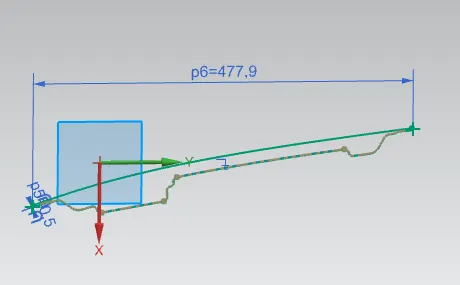
- Convert the 3D sketch into 2D using project command.
- Make some small changes in the sketch.
- Find section modulus using section inertia analysis command.
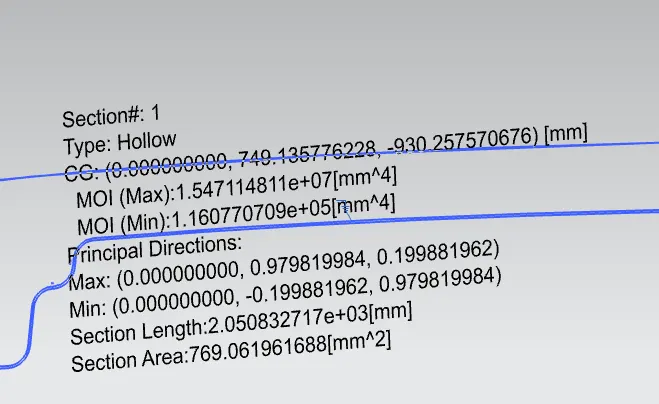
- Distance is
- caculation
- S=I/Y =1.16*10^4/(4779/2)=4.85mm^4
- Then copy the sketch and paste it.
- Again make some small changes in the sketch and find the section modulus .
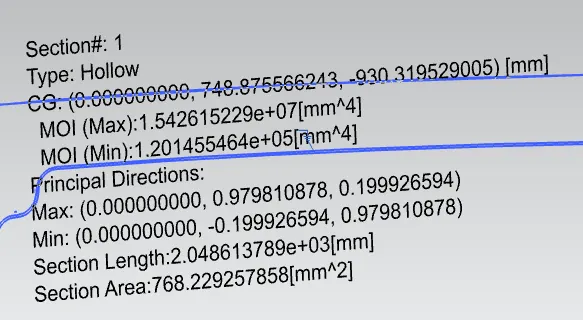
calculation
S=I/Y =1.20*10^4/(4779/2)=5.02mm^4
CONCLUSION:
The section modulus of the section was calculated.
When the depth of the section is increased it is noticed that the section modulus increases.