Section Modulus calculation and optimization
Submitted by: Syed Rizwan Ali
Course: Automotive sheet metal design using Seimens NX Cad
Challenge: Section Modulus calculation and optimization
Study on Section Modulus calculation and optimization-
What is section modulus?
Section modulus: This is a geometric property for a given cross-section used in the design of beams or flexural members. Other geometric properties used in the design include an area for tension and shear, the radius of gyration for compression, and the moment of inertia and polar moment of inertia for stiffness. Any relationship between these properties is highly dependent on the shape in question. Equations for the section moduli of common shapes are given below. There are two types of section moduli,
1. Elastic section modulus
2. Plastic section modulus
The section moduli of different profiles can also be found as numerical values for common profiles in tables listing properties of such.
Use the Section from your Hood design and calculate the section modulus using the formula S = I/y
S = Section Modulus (mm^3)
I = Moment of Inertia (mm^4)
y = distance between the neutral axis and the extreme end of the object (mm)
Come up with a new section that has improved the section modulus of the previous section and mention what change you made that has increased the strength.
Some basic shapes rectangle, circle, cylinder section modulus equations are-
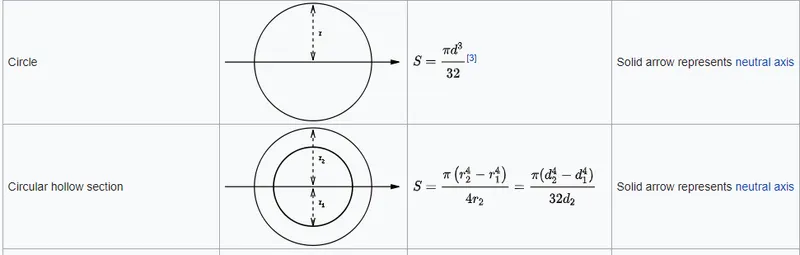
Now studying the change in the value of section modulus if we change the shape and area of a cross-section-
Study 1: Before optimization-
The study element is hood made in the hood design challenge. The curves are taken in using the intersection command in NX cad and with any change find the value of section modulus.
To find the value first we need to create the 2D curves using the intersection command and then project those curves in the sketch.
After the project trim the curve and joined them to get a closed-body curve.
Use a command called section inertia analysis to get the value of the moment of inertia as shown below-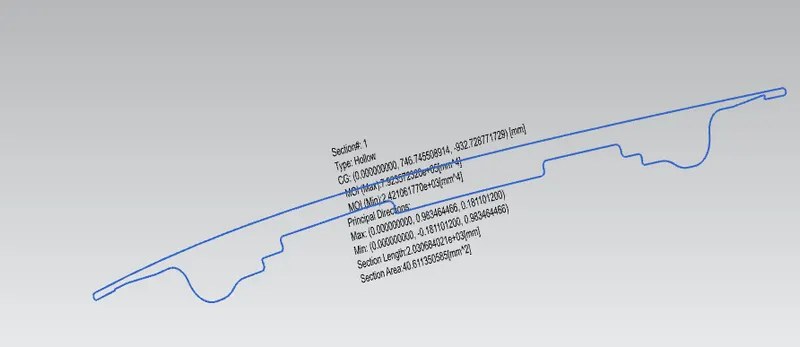
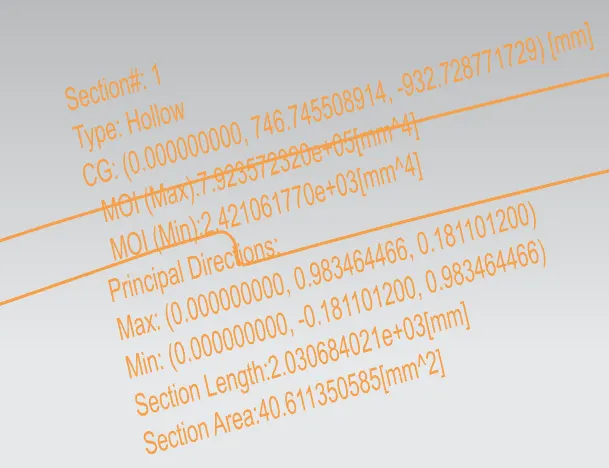
MOI (max) = 7.923572320x10^5 (mm^4)
MOI (min) = 2.421061770x10^3 (mm^4)
As per the section modulus equation,
S = I/Y
I = MOI (min) value is considered
now to find the distance 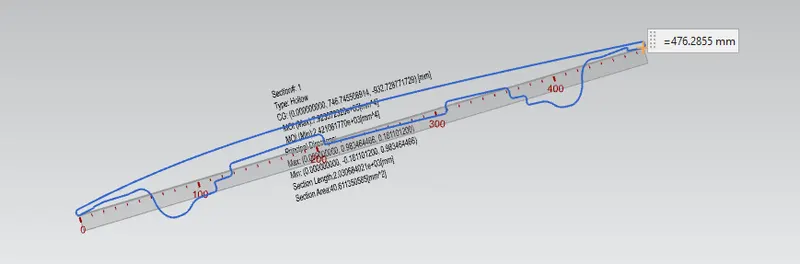
Y = Total distance /2, Total distance =476.2855mm
Y = 476.2855 / 2
= 238.14275 mm
Therefore, S = 2421.061770 mm^4/238.14275 mm
S = 10.1664307 mm^3
Study 2- After optimization
Now, what will happen to the value if there is any changes are made in the geometry of the section?
so offsetting the curve by some mm and measuring the section modulus of the new area.

now finding the value for the new cross-section area
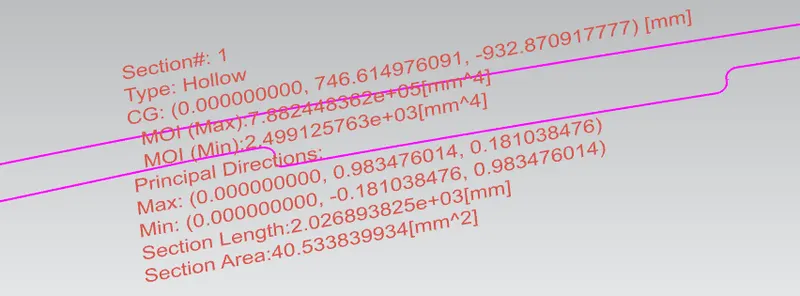
MOI (max) =7.882448362x10^5 (mm^4)
MOI (min) =2.499125763x^10^3 (mm^4)
As per the section modulus equation,
S = I / Y
I = MOI (min) value is considered
now to find the distance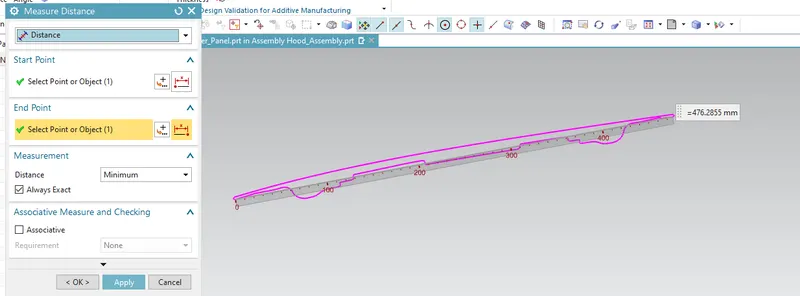
Y = Total distance /2, Total distance =476.2855mm
Y = 476.2855 / 2
= 238.14275 mm
Therefore, S = 2499.125763 mm^4 / 238.14275 mm
S = 10.4942291 mm^3
Conclusion:
Hence when comparing case 1 & case 2,
1. The section modulus value of case 2 is slightly higher than case 1
2. As we increase the section area, the moment of inertia & section modulus increase which means strength and load material also increase.
=============================================================
Thank you