Section Modulus calculation and optimization
SECTION MODULUS OF AN HOOD
- Any sectional area of an object's strength along a reference axis is directly measured by its section modulus (neutral axis).
- Strength is nothing more than the ability to withstand heavier weights, hence an object's strength determines how well it can withstand heavier loads.
- The formula below defines this strength and can be used to measure it directly using the Section Modulus formula.
- Section modulus is denoted by the letter "S."
Using the Section from your Hood design and calculate the Section Modulus using the formula
S = I/y
Where,
S = Section Modulus
I = Moment of Inertia
y = distance between the neutral axis and the extreme end of the object
- Moment of inertia is nothing more than providing resistance to moments, bending, or twisting, i.e., how much resistance the body provides to tend to deform when we apply any external load.
- Therefore, we can state that the moment of inertia is directly proportional to the material's strength, and the material's strength can be calculated with the aid of section modulus. The higher the value of the moment of inertia, the higher the resistance to deform under a certain load.
- Because the neutral axis line lies in the middle of the section and the body's overall strength is reduced when we move the neutral axis to either the positive or negative side, the Y value in this case was inversely proportional to the section modulus.
By using the same principle calculating the strength of a hood panel.
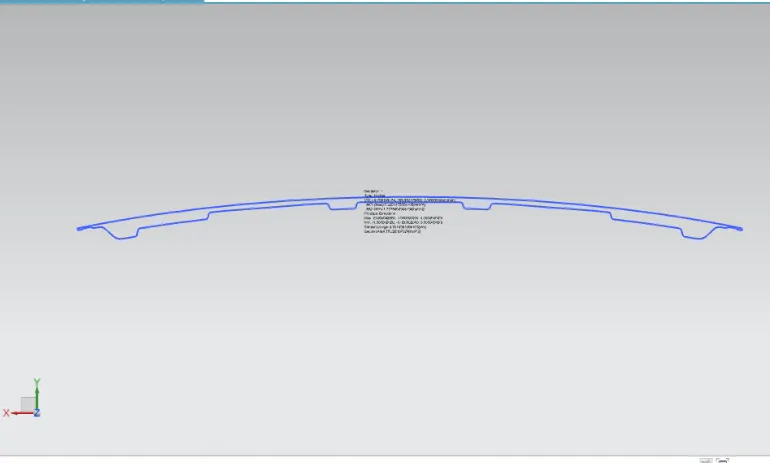
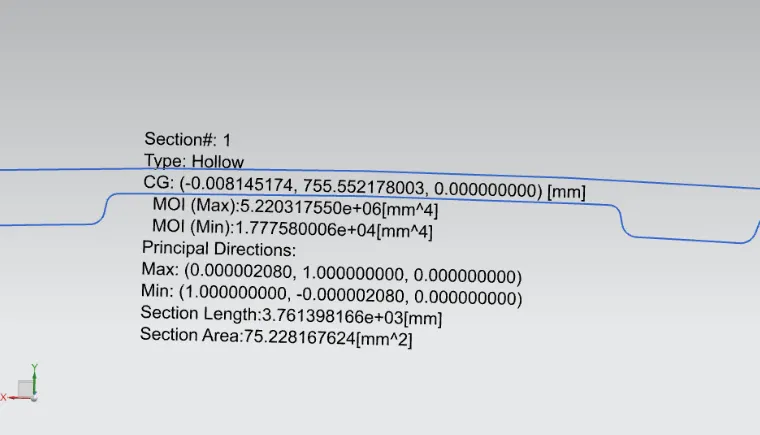
The first case values are
IMAX:5.220X106mm4
Imin:1.777x`10^4`mm4
The total length of the 'Y' value was = 904.5mm
So, at the neutral axis, we need a 'Y' value:-Y/2=904.5/2=452.25mm
1) Section modulus(S):-I/Y=5.220X106mm4/452.25mm
=11.5422886X`10^3`mm3(Maximum strength).
2) Section modulus(S):-I/Y=1.777x`10^4`mm4/452.25mm
=0.0392924x`10^3`mm3(minimum strength).
So the strength of a hood varies from 0.0392924x`10^3`mm3to 11.5422886X`10^3`mm3
Now, in a further experiment, the inner panel curvature was offset from the exterior by 0.5 mm, increasing the cross-sectional area. The findings are displayed below.
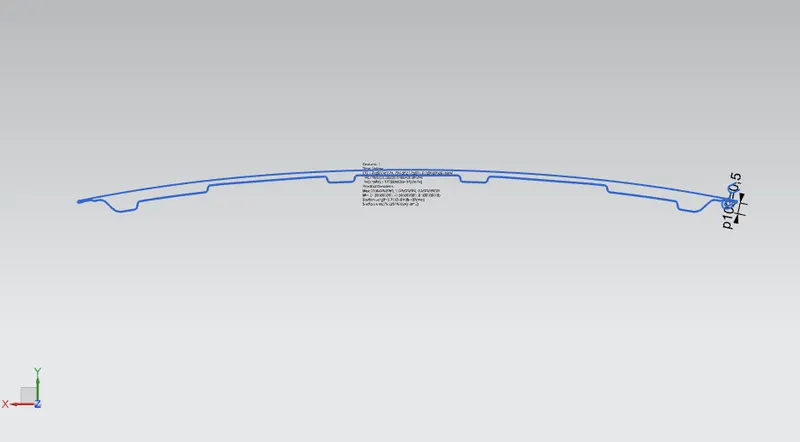
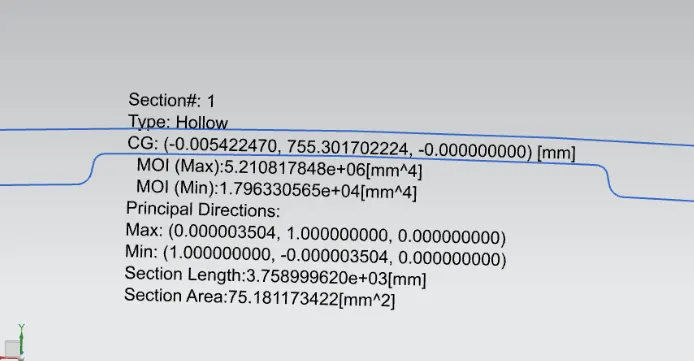
The second case values are
IMAX:5.210181784X106mm4
Imin:1.796330565x104mm4
The total length of the 'Y' value was 904.5mm
So, at the neutral axis, we need a 'Y' value:-Y/2=904.5/2=452.25mm
1)Section modulus(S):-I/Y=5.210X106mm4/452.25mm
=11.5201769X`10^3`mm3(Maximum strength).
2) Section modulus(S):-I/Y=1.796x104mm4/452.25mm
=0.0397125x`10^3`mm3(minimum strength).
So the strength of a hood varies from 0.0397125x`10^3`mm3 to 11.5201769X`10^3`mm3.
- The MAX and MIN strength values have changed when comparing the two hoods, and I discovered that when I increased the cross-sectional area by 1 mm, the minimum strength value increased from 0.0392924x10^3 mm^3 to 0.0397125x10^3 mm^3. This indicates that increasing cross-sectional area results in an increase in strength.
- However, the maximum strength value was slightly lower than expected, going from 11.5422886 x 10^3 mm^3 to 11.5201769x10^3 mm^3. I believe this was a result of the hood's design. In this case, what we are trying to determine is whether an increase in the cross-sectional area will result in an increase in minimum strength and a decrease in maximum strength.
- As a result, Newton's first rule also explains that as an object's mass increases, more effort is needed to move it because it faces more resistance. This resistance is known as a MOMENT OF INERTIA.
- The same idea applies in the case of the hood as well; as we saw from the discussion above, the minimum load-carrying capacity or strength rose by about 8% percentage for every 0.5 mm increase in cross-sectional area.
- The material's composition, thickness, and cross-sectional area of an object are all factors that affect its strength.
CONCLUSION:
The relationship between a material's strength and its moment of inertia is direct; as a result, when a sectional area increases, an object's overall mass increases and its strength does as well.