Section Modulus calculation and optimization
SECTION MODULUS CALCLUATION AND OPTIMIZATION OF HOOD
Objective:
To come up with a new design that has improved section modulus compared to previous one and optimize our design to obtain better results.
Introduction:
Section modulus is a geometric property for a given cross-section used in the design of beams or flexural members. It is the direct measure of the strength of the section. Higher the section modulus of a structure, the more the resistive it becomes to bending.
Though generally section modulus is calculated for the extreme tensile or compressive fibers in a bending beam, often compression is the most critical case due to onset of flexural torsional (F/T) buckling. Generally (except for brittle materials like concrete) tensile extreme fibers have a higher allowable stress or capacity than compressive fibers.
In the case of T-sections if there are tensile fibers at the bottom of the T they may still be more critical than the compressive fibers at the top due to a generally much larger distance from the neutral axis so despite having a higher allowable stress the elastic section modulus is also lower. In this case F/T buckling must still be assessed as the beam length and restraints may result in reduced compressive member bending allowable stress or capacity.
Mathematically,
It is defined as the ratio of the moment of inertia of a section about its centroidal axis and to the distance of the extreme layer from the neutral axis.
It is denoted by S.
S = I/y
Mathematically By bending stress equation,
M/I = σmax/ymax
M = σmax × (I/ymax)
M = σmax × Z
Where,
S= Section modulus
I = Moment of Inertia
y = distance between the neutral axis and the extreme end of the object
SIGNIFICANCE OF SECTION MODULUS:
- The section modulus of the cross-sectional shape is of significant importance in
designing beams. It is a direct measure of the strength of the beam. A beam that has a larger section modulus than another will be stronger and capable of supporting greater loads.
SECTION MODULUS OF HOOD (SECTION# 1):
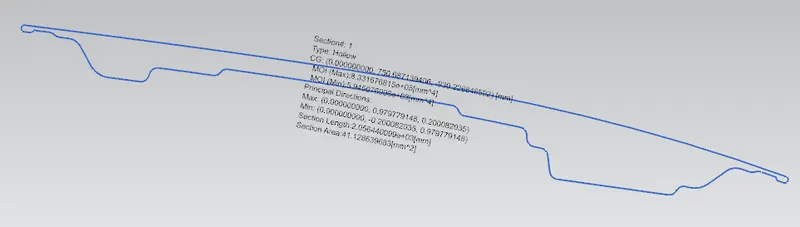
Calculating section modulus of existing design of hood by using NX CAD software by taking cross section of hood along X-X axis for calculating moment of inertia.
Cross Section of Hood:

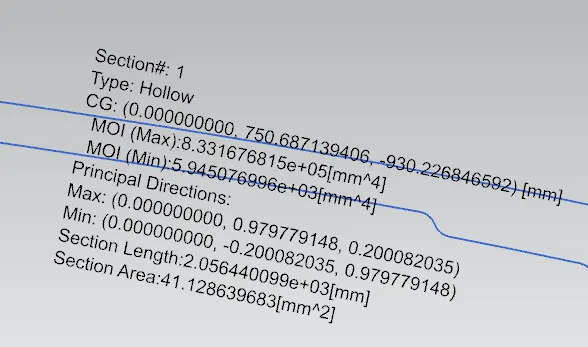
Section Report:
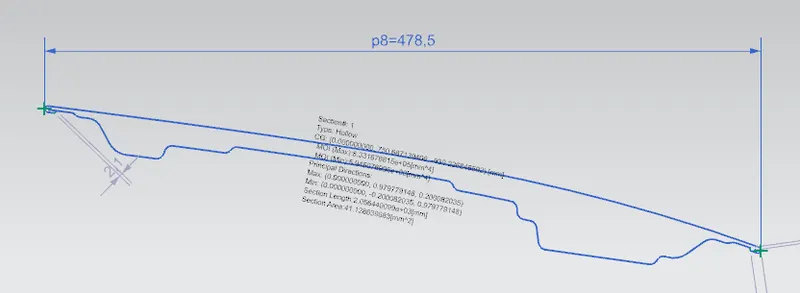
Y Distance of Hood:
Here in the above sectional report we can see that MOI(max) and MOI(min)
So,
Imax = 8.331676815e5 mm4
Imin = 5.945076996e3 mm4
y = 478.5 mm
Zmax = Imax / y
= 8.331676815e5 / 478.5
= 1741.20727586 mm3 .
Zmin = Imin / y
= 5.945076996e3/ 478.5
= 12.4244033354 mm3 .
SECTION MODULUS OF HOOD (SECTION# 2):
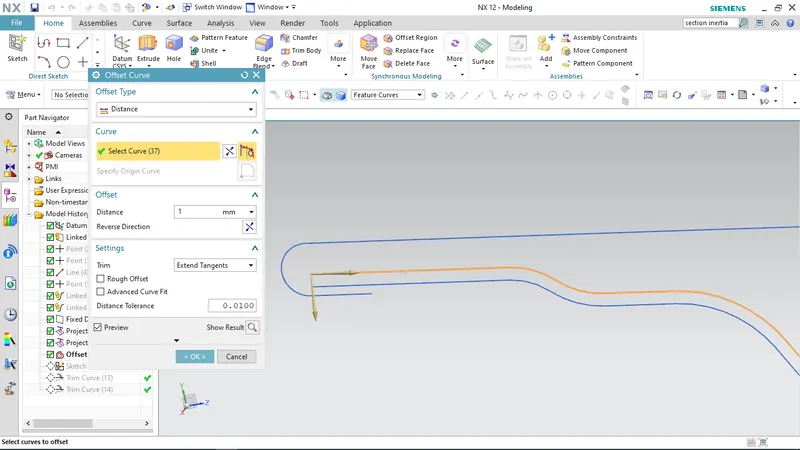
To improve the value of section modulus we need to offset the inner panel by 1 mm to obtain optimized hood design.
The increase the sectional area of hood in the increase in section modulus of hood. If the increase in section modulus the strength of the hood also increase.
CROSS SECTION IMPROVED DESIGN:
Section Report:

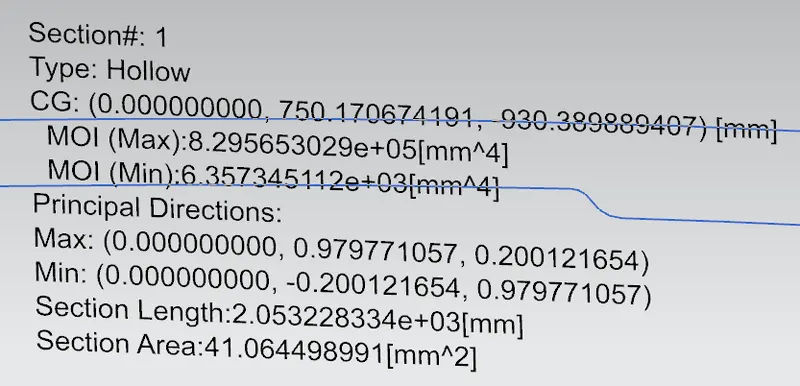
Here above the section report we can that the section modulus has changed by changing the sectional area of the hood by offsetting the hood inner panel by 1 mm.
So,
Imax = 8.295653029e5 mm4
Imin = 6.357345112e3 mm4
y = 478.5 mm
Zmax = Imax / y
= = 8.295653029e5 / 478.5
= 1733.67879394 mm3 .
Zmin = Imin / y
= 6.357345112e3 / 478.5
= 13.2859876949 mm3 .
Hence the section modulus of our hood has been increased as compared with the previous value which is 12.4244033354 mm3 and the new value is 13.2859876949 mm3.
Percent increase in section modulus = 6.93%.
Conclusion:
Therefore the optimized and improved of our hood is obtained by increasing the sectional area as results in increase in section modulus as 6.93%.