Section Modulus calculation and optimization
Explanations:
When designing beams or flexural members, it is a geometric property for a certain cross-section that is taken into consideration. The area for tension and shear, the radius of gyration for compression, the moment of inertia and polar moment of inertia for stiffness, and others geometric parameters are also considered in design.
Section moduli come in two varieties:
- Elastic section modulus
- Plastic section modulus.
Most metals and other popular materials' yield points are covered by the Elastic Section Modulus, which is used for general design. The definition of the elastic section modulus is given as S = I / y, where I is the second moment of area it’s also known as the area moment of inertia and y is the separation between the neutral axis and the elastic section to any given fiber. It is also frequently used to calculate the yield moment (My), where My = S y, where y is the material's yield strength and indicates the highest load that can be placed on a mechanical component without failure. When elastic yielding is acceptable and plastic behavior is thought to be a tolerable limit, the plastic section modulus is employed for the material.
Calculations:
- Section 1:
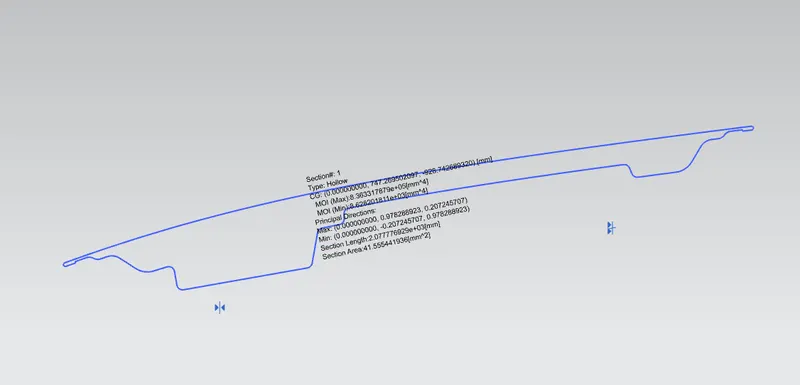
S = I/y
I = 8.628e+03 [mm^4] (As shown in above image)
y = L/2
L = 4752 mm
y = 2376
S = 8.628e+03/2375
S = 0.01113mm^3
- Section 2:
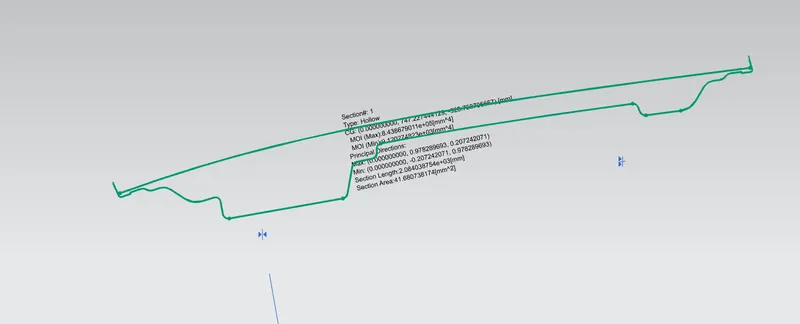
S = I/y
I = 9.120e+03 [mm^4] (As shown in above image)
y = L/2
L = 4805 mm
y = 2402.5
S = 9.120e+03/2402.5
S = 0.01156mm^3
Conslusion :
Therefore by offsetting the hood assembly we were able to obtain the hgher value of the section modulus hence the result is increase in strenght.