Section Modulus calculation and optimization
REPORT ON SECTION MODLUS
OBJECTIVE:
- To Calculate the section modulus for the previously designed hood and optimized hood.
- To Come up with a new section that has improved the section modulus of the previous section.
SECTION MODULUS:
- It is the ratio of the moment of inertia and the distance of the topmost or the bottommost fiber from the neutral axis.
Section Modulus, Z = Iymax
- It represents the strength of the section.
- Greater the value of Z, the greater will be the strength of the section.
- The section modulus depends upon the moment of inertia which again depends not only on the total area of the cross-section but also on the disposition of the area with respect to neutral axis.
Types of Section Modulus
- Elastic Section Modulus
- Plastic Section Modulus
SECTION MODULUS OF VARIOUS SHAPES:
-
TRIANGLUAR SECTION:
Moment of Inertia at neutral axis, IN.A = bh336
-
SQUARE SECTION (Horizontal and Vertical Sides):
Area, A = a2
Moment of Inertia, IN.A = a412
ymax = a2
Section Modulus, ZN.A = a4/12a/2 = a36
-
SQUARE SECTION (Horizontal and Vertical Diagonals):
Area, A = a2
Moment of Inertia, IN.A = a412
ymax = a√2
Section Modulus, ZN.A = a4/12a/√2 = a36√2
- For axial loading, square with horizontal and vertical sides are equally strong.
- For bending stress, square with horizontal and vertical diagonals is stronger than square with horizontal and vertical sides because its section modulus is more.
- A square cross-section with horizontal and vertical sides is 41.4% stronger than square cross-section with horizontal and vertical diagonals.
-
RECTANGULAR SECTION:
Moment of Inertia at neutral axis, IN.A = bd312
ymax = d2
Section Modulus, ZN.A = IN.Aymax = bd3/12d/2 = bd26
-
CIRCULAR SECTION:
Moment of Inertia at neutral axis, IN.A = πd464
ymax = d2
Section Modulus, ZN.A = IN.Aymax = πd4/64d/2 = πd332
Case 1. Default design

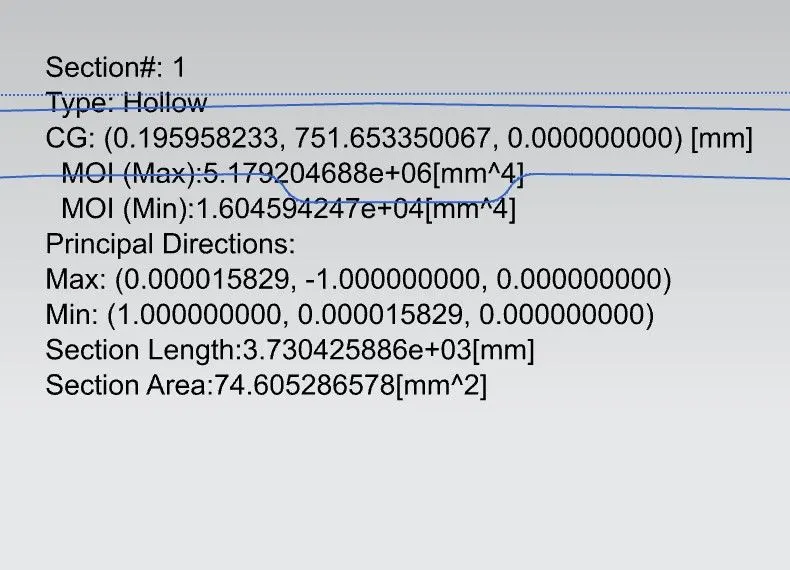
From the above analysis, the following minimum and maximum moment of inertia are obtained :
I(max)=5179204mm^4
I(min)=1604592mm^4

ymax=902.5451/2= 451.2725mm
Section modulus= I/ymax
Z(max) =11476.8mm^3
Z(min)=3555.7mm^3
Case2. Offsetting the width by 0.5mm
What changes I made and Why?
Section Modulus can also be represented as
S = Σ miAi2 / y where A is the area of the section and M is the mass of the body
From the above equation, it can be observed that the section modulus of the body is directly proportional to the sectional area of the body.

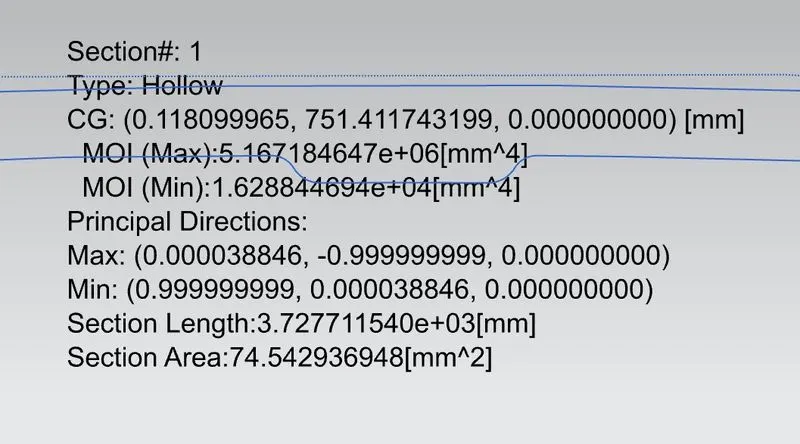
From the above analysis, the following minimum and maximum moment of inertia are obtained :
I(max)=5167184mm^4
I(min)=1628844mm^4
ymax=902.5451/2= 451.2725mm
Section modulus= I/ymax
Z(max) =11450.2mm^3
Z(min)=3609.4mm^3
Case 3. Adding more embosses

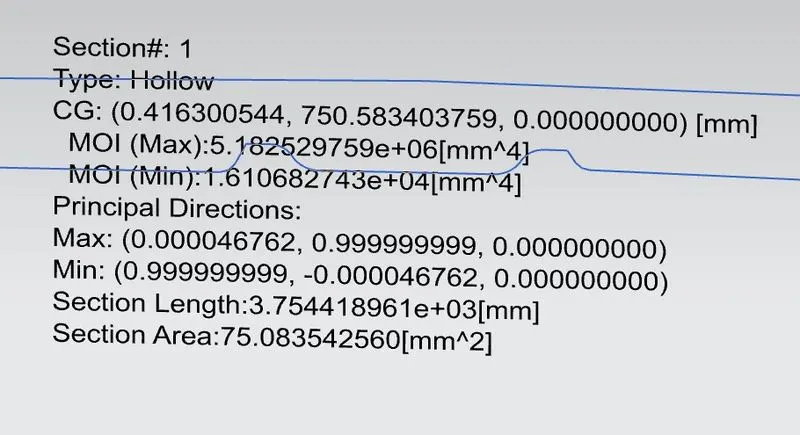
From the above analysis, following minimum and maximum moment of inertia are obtained :
I(max)=5182529mm^4
I(min)=1610682mm^4
ymax=902.5451/2= 451.2725mm
Section modulus= I/ymax
Z(max) =11484.3mm^3
Z(min) =3569.2mm^3
Outcome:
- By comparing the values we can say that the section modulus of the optimized hood (#Design 3) is increased by 1 %.
- MOI increases with the increase of section area.
- MOI increases with the increase of section length.
- If we increase the gap between the inner and outer panel of the hood eventually section length will increase thus MOI will increase.
#Conclusion: Changing the dimension affects the section modulus. wit increasing area, modulus also increases. So for better results more emboss can be good till it doesn't affect the manufacturing cost a lot.