Hood design-Week 2
CAR HOOD DESIGN
AIM:
To design the car hood and understand the mechanism behind the design of the hood, then development& its safety features as per the design consideration.
The following task is performed:
- Design Outer Panel with the Hem
- Develop the Inner Panel
- Develop all the Necessary Reinforcements
- Mirror and position the Hinge & Striker
- Provide Mastic Data
- Provide the required Emboss definition
- Develop a detailed Report for the Mastic position and embosses you have placed.
Master sketch:
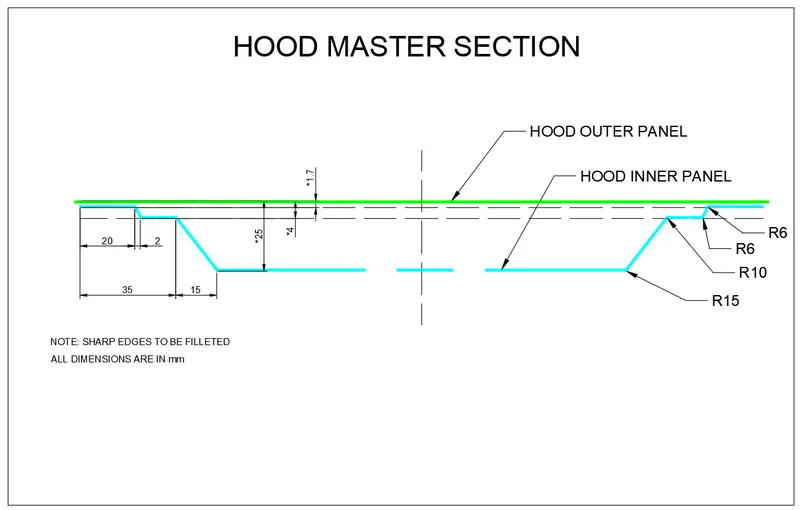
Data to be used:
Hood Thickness Information
- Outer Panel Thickness = 0.75mm
- Inner Panel Thickness = 0.75mm
- Reinforcement Thickness = 1.5mm
INTRODUCTION
The hood or bonnet is the hinged cover over the engine of the vehicle. Hoods can open to allow access to the engine compartment or trunk on rear-engine and some mid-engine vehicles) for maintenance and repair.
A car hood is meant to protect the performance parts of your vehicle, including the engine, while also providing easy access for repairs and maintenance. The hood can incur damage as well. One of the most common types of damage is to the hinge, which is the device that connects the hood to the body of the vehicle. Over time, the hinge can become loose or may fall off completely. The hood is also prone to receiving scratches and dents. Although this might appear to be a minor problem, dents and scratches can lead to depreciation in the value of your vehicle. Scratches and dents can also lead to exposure to the elements that can result in rust and corrosion. This can be a serious problem that can ultimately expose the engine in your car to snow, sunlight, and rain. When this happens, it can impact the performance of your car's engine.
The first important criterion for designing the hood is to set an opening angle till which the hood panel can be opened. This opening angle is different for different countries which largely depends on the average height of a person in that particular country.
TYPES OF HOOD SUPPORT:
There are two types of support is there,
- Gas stay
- Support rod
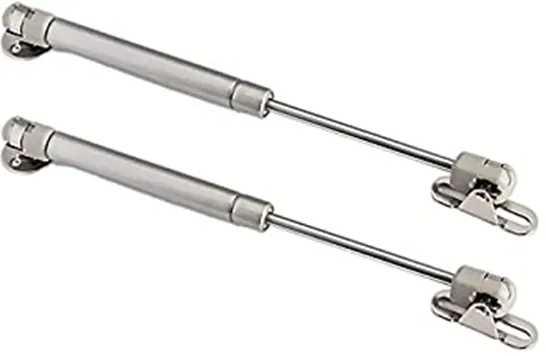
1. Gas stay
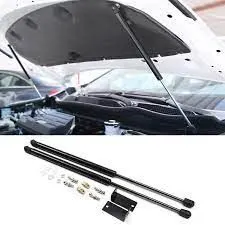
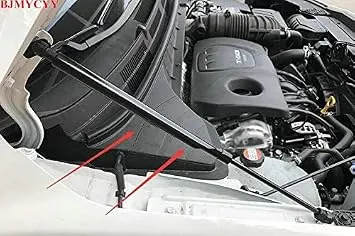
spring stays are designed to be used on upward-lifting doors, once you have opened the door slightly the spring will push the door to the fully open position, Euro fit stock various size springs depending on the door size requirements. This is mostly used where the car bonnet's weight is heavy.
2. Support rod
This is widely used in many cars because this was very easy and cheap. In this type, we have to lift the hood by ourselves and place the support rod in the space provided either in the hood or the engine component. This is mostly used where the car bonnet's weight is small.
It is very important to consider that the support rod should not collide with the engine compartment.
Inner panel:
The inner panel supports the outer panel. It consists of different embosses and holes at different places. Embosses provide stiffness as well as dissipate energy towards hinges. To determine the most effective position of the hole, the method of modal stiffness is employed. The inner panel is offset from the parent work surface. inner panel thickness is 0.75mm.
Emboss
Sheet metal embossing is a stamping process for producing raised or sunken designs or reliefs in sheet metal. This process can be made using matched male and female roller dies, or by passing a sheet or a strip of metal between rolls of the desired pattern. It is often combined with foil stamping to create a shiny, 3D effect.
The metal sheet embossing operation is commonly accomplished with a combination of heat and pressure on the sheet metal, depending on what type of embossing is required. Theoretically, with any of these procedures, the metal thickness is changed in its composition.
The metal sheet is drawn through the male and female roller dies, producing a pattern or design on the metal sheet. Different patterns can be produced on the metal sheet depending on the roller dies used. The pressure and a combination of heat actually "irons" while raising the level of the image higher than the substrate to make it smooth. The term "impressing" refers to an image lowered into the surface of a material, in distinction to an image raised out of the surface of a material.
In most pressure embossing operation machines, the upper roll blocks are stationary, while the bottom roll blocks are movable. The pressure with which the bottom roll is raised is referred to as the tonnage capacity.
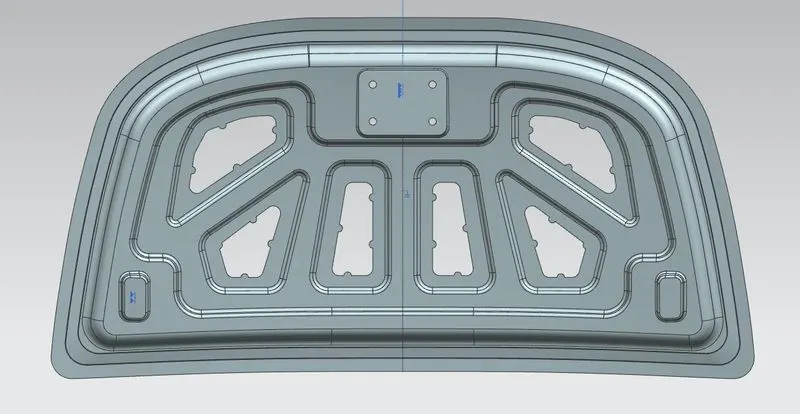
The above image shows the embosses that were designed on the hood inner panel.
The sheet was trimmed in the middle portions of the embosses to improve the strength of the hood inner panel.
To attach the hood inner panel with the hood outer panel mastic sealer will be used, in the automotive industry the most important criterion while making any product is that the aesthetic part of the vehicle which is visible to the naked eye should not have any sort of irregularities of damages, considering this important factor mastic sealer will be used to attach both the panels.
The mastic sealant is dropped through a machine on the mastic points and then the sealant gets spread around 80 mm in diameter when pressed. This way, the outer hood panel is attached to the inner hood panel.
The assembly of the hood's inner and outer panels is shown below:
To provide strength to the inner panel and to distribute the force produced during the impact with pedestrians or other obstacles to ensure the safety of the passengers. The forces are directed outwards through the embossing path.
Mastic Sealant:
The Mastic sealant or the Mastic point is an elastic compound that behaves like a rubber. The mastic points are defined on the hood inner panel where the hood can easily deform. They help the hood's outer panel to come back to its original shape after it gets deformed. The mastic has an influence area of 80mm.
Both are attached with the help of a hemming operation performed on the edges of the hood outer panel.
Hemming:
Hemming is the process of joining both the outer and inner panels together. The hemming process roles and wraps the hood's outer panel around the inner panel and holds it tightly together. The following are the dimensions followed for hemming.
Both are attached with the help of a hemming operation performed on the edges of the hood outer panel.
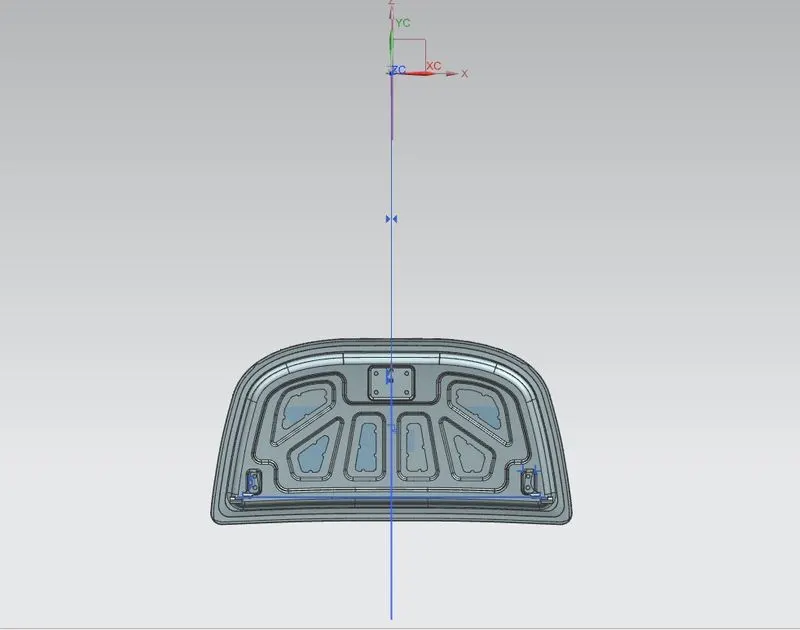
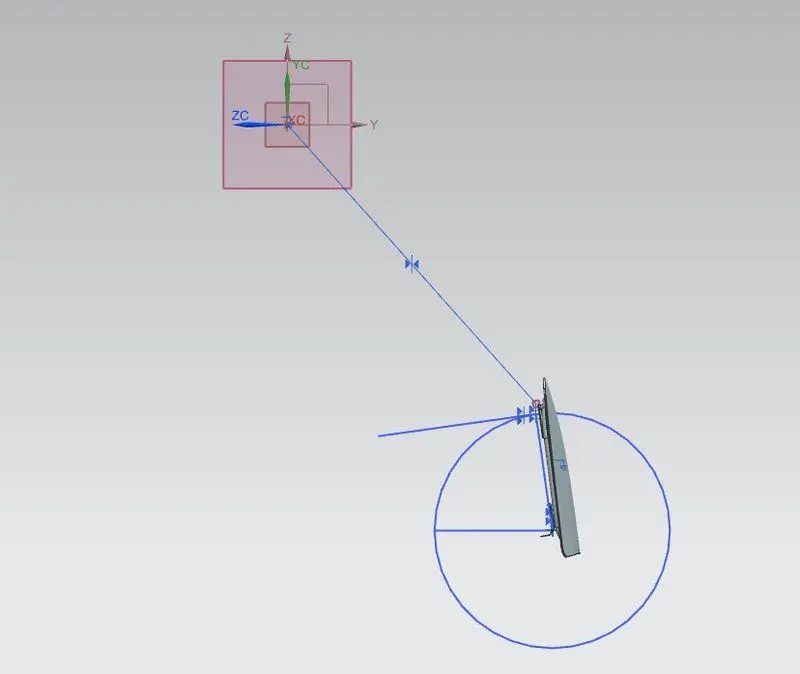
POSITION OF HINGE AND STRIKER:
For positioning the hinge and striker, we have to place the hinge tentatively and take the hinge axis point and place the position from data taken from the parent car or our own. The other major function of the hood is the opening and closing of the hood. This is done with the help of the latch and striker. To position the latch and striker effectively, we position the hinge and draw the hinge axis. Now, using the hinge axis as the center we draw a big circle to the position where we need the latch to be placed. Then, we draw a tangent line to the circle at that point and place the latch in that region.
Building re-enforcements and crash bead:
After the development of the entire inner panel for the hood, we need to develop some additional necessary reinforcements. The Latch striker and the hinges will need a re-enforcement that needs to be developed. All the reinforcements are made from sheet metal of thickness 1.2mm.
The reinforcements are attached to the hood inner panel using the spot welding method. The positions to be spot-welded are provided by the design team.
To provide strength at these places 1.5 mm thickness reinforcements will be placed. Reinforcement will be a metal part spot welded into the embossing of the hinge and the striker. It can't be seen from the outside as it will be welded in the back portion of the hood inner panel.
ASSEMBLED VIEW:
CONCLUSION:
All the parts of the hood are designed based on the required conditions given values and assembled to complete the hood design.
Note: I tried my best knowledge to make the hood accurate and according to the given data but there might be some errors that I can't rectify properly. I hope to get enough support to full fill the demands of the challenges by gaining sufficient knowledge of this software. Thanks for your mentoring.