Section Modulus calculation and optimization
| SECTION MODULUS |
AIM
To Calculate the section modulus of the hood design by using catia v5 and improve the strenght of the hood design.
INTRODUCTION
Section modulus is a geometric property for a given cross-section used in the design of beams or flexural members. Other geometric properties used in design include area for tension and shear, radius of gyration for compression, and moment of inertia and polar moment of inertia for stiffness. Any relationship between these properties is highly dependent on the shape in question. Equations for the section moduli of common shapes are given below. There are two types of section moduli, the elastic section modulus and the plastic section modulus. For general design, the elastic section modulus is used, applying up to the yield point for most metals and other common materials. The elastic section modulus is defined as S = I / y, where I is the second moment of area (or area moment of inertia, not to be confused with moment of inertia) and y is the distance from the neutral axis to any given fibre. It is often reported using y = c, where c is the distance from the neutral axis to the most extreme fibre, as seen in the table below. It is also often used to determine the yield moment (My) such that My = S × σy, where σy is the yield strength of the material.
It gives us and idea about how much of load the given structure can take OR If the section modulus increases the moment of resistance increases and hence its load bearing capacity OR Ratio of total moment resisted by the section to the stress in the extreme fibre.
Formula -
| S=I/Y |
where,
S = Section modulus
I = Moment of Inertia
Y = Distance between the neutral axis and the extreme end of the object.
| SECTION MODULUS PART 1 |
using the 'Measure inertia' tool in Catia, we have to find the minimum & maximum moment of inertias (M1 & M2 respectively). Here M1 denotes the 'I' value in section modulus formula we are going to use.
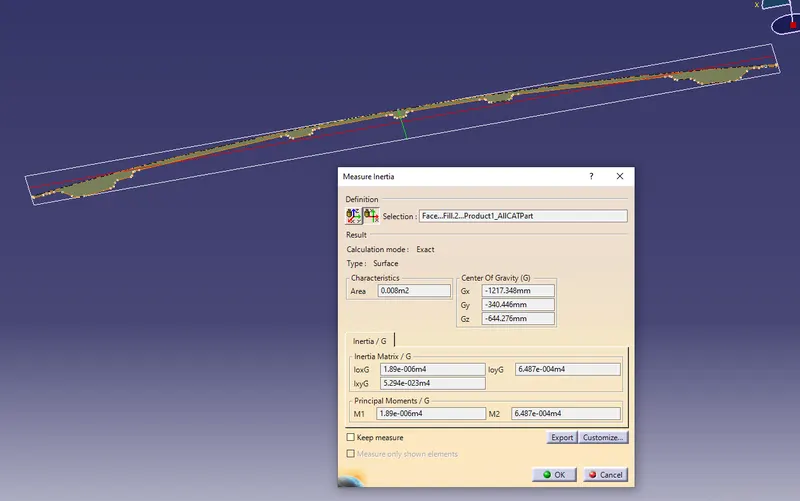
Inertia of part 1
Minimum Value = 1.89e-006 m^4
= 1.89e-006 x 10^12 mm^4
= 1.89e006 mm^4
Maximum Value = 6.487e-004 m^4
= 6.487e-004 x 10^12 mm^4
= 6.487e008 mm^4
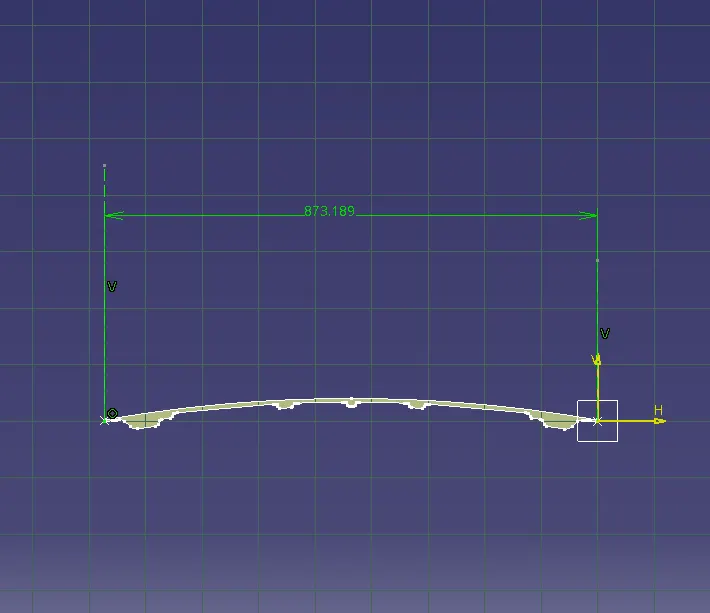
Distance between the neutral axis and the extreme end of the object.
Y = 873.189/2
= 436.5945 mm
Hence section modulus,
S = I/Y
= 1.89e006 / 436.5945
= 4328.9597 mm^3
(Note: 302 stainless steel is an Austenitic, non-magnetic, extremely tough and ductile stainless steel alloy. AISI 302 annealed stainless steel is highly corrosion resistant and maintains its strength at high temperatures up to 550°F (288°C). Additionally, 302 stainless steel is non-magnetic in the annealed condition and cannot be further hardened by heat treatment. As an added benefit both the hardness and tensile strength of AISI 302 can be increased by cold working)
| SECTION MODULUS OF PART 2 BY OFFSECTING 0.5 MM |
Now, in order to improve the strength, I tried changing the distance between inner and outer panel of hood assembly. So, I offsetted the outer contour of inner panel by 0.5mm (outwards).
The result is as shown below.
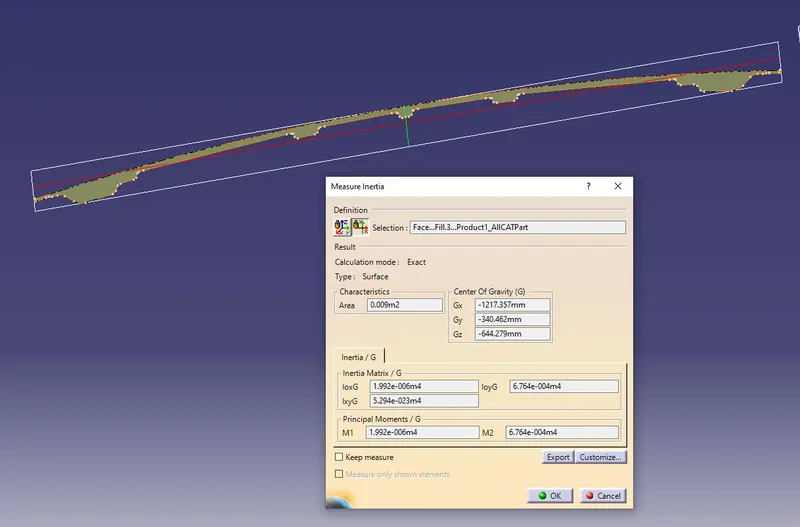
Inertia of part 2
Minimum Value = 1.992e-006 m^4
= 1.992e-006 x 10^12 mm^4
= 1.992e006 mm^4
Maximum Value = 6.764e-004 m^4
= 6.764e-004 x 10^12 mm^4
= 6.764e008 mm^4
Y = Distance between the neutral axis and the extreme end of the object
Y = 873.189/2
= 436.5945 mm
Hence section modulus,
S = I/Y
= 1.992e006 / 436.5945
= 4562.5861 mm^3
CONCLUSION
The section modulus of hood is 4328.9597 mm^3 and by increasing the 0.5mm value it is 4562.5861 mm^3, Hence by increasing the value the section modulus strenght also increases.