Section Modulus calculation and optimization
SECTION MODULUS OF THE HOOD
Objective: To find the section modulus of the hood and optimisation to improve the overall section modulus.
Section Modulus: The section modulus (S) is geometric property of the cross section used for designing beams and flexural members. It does not represent anything physically.
Formula of Section Modulus: It may be defined as the ration of total moment resisted by the section to the stress in the extreme fibre which is equal to yield stress.
There fore
S = I/Y, Where
S = Section modulus (mm^3)
I = Moment of Inertia of the section about the bending axis. (mm^4)
Y = Distance between the neutral axis and extreme end of the object (mm)
Area Moment of Inertia:
The area moment of inertia of a beam cross section area measures the beam ability to resist bending. The larger the moment of inertia less will be the bend.
Where,
M = Bending Moment
I = Area moment of Inertia
E = Young modulus
R = Radius of gyration
Neutral Axis: When beam is subjected to pure bending the top most fibres of the beam are subjected to maximum compression, while the bottom most fibre of the beams are subjected to maximum tension.
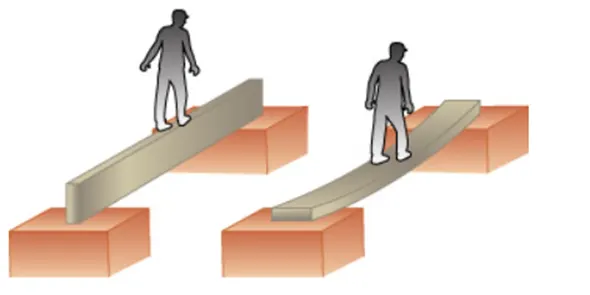
- This picture contains the following scene, Diagram of a beam on its narrow edge supported at both ends. A man is walking on a straight beam. Diagram of a beam resting on its flat side supported at both ends. A man is walking on the straight beam and its bending in the middle.
Use the formula: where b = breadth (width) and d = depth (height) to calculate the moment of inertia about the x-x axis for beams A and B using information from the diagram.
Section modulus is defined as the ratio of polar moment of inertia to the radius of the shaft or the distance from the neutral axis to the outer fibres.
For a beam which has been bent, the maximum stress σmax will occur at the maximum distance ymax from the neutral axis.
Thus:
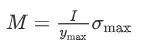
The quantity I/ymax is a purely geometric function and is termed the section modulus Z. Thus we can write:
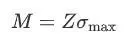
Therefore :
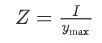
Z = Section modulus.
I = Moment of Inertia.
Ymax = distance between the neutral axis and the extreme end of the object.
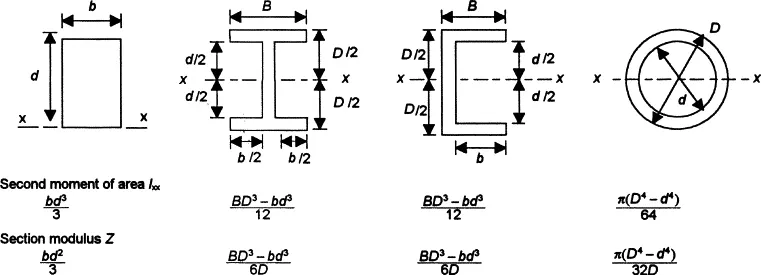
Calculation:
case 1:
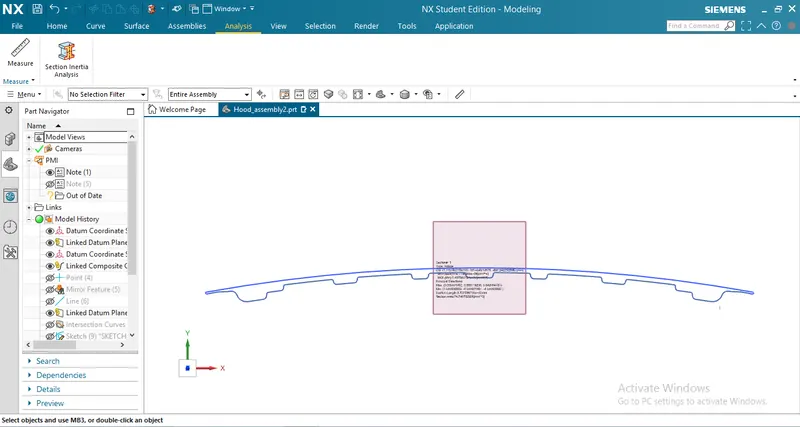
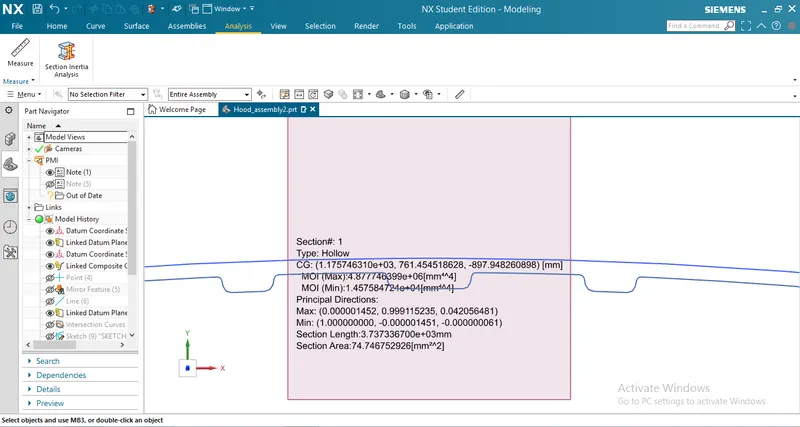
From the above Sectional Analysis the results apperared :
Moment of Inertia (Imin) = 1.457584724×104 mm^4
Moment of Inertia (Imax) = 4.877748399×106 mm^4
The Distance from neutral fibre to extreme fibre is calculated by making two points to the extreme of section and measuring distance between them and half it.
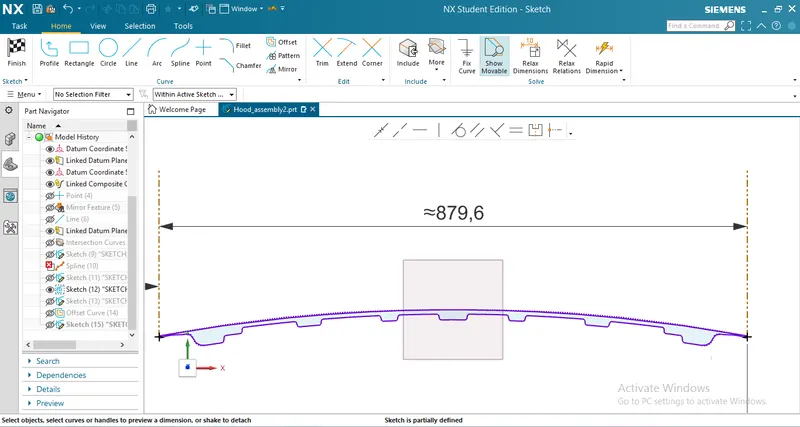
So the distance from neutral fibre is :(Ymax)
Ymax = 879.6/2 mm
Ymax = 439.8 mm
Section modulus :
Z(min) = (1/439.8)*1.457584724×104 mm^4
Z(min) = 0.003314188×104 mm^4
Z(max) = (1/439.8)*4.877748399×106 mm^4
Z(max) = 0.0110908×106 mm^4
case 2:
In 2nd Iteration the inner hood panel is offset to 1mm outside so that the section area will be increased as Sectional Inertia is directly proportional to the sectional modulus the value of sectional modulus will increase.
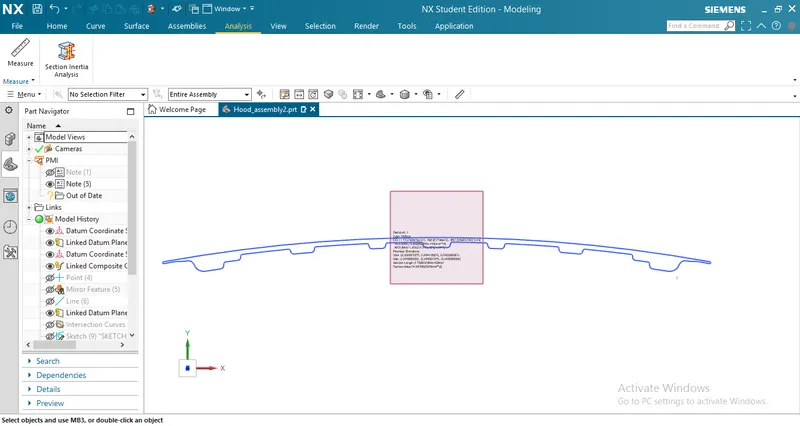
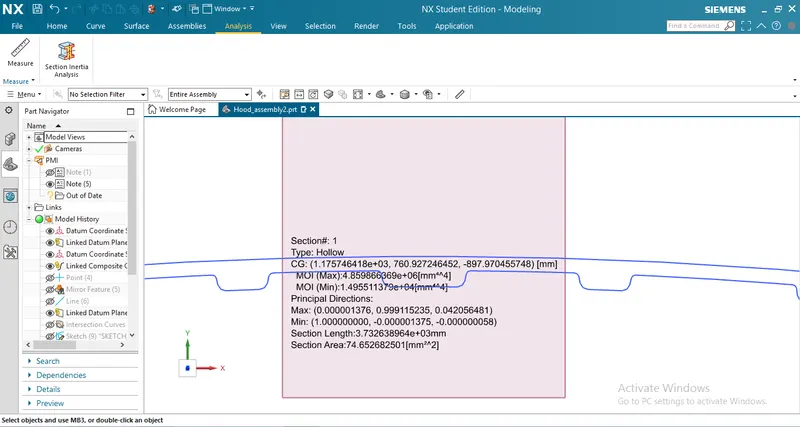
From the above Sectional Analysis the results apperared :
Moment of Inertia (Imin) = 1.495511379×104 mm^4
Moment of Inertia (Imax) = 4.859866369×106 mm^4
The Distance from neutral fibre to extreme fibre is calculated by making two points to the extreme of section and measuring distance between them and half it.
So the distance from neutral fibre is :(Ymax)
Ymax= 879.6/2 mm
Ymax= 439.8 mm
Section modulus :
Z(min) = (1/439.8)*1.495511379×104 mm^4
Z(min) = 0.003400435×104 mm^4
Z(max) = (1/439.8)*4.859866369×106 mm^4
Z(max) = 0.011050×106 mm^4
CONCLUSION :
Therefore the value of section modulus is increased from 0.003314188×104 mm^4 to 0.003400435×104 mm^4 with 1mm offset of the inner panel to outside. By the result of this we can say that increase in the cross sectional area of the section, the minimum load taking capacity of the part will be increased.