Roof Design
ROOF DESIGN
AIM: To design a roof with all the components like front roof rail, rear roof rail, and bow roofs by following the given master sections and the high-quality surface, considering all the design requirements as per the OEM standards.
ROOF
An automobile roof or car top is the portion of an automobile that sits above the passenger compartment, protecting the vehicle occupants from sun, wind, rain, and other external elements. The roof is not a single panel as seen from the exterior it consists of front roof rail, bow roofs, center roof rail, and rear roof rail with different thicknesses which act as a reinforcement for the top.
OBJECTIVE
- To design a roof of the car with all the reinforcement from the given styling surface.
- To perform the curvature study on the roof by considering Heat Distortion and Snow load criteria.
- To calculate the moment of inertia for the reinforcements.
- To Perform the draft analysis for analyzing the components' manufacturing feasibility.
TYPICAL SECTIONS
- Front Roof Rail.
- Rear Roof Rails.
- Center Roof with a reinforcement.
- Bow Roof Rails.
INPUT DATA
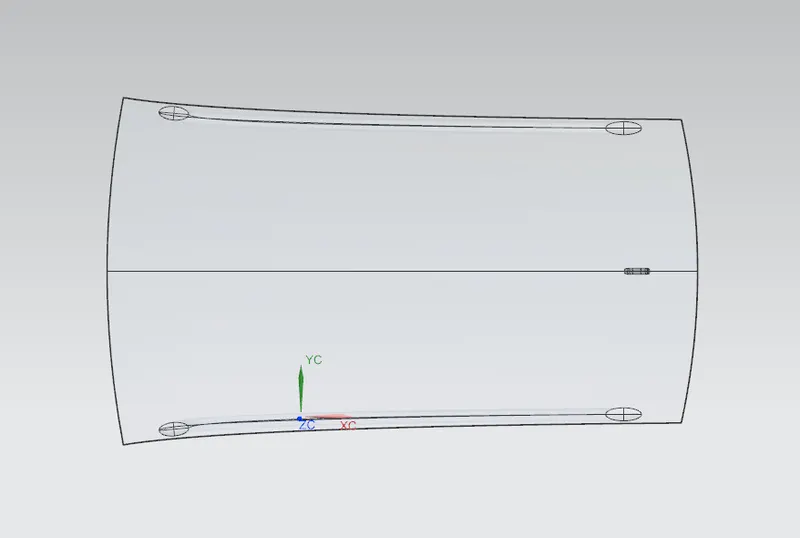
According to the given data,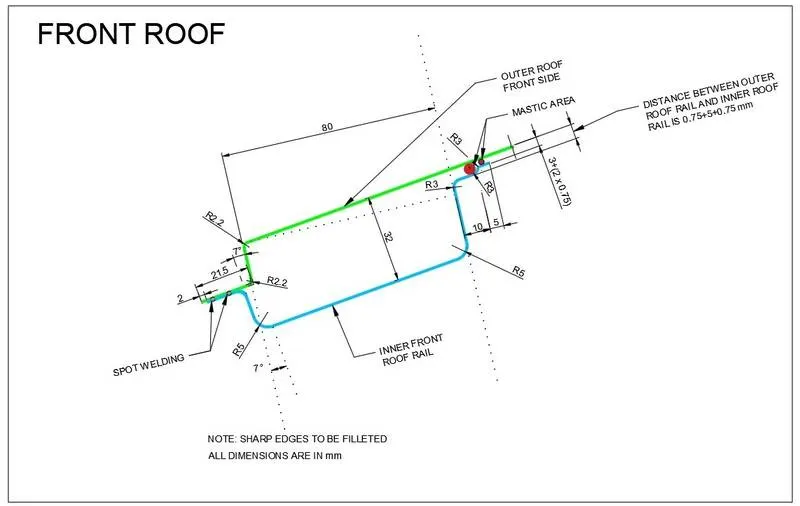
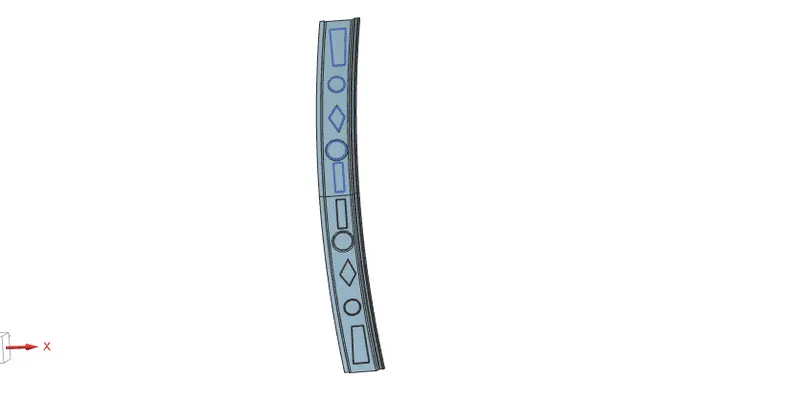
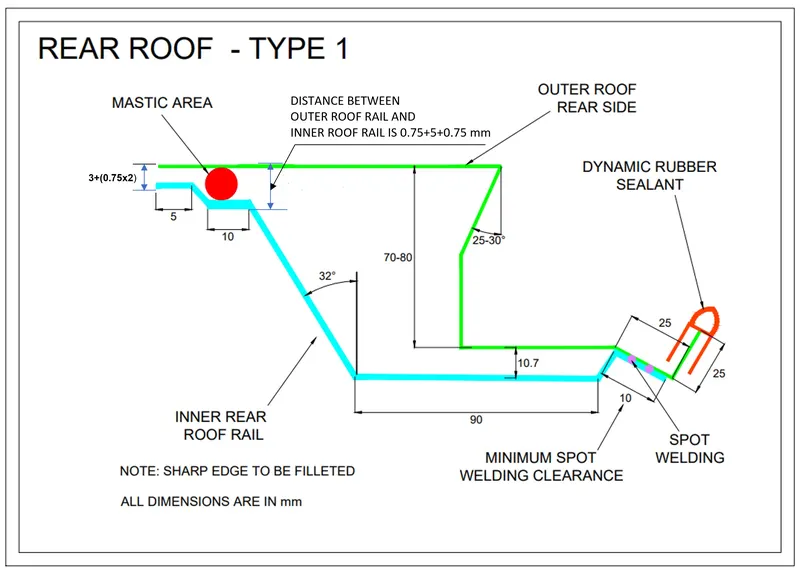
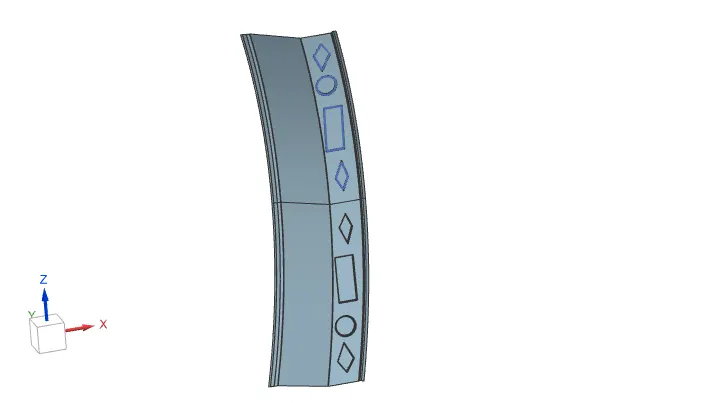
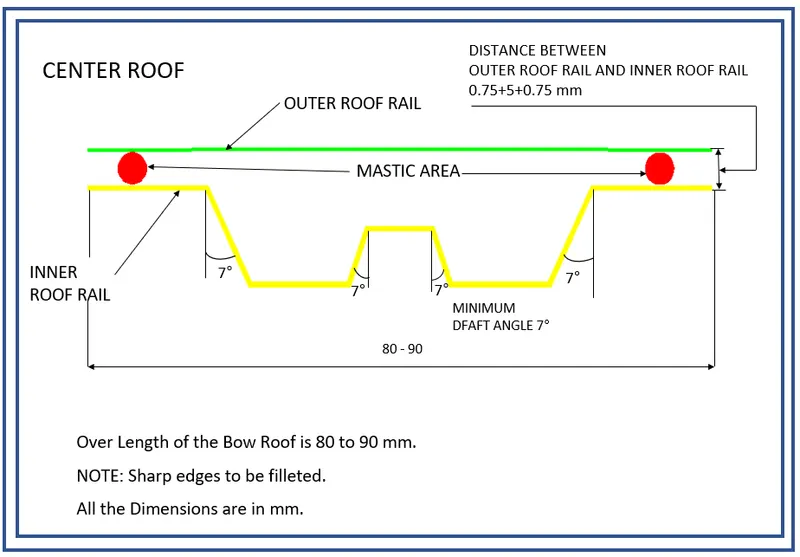
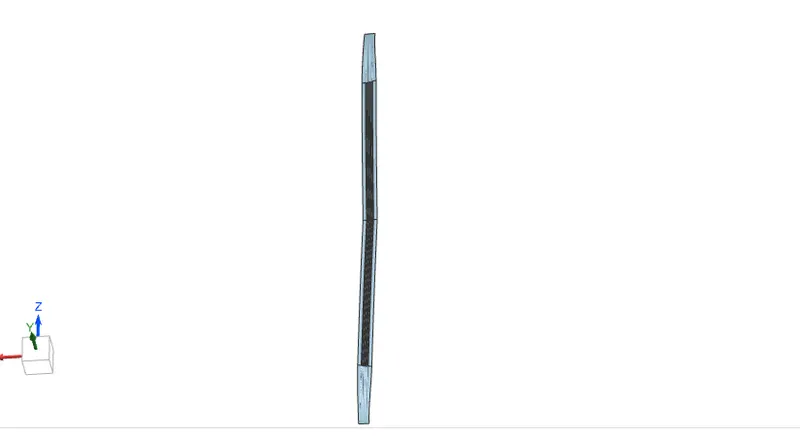
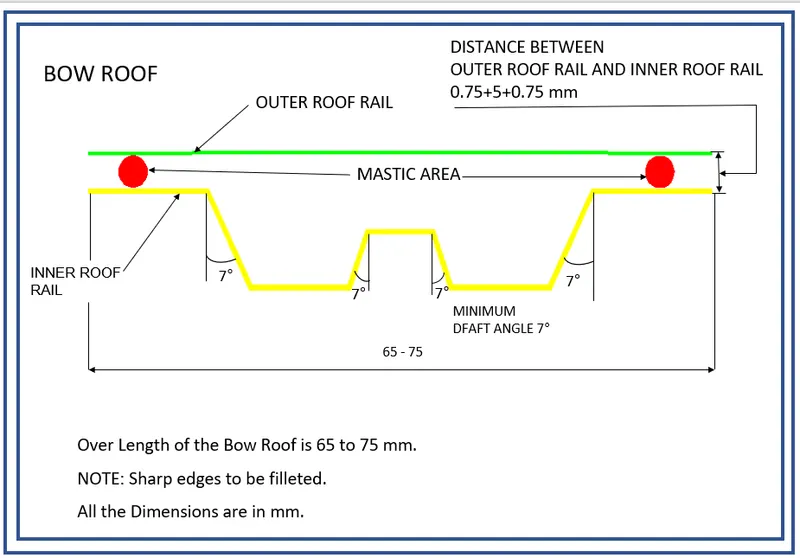
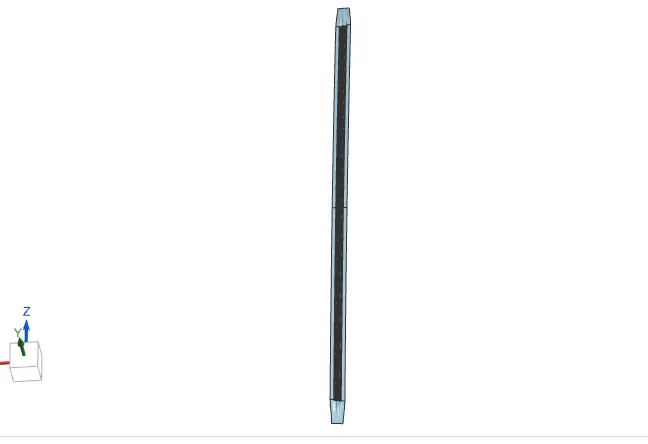
BOW ROOF 2
ASSEMBLY
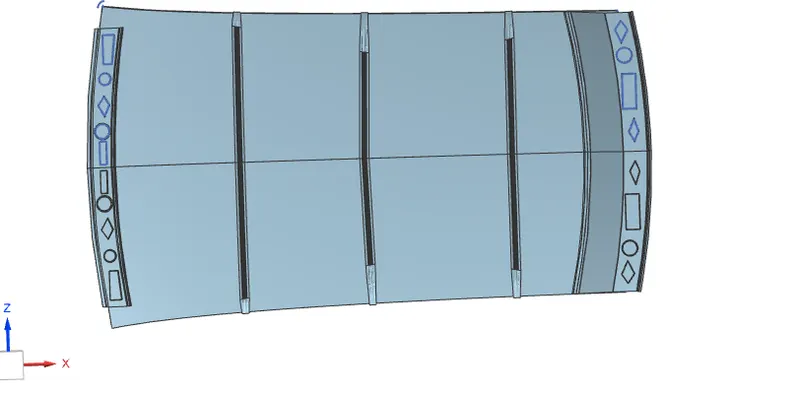
- HEAT DISTORTION CRITERIA
Heat distortion temperature is the temperature at which the metal softens and deforms under a specific load. This study is done to check the ability of the roof to withstand high temperatures concerning the positioning of the reinforcements which contribute to increased strength.
Procedure:
- Create a center line at the 0-Y region of the roof and then offset the same to -3Y.
- Create a symmetric line from the -3Y region at a distance of 100mm.
- Draw a vertical line at the midpoint of the line drawn from the center points of the FRR and BR 1 and followed the same till the rear roof rail.
- Offset the vertical line to a distance of 100mm on each side.
- Create intersection points and project them on the roof.
- From these projected points, make a 3-point arc and the Rx and Ry values.
Formula:
W = [1.73 x 10^(-3) x L] + [1.85 x 10^(-8) x (R^2)/t] + [ 1.10x10^(-3) x l] - 2.68
Where,
L = Roof Length in X-Direction[mm](Roof dimension in 0-Y)
R = Roof curvature
R = 2(Rx*Ry)/(Rx+Ry)
Rx = X curvature
Ry = Y curvature
t = Roof plate thickness [mm]
l = Bow Roof Span [mm]
Judgment Condition
OK< 2.7

From the above results, the positioning of the bow roofs satisfies the condition for Heat Distortion Criteria.
- SNOW LOAD CRITERIA
A snow load study is done to check the ability of the roof to withstand snowfall and bounce back to its original position without undergoing permanent deformation upon the removal of the load.
Procedure:
- Create a center line at the 0-Y region of the roof and then offset the same to 100mm on each side.
- Draw a vertical line at the midpoint of the line drawn from the center points of the FRR and BR 1 and followed the same till the rear roof rail.
- Offset the vertical line to a distance of 100mm on each side.
- Create intersection points and project them on the roof.
- From these projected points, make a 3-point arc and the Rx and Ry values.
- Project the extreme edges of the styling surface fro measuring the width at the respected sections.
Formula:
Qr = [Iy x t2] / [α x s x [(Rx + Ry)/2]2 x 10-8]
Where,
α = My x Lx2 x 10-12 ,
My = Y(Ly-Y)
t = Roof plate thickness [mm]
Ly = Distance between the front and rear roof Rails on the Vehicle along with 0Y[mm]
Lx = Distance between the Left and Right end of the roof on the Roof BOW [mm]
Y = Distance front Front Roof Rail to Roof BOW[mm]
s = Distance for which Roof BOW bears divided load [mm]
s = L1/2 + L2/2
Iy = Geometrical moment of inertia of Roof BOW (Y cross-section )[mm4]
Rx = Lateral direction curvature radius of roof panel Y cross-section on Roof BOW [mm]
Ry = Longitudinal Direction curvature radius of the Roof panel X cross-section on Roof BOW [mm]
Judgment condition
Qr ≥ 3.1
250 ≤ s ≤ 380

CONCLUSION
Thus the roof is designed with all the necessary reinforcements and roof rails according to the given master section and the styling surface, by considering all the design parameters. Also, the curvature study is done by taking the heat distortion and snow load criteria for determining the strength of the roof.