Roof Design
Introduction:
The roof of a car is the portion of an automobile that sits above the entire car body, protecting the vehicle occupants from sun, wind, rain & other external elements. Because the earliest automobiles designed in an era of horse-drawn carriages, early automobile roofs used similar materials & designs.
Objective:
The main objective of this project is to create the roof sheetmetal design, Front roof rail, bow roof rails & rear roof rail & reinforcements to provide strength to the roof.
As it is wide & long & only a thin sheetmetal so it gets easily deform when exerts a load on that. So to avoid that deformation we provide strength to the roof.
Study of Heat distortion & snow load criteria to determine the positions of bow roof rails, In accordance to provide better strength to the roof.
Calcutation of Section modulus "I" for bow roof rails, to calculate heat distortion & snow load test.
Draft analysis for each part to make sure the drawing process carries out efficiently & avoid strucking of parts.
Types of Car Roofs:
There are mainly 3 types of car roofs available in the market.
- Pillarless hardtops:-
The pillarless hardtop car body designed with no center or B-Pillar or glass frames. If window glass frames are present, they are designed to retract with the window when lowered. This creates an impression of uninterrupted glass along the side of the car.
A pillarless hardtop is inherently less rigid than a pillared body, requiring extra underbody strength to prevent shake. Production hardtops commonly share the frame or reinforced body structure of the contemporary convertible model, which is reinforced to compensate for the lack of a fixed roof. The hardtop design received criticism that its roof structure may not provide adequate protection in the event of a rollover crash.
- Detachable hardtops:-
Rigid removable hardtops, many of which can be stored in a car's trunk/boot, have been available at least since the 1950s. These usually provide greater weatherproofing, soundproofing, and durability compared to fabric-based tops; some are available with integrated rear-window defrosters and windscreens. Examples include the Mercedes, Porsche, Jeep Wrangler, Ford Mustang Cobra & Mazda-Mx.
The metal-framed "carson-top" was a popular addition for the 1930s Ford convertibles or roadsters because it turned these models into an almost instant hardtop. The design mimicked a convertible top, but lacking the bulky folding mechanisms enabled the removable hardtop have a much lower and more rakish profile. - Retractable hardtops:-
A retractable hardtop (also known as coupé convertible or coupé cabriolet) is a type of convertible that forgoes a folding textile roof in favor of an automatically operated, multi-part, self-storing roof where the rigid roof sections are opaque, translucent, or independently operable.
Components of a Car Roof:
The Components (reinforcements) of a car roof is to provide strength to the roof. As the roof of a car is a piece of a plain sheet metal so, at the time of accident the roof will easily get crushed. Even if anything dropped off on a roof from above then also the roof of the car will get deformed.
The main purpose of providing reinforcements to the car roof is to eliminate the risk of deaths in an accident by providing better strength. It also eliminates the buckling of sheet metal. These reinforcements are provided on the different regions of the roof to provide proper safety.
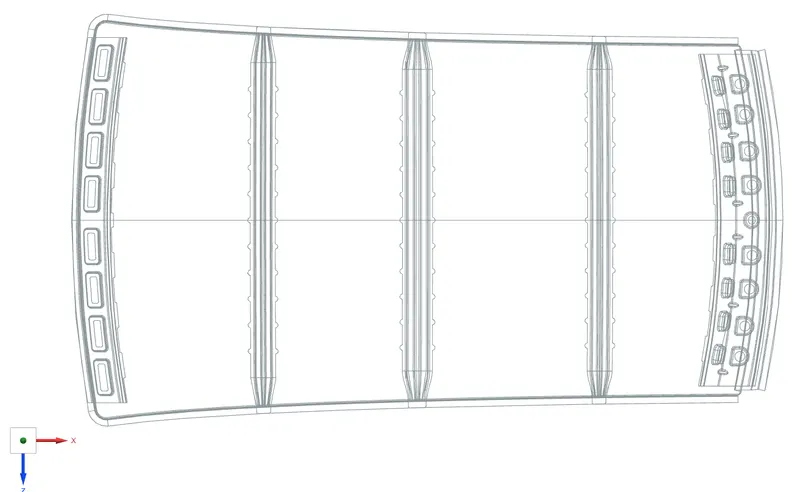
Fig: Car Roof with Front, Centre & bow roof rails
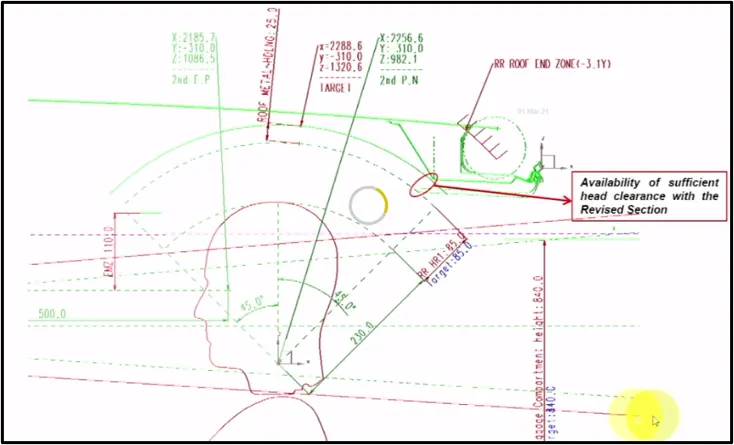
Ditch area:- Ditch area is the extended area of the car outer roof which remain hidden & not direcntly exposed. Windshield, A-pillar, B-pillar, C-pillar will be mounted on the ditch area by spot welding process. Headroom clearance, visibility criteria, clearance for windshield & back door are some of the considerations should be taken while designing the roof.
Why Reinforcements?
If the car roof is flat it is very weak & cannot able to withstand the forces like snow, so in order to increase the strength of the roof these reinforcements like front roof rail, centre roof rail, bow roof rail & rear roof rail are introduced & fixed to the flat surface of the roof with the different joining process.
It consists of following components:-
- Front Roof Rail.
As It's name suggests It is mounted at the front (beneath the styling surface) of the car roof & has a thickness of 0.75mm. Proper draft angle shall be given while designing the front roof rail, It should not got stuck while drawing process. Proper embosses & cutout shall be provide while designing without compromising the strenth of the rail, as it is the reinforcement.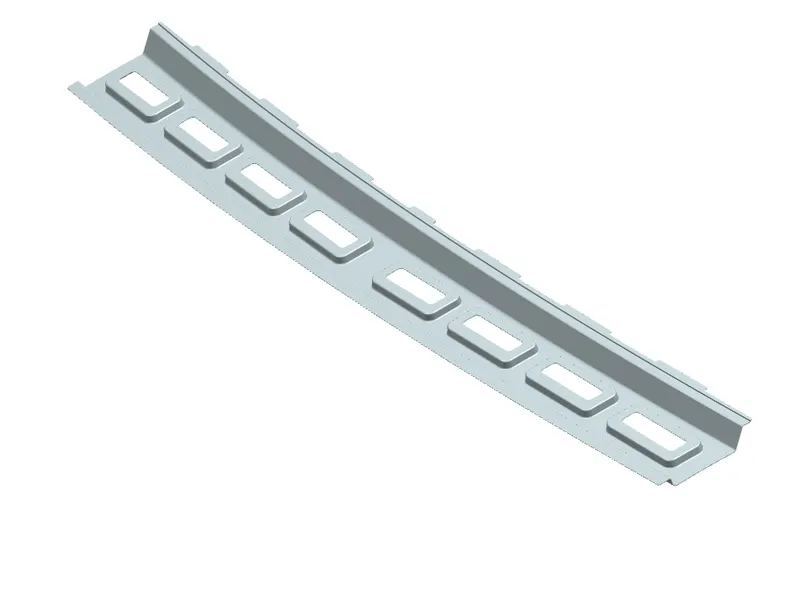
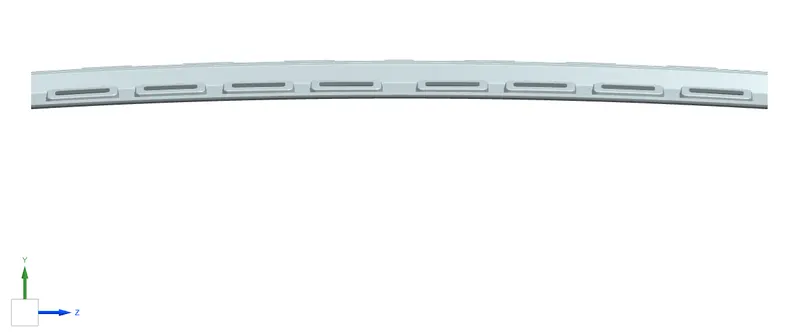
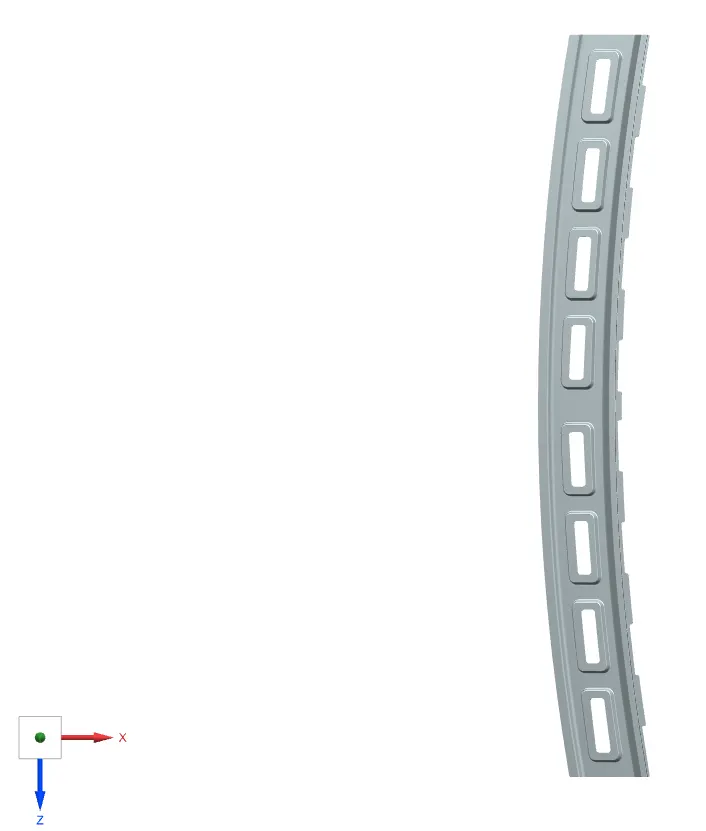
Fig: Front Roof Rail
- Centre Roof Rail.
As It's name suggests It is mounted at the centre (beneath the styling surface) of the car roof & has a thickness of 0.75mm. Proper draft angle shall be given while designing the centre roof rail, It should not got stuck while drawing process. Proper embosses & cutout shall be provide while designing without compromising the strenth of the rail, as it is the reinforcement.
In case of Sun roof & Moon roof the design of centre roof rail is bit different, It has another secondary rail under the primary roof rail. It is fixed with spot welding. it provides more strength to the roof as it has an opening on the roof. The thickness of the centre roof rail is also same as the primary roof rail.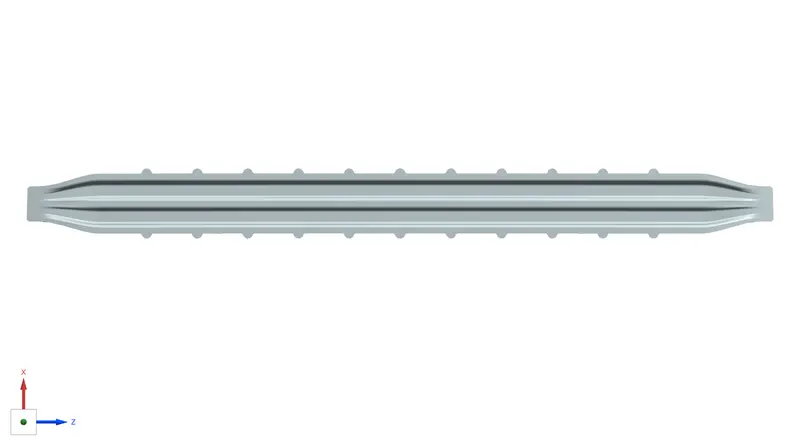
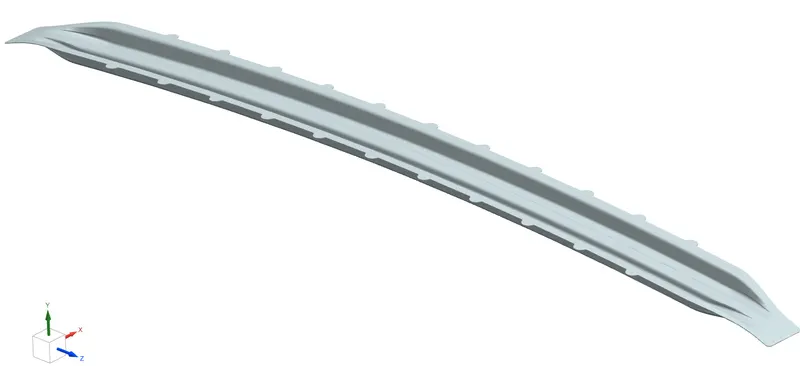
Fig: Centre Roof Rail - Rear Roof Rail.
As It's name suggests It is mounted at the rear (beneath the styling surface) of the car roof & has a thickness of 0.75mm. Proper draft angle shall be given while designing the rear roof rail, It should not got stuck while drawing process. Proper embosses & cutout shall be provide while designing without compromising the strenth of the rail, as it is the reinforcement. Back door & C-pillars are mounted here along with rear roof rail.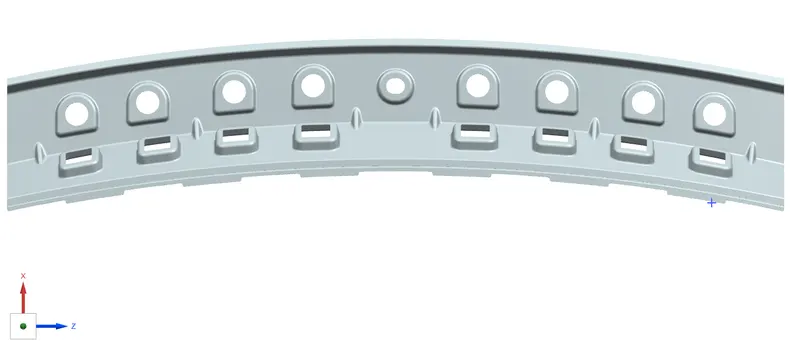
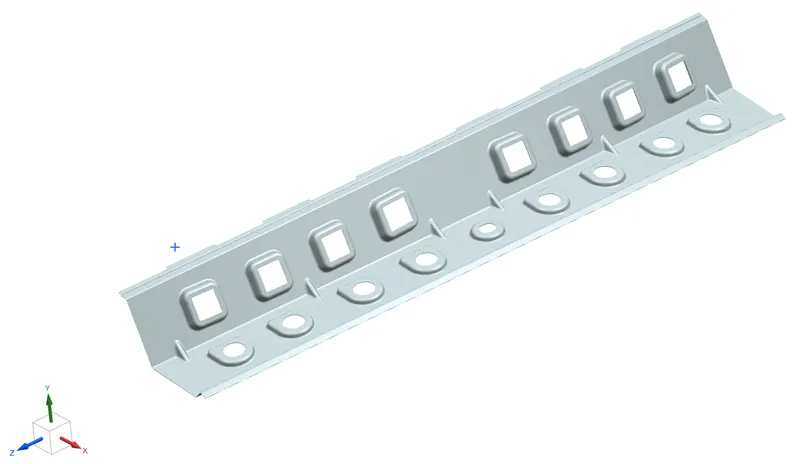
Fig: Rear Roof Rail - Bow Roof Rails.
The bow roofs are give to improve the torsional stiffness and load bearing capacity of the roof structure. The number of bow rails are depends upon the length & width of the car roof. In this case we are going to provide only 2 bow roof rails.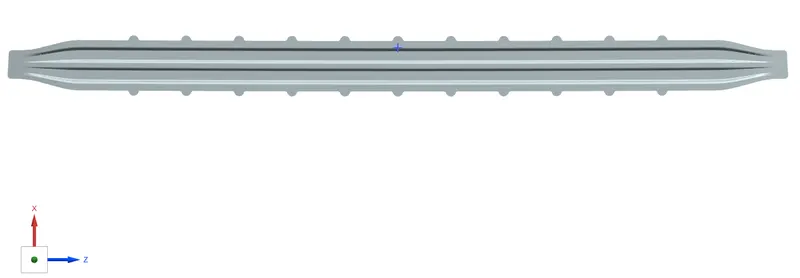
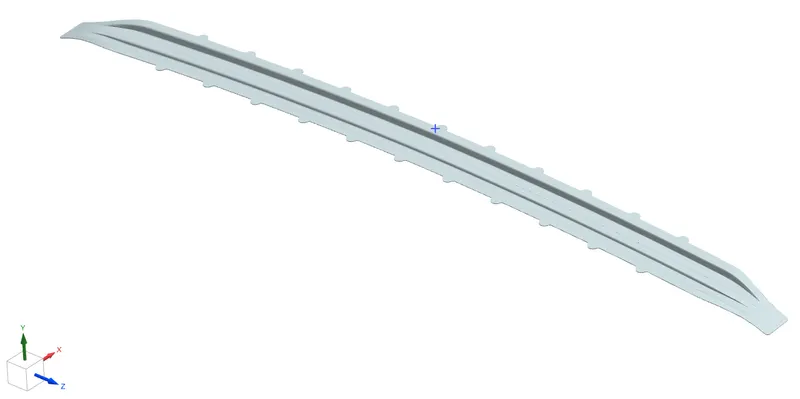
Fig: Bow Roof Rail-1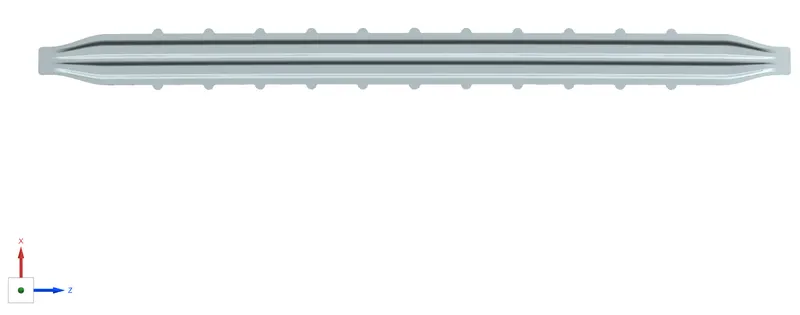
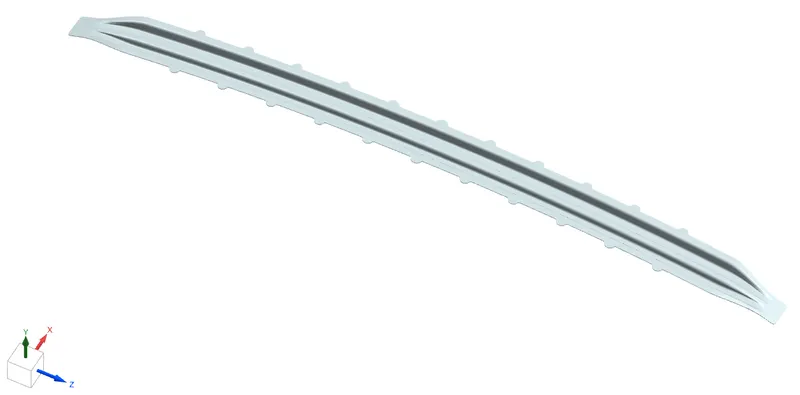
Fig: Bow Roof Rail-2
Design Considerations for Designing a Car Roof:
- Head Clearance & visibility criteria
- Draft analysis or curvature study
Components should be at an desired angle (>7`degree`) to overcome the issue of part stucking in die in drawing process. Draft Analysis is the technique used to analyse weather our designed product are manufacturable with required conditions or not. Below shown images is the Draft analysis of the above designed car Roof.
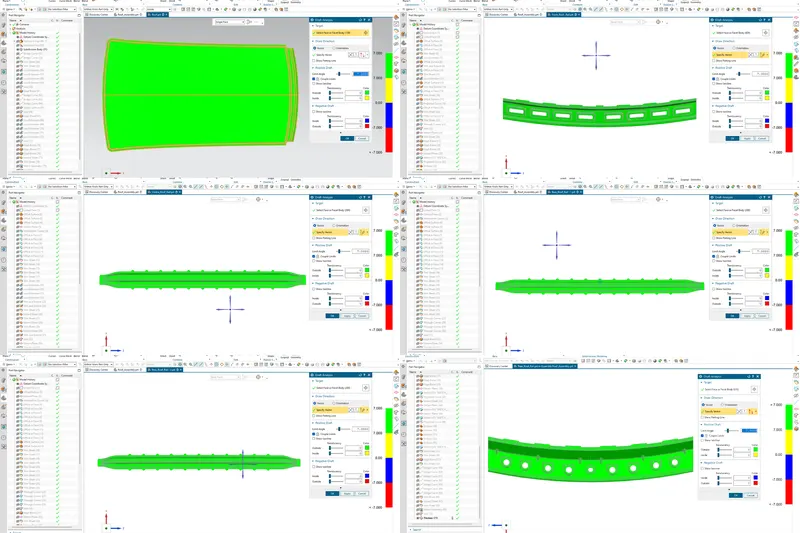
Fig: Draft Analysis of Car roof & Roof rails
- Heat distortion & snow load criteria
The Heat distortion study plays a major role in car roof designing. In this method we calculate the temperature limits of the material (steel), If it can be used or not. This study used to predict the heat distortion temperature at at where the material starts to soften when exposed to a fixed load at high temperature, in order to avoid bending or deforming of the sheet metal. This Study helps to provide enough strength at desired location on the car roof.
Bow roof prediction formula:
W = [1.73 x 10^(-3) x L] + [1.85 x 10^(-8) x (R^2)/t] + [ 1.10x10^(-3) x l] - 2.68
Where,
L = Roof Length in X-Direction[mm](Roof dimension in 0-Y)
R = Roof curvature
R = 2(Rx*Ry)/(Rx+Ry)
Rx = X curvature
Ry = Y curvature
t = Roof plate thickness [mm]
l = Bow Roof Span [mm]
Judgment Condition
OK< 2.7
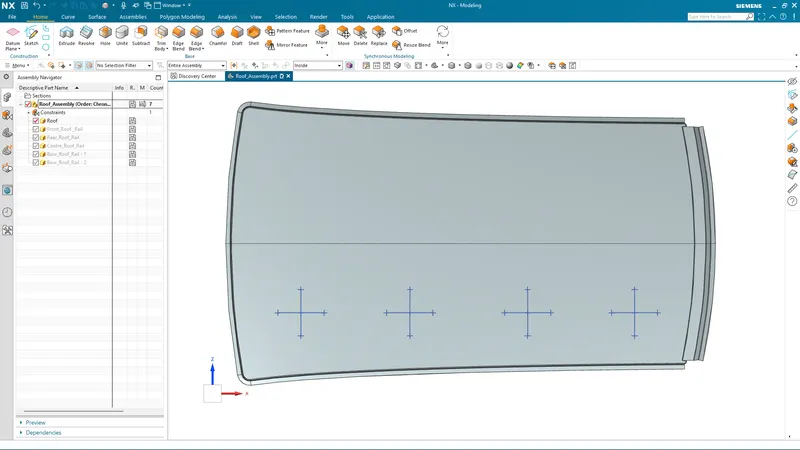
We have prepare the 4 cases on different region of a car roof.
|
Heat Distortion Calculation |
||||||||
| Rx (mm) |
Ry (mm) |
I (mm) |
t |
L (mm) |
R (mm) |
W (mm) |
Result | |
| Case - 1 | 4000.73 | 3289.68 | 404.83 | 0.75 | 2044.6 | 3610.53 | 1.7 | Ok |
| Case - 2 | 3604.46 | 6345.61 | 364.62 | 0.75 | 2044.6 | 4597.46 | 1.8 | Ok |
| Case -3 | 5606.2 | 10706.75 | 448.44 | 0.75 | 2044.6 | 7359.08 | 2.6 | Ok |
| Case - 4 | 3257.44 | 7004.66 | 299.77 | 0.75 | 2044.6 | 4446.9 | 1.6 | Ok |
Conclusion:- From above table we conclude that the values satisfying the heat distortion criteria & is passed in this situation. The position of the bow roofs are also satisfied. Value of W<2.7 & W>3.1.
Snow load prediction formula:
Qr = [Iy x t2] / [α x s x [(Rx + Ry)/2]2 x 10-8]
Where,
α = My x Lx2 x 10-12 , My = Y(Ly-Y)
t = Roof plate thickness [mm]
Ly = Distance between the front and rear roof Rails on the Vehicle along with 0Y[mm]
Length of Roof panel with the center point between Roof rail Front /Rear as the front and rear reference point.
Lx = Distance between the Left and Right end of the roof on the Roof BOW [mm]
The width of the roof panel is exposed on the surface.
Y = Distance front Front Roof Rail to Roof BOW[mm]
s = Distance for which Roof BOW bears divided load [mm]
s = L1/2 + L2/2
Iy = Geometrical moment of inertia of Roof BOW (Y cross-section )[mm4]
Rx = Lateral direction curvature radius of roof panel Y cross-section on Roof BOW [mm]
Roof panel curvature Radius of the Length Lx in Front view
Ry = Longitudinal Direction curvature radius of the Roof panel X cross-section on Roof BOW [mm]
Roof panel X curvature radius of length s in Side view
Judgment condition
Qr ≥ 3.1
250 ≤ s ≤ 380
| Snow Load Prediction Calculation | ||||||||||||||
| Rx (mm) |
Ry (mm) |
Lx (mm) |
Ly (mm) |
Y (mm) |
L1 (mm) |
L2 (mm) |
My | α (alpha) |
s | Ly (mm) |
t (mm) |
QR | Result | |
| Case -1 | 2665.04 | 2639.96 | 1132.2 | 1967.4 | 495.2 | 495.2 | 461.7 | 729033.44 | 0.93 | 478.45 | 1.42 | 0.75 | 0.02 | Fail |
| Case - 2 | 2939.93 | 4255.66 | 1082.5 | 1967.4 | 956.9 | 461.7 | 545.6 | 966947.45 | 1.13 | 503.65 | 6.82 | 0.75 | 0.05 | Fail |
| Case - 3 | 6318.62 | 4188.81 | 1054.8 | 1967.4 | 1502.5 | 545.6 | 418.3 | 698512.25 | 0.77 | 481.95 | 3.42 | 0.75 | 0.01 | Fail |
Conlusion:- From above table the values does not meet the desired criteria for the snow load prediction test & will fail to withstand the weather conditions. In this condition we have to provide the required embosses to meet the desired Conditions.
Roof Crush test:
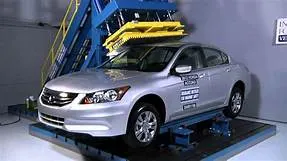
The IIHS makes use of a roof crush test, whereby a machine pushes an angled metal plate down on one side of the roof. The peak force applied by the machine before the roof is crushed by 5 inches (13 cm) is determined, and compared to the vehicle’s weight to determine the roof strength-to-weight ratio.
Purpose:
The purpose of the Roof Crush Resistance Testing standard is to reduce deaths and injuries due to the crushing of vehicle roofs into the occupant compartment in rollover crashes.
Who conducts car roof crush test?
Vehicle manufacturers can validate CAE crush predictions with a physical roof crush test during the development stage of a program, prior to committing to production tooling and manufacturing processes. Vehicle Certification Agency (VCA) witnessed roof crush tests can also be conducted on production intent vehicles at Millbrook.
Procedure:
- To perform a roof crush test, the vehicle or body-in-white is mounted on the rig bedplate, supported along the sills and chassis frame.
- The loading platen, held at the regulation requirement angles, is lowered onto the roof structure.
- It is then loaded to the specified force based on the unloaded mass of the vehicle.
- Video recordings from inside and outside of the vehicle are made during the roof crush test, for post-test analysis of the roof structure performance.
- Post-test investigation of the vehicle structural performance is conducted with, or on behalf of, the customer and is supported with photographs.
Result:
If the displacements goes above the requirement level then we have to increase the bow roof thickness or add more mastic points to increase the strength of the car roof. The stronger the roof the better it can protect the occupants in the roll over crashes.
Conclusion for this project:
- Design & calculation of the Car roof reinforcements which Includes-
Ditch area.
Outer roof rear portion.
Front roof rail.
Bow roofs (x2).
Centre roof rail. - Providing sufficient mastic areas on desired surfaces.
- Keep in mind the limitations of designing reinforcements.
- Provide good draft angles & fillets.
- Calculation of heat distortion & snow load prediction.
Software used NX CAD