Roof Design
Submitted by: Syed Rizwan Ali
course: Automotive sheet metal design using Seimens NX cad
Challenge: Roof Design
AIM:
1. Main objective of the project is to create the Roof sheet metal design in NX cad, and also design the reinforcements-
Front roof rail
Rear roof rail
Bow roof front
Bow roof rear, and
Center roof rails to make a strong roof.
2. Do a curvature study on the Roof and performance calculations for Heat distortion and Snow load criteria to determine the position of the Bow roofs.
3. Finding the moment of inertia and section modulus for Bow-roofs and center roof rail.
4. And, also finding the Draft Analysis of each part.
INTRODUCTION:
What is the Roof of a Car?
An automobile roof or car top is the portion of an automobile that sits above the passenger compartment, protecting the vehicle occupants from sun, wind, rain, and other external elements.
When it is seen from the outside of the car, it is just closing the top portion. But from a design point of view, it is hard to create the design. Because you have to create no support rails for enough strength to withstand the load. Bow roofs are primarily fixed in flatter regions to enhance strength.
The front roof and rear roof rails are fixed to the ditch area using spot weld operation. But the front, rear bow roof, and center roof rails are fixed to the roof using mastic sealants. We don’t want so much gap between the roof rails and the bow roof area. So, we reducing the NVH issues.
Need of Reinforcement in Roof-
If the roof is flat it is very weak and cannot able to withstand the forces like snow, so in order to increase the strength of the roof these reinforcements like front roof rail, central roof rail, rear roof rail, and bow roofs are introduced and joined to the flat surface of the roof with the different joining process. Below is the screenshot of the reinforcements applied in the roof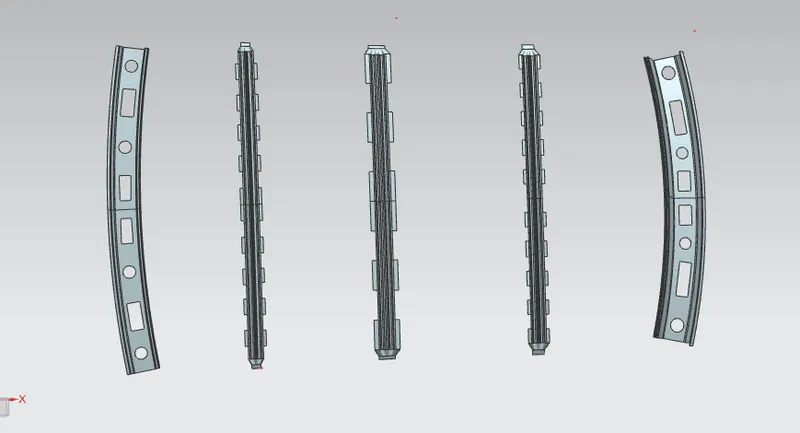
Front roof rail- Front roof rail is the one that joins the windshield glass, the body side outer, and the inner panel also. Here the front roof rail is designed based upon the master section given
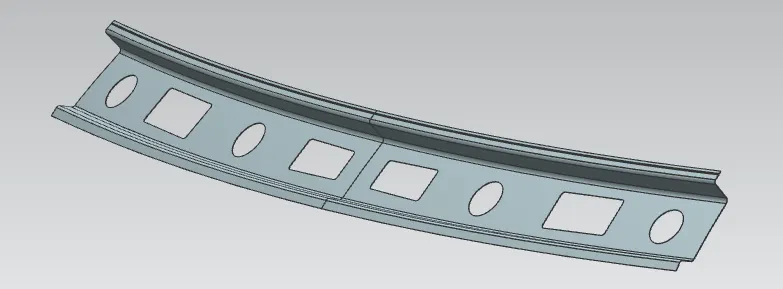
Rear roof rail-Rear roof rail is the one that joins the back door and the body side outer. The ditch of the rear roof is so designed that the trajectory of the back door does not intersect with the flanges and gave the appropriate height for opening and closing.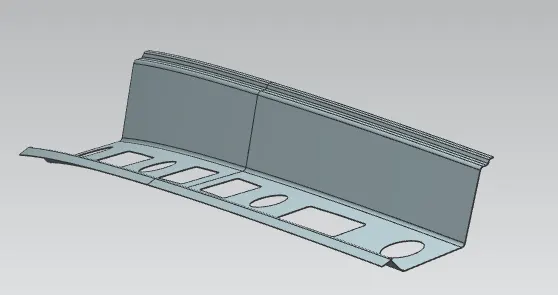
Bow roof front/rear- The bow roofs are given to improve the torsional stiffness and load-bearing capacity of the roof structure. The number of bow roofs present depends on the overall size of the roof. Presently in this project, two bow roofs are added.

Center roof rails- Central roof rail helps in providing effective support to the flat area of the roof as it is more susceptible to failure under the action of load. generally, the central roof rail is placed at the center of the roof which is connected to the B-pillar support structure. This central roof rail helps in adding strength to the roof during the roll-over test. The thickness of the central roof rail is 1.25 mm.
JOINING PROCESS -
Mastics are introduced between the roof's outer panel and the reinforcements for joining. where ever the mastic is introduced there is a remarkable improvement in the strength.
Spot welding is also introduced to join the reinforcements and the outer panel
DESIGN CONSIDERATIONS FOR A ROOF -
1. Visibility criteria- The ditch design should be precise in a manner that its deep length does intersect the driver view range and it should not be much low so that it can create any problem in joining.
2. Head clearance- Design much provide a proper headroom (enough gap between the roof and the head of occupants.)
3. Curvature study- Heat distortion and snow load criteria
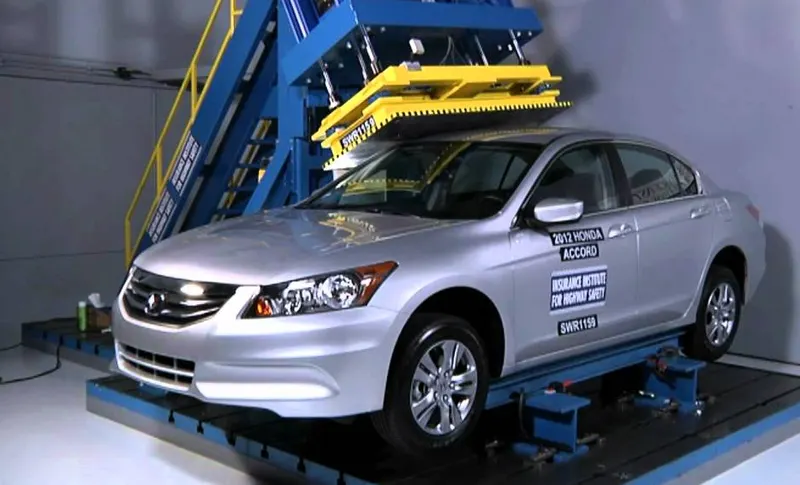
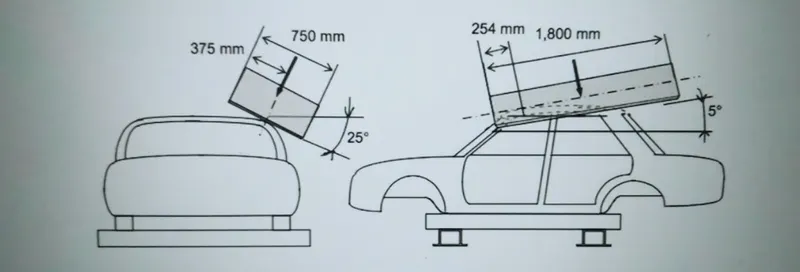
The roof crush test is the design given by the IIHS ( insurance institute of highway safety ). After analyzing the many accidents IIHS has then fixed some regulations, that how to perform the crush test.
IIHS gives the rating based on this test. For this, they consider two points while giving the rating
- How fast the car can reform to its original shape after the rollover and
- How deep is the protrusion after the rollover
The AIM of the crush test is to minimize the protrusion into the occupant compartment so that the seat belts and airbags can do their job for the safety of the passengers
CONDITIONS TO FOLLOW FOR ROOF CRUSH TEST-
There are two conditions that should be followed for the roof crush test, they are
INITIAL CONDITION-
- Close and lock all the doors
- Close all the windows
SECOND CONDITION-
Fix the body sill or chassis frame on a hard lever surface horizontally
METHOD OF APPLYING THE FORCE-
The load is applied in such a way that 50 is tilted from the front end to the rear end and the load will be 1800 mm in length and 750 mm in width. The load is applied at the position of 250 from the flatness of the roof. The load is applied on the roof for almost 120 sec and the crushing speed at which the load is applied is 13 mm/sec or less than that
RESULTS-
If the displacements go above the requirements level then we have to increase the bow roof thickness or add more mastics points to increase the strength. the stronger the roof the better it can protect the occupants in rollover crashes.
HEAT DISTORTION STUDY ON THE ROOF-
The heat distortion study plays a major role in sheet metal usage. heat distortion temperature is a temperature limit above which the material cannot be used for structural applications. This study is used to predict the heat distortion temperature at where the material starts to soften when exposed to a fixed load at an elevated temperature. In order to avoid bending or damage to the roof, based on the heat distortion temperature, this study will predict the bow roof position which helps to strengthen the roof.
Bow–roof prediction Formula
W = [1.73 x 10^(-3) x L] + [1.85 x 10^(-8) x (R^2)/t] + [ 1.10x10^(-3) x l] - 2.68
Where
L = Roof Length in X-Direction[mm](Roof dimension in 0-Y)
R = Roof curvature
R = 2(Rx*Ry)/(Rx+Ry)
Rx = X curvature
Ry = Y curvature
t = Roof plate thickness [mm]
l = Bow Roof Span [mm]
Judgment Condition: OK< 2.7> 3.1
CALCULATIONS-
L = Roof Length in X-Direction[mm]
BOW ROOF SPAN (I):
Here we want to take the distance from the front roof rail to the bow roof front for finding the bow roof span(I), we want to measure another bow roof span also.,
RX & RY (X & Y Curvature):
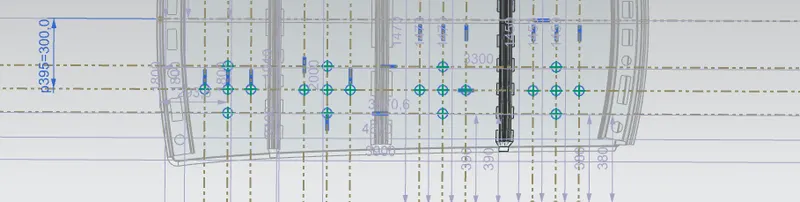
- From the 0-Y axis, at -3Y about a distance of 300mm is drawn parallel on the perpendicular plane. After that 100mm lines are offset to either side of the -3Y line. Now center lines are drawn between each adjacent roof rail edge respectively. Intersection points are marked on the sketch. Make all geometry lines construction lines except points.
- Project the intersection points on the sketch to the Roof surface.
- Join the intersection points in the roof surface using the arc curve and measure the radius using the minimum radius comment.
APPLY THE VALUES IN THE FORMULA :
In order to find the heat distortion apply all the necessary values from the roof to the give formula
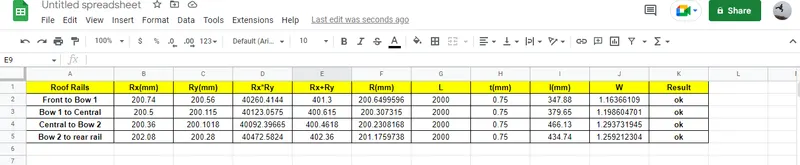
From the above table, it can be concluded that all values of w<2.7 and also not w>3.1 so thus infers that the current positioning of the bow row is good in the state as per the design and found ok
SNOW LOAD CRITERIA :
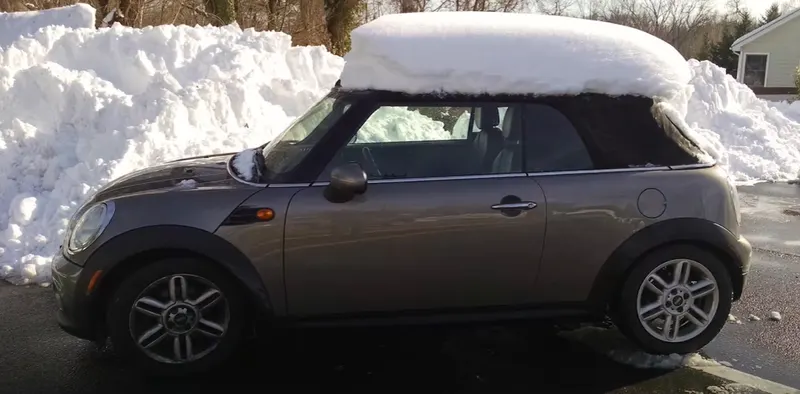
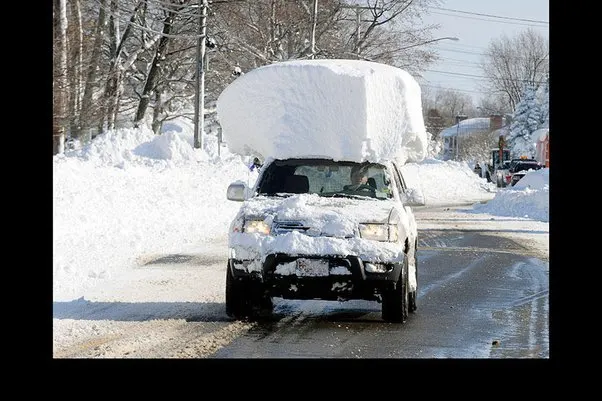
This test is done to know how is the roof behaving when there is snow over it. normally due to the snow weight the dent will happen. But the roof should be designed in such a way that when the snow is removed the roof should go it its original position. These are the basic requirements for snow load criteria.
Qr = [Iy x t2] / [α x s x [(Rx + Ry)/2]2 x 10-8]
Where
α = My x Lx2 x 10-12 , My = Y(Ly-Y)
Judgement condition = Qr ≥ 3.1
250 ≤ s ≤ 380
t = Roof plate thickness [mm]
Ly = Distance between the front and rear roof Rails on the Vehicle along with 0Y[mm]
Length of Roof panel with the center point between Roof rail Front /Rear as the reference point of the front and the rear.
Lx = Distance between the Left and Right end of the roof on the Roof BOW [mm]
Width of the roof panel exposed on the surface.
Y = Distance front Front Roof Rail to Roof BOW[mm]
s = Distance for which Roof BOW bears divided load [mm]
s = L1/2 + L2/2
Iy = Geometrical moment of inertia of Roof BOW (Y cross-section )[mm4]
Rx = Lateral direction curvature radius of roof panel Y cross-section on Roof BOW [mm]
Roof panel curvature Radius of the Length Lx in Front view
Ry = Longitudinal Direction curvature radius of the Roof panel X cross-section on Roof BOW [mm]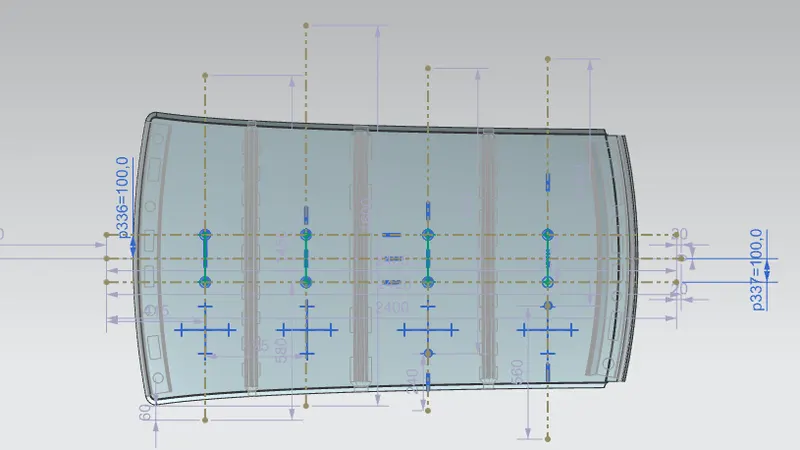
Now find the value for Iy
Front rail roof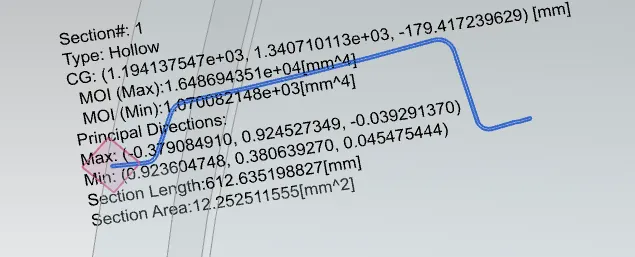
Bow Roof1
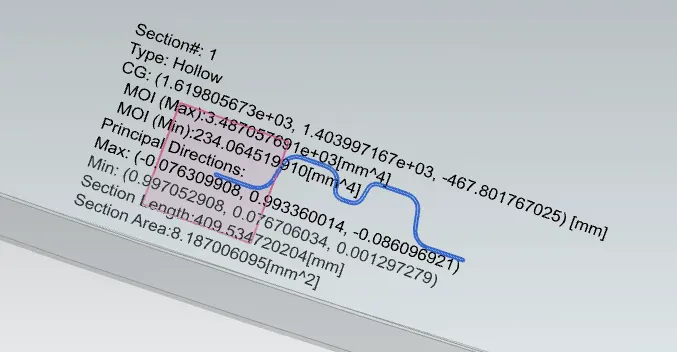
central bow roof
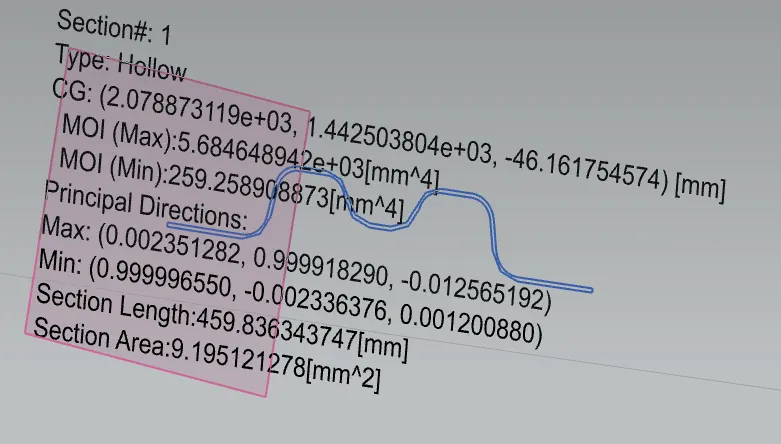
Bow Roof 2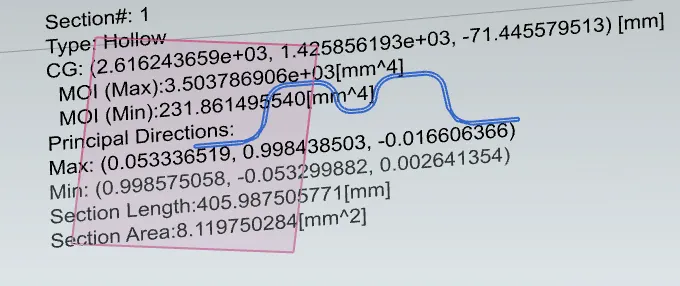
Rear Roof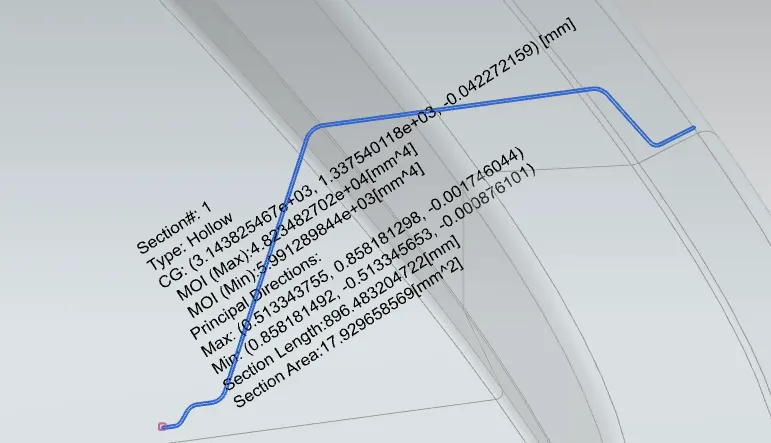
APPLY THE VALUES IN THE FORMULA :
In order to find the heat distortion apply all the necessary values from the roof to the given formula
CALCULATIONS -
If the roof structure passes the snow load condition. They must have Qr values from above 3.1.
Qr > 3.1
So, we have done the curvature study on the roof. Heat distortion and snow load condition my roof passes the two criteria, so the position of the bow roofs and center reinforcement roofs are placed in the right area.
Draft analysis-
DRAFT ANALYSIS FOR FRONT ROOF RAIL-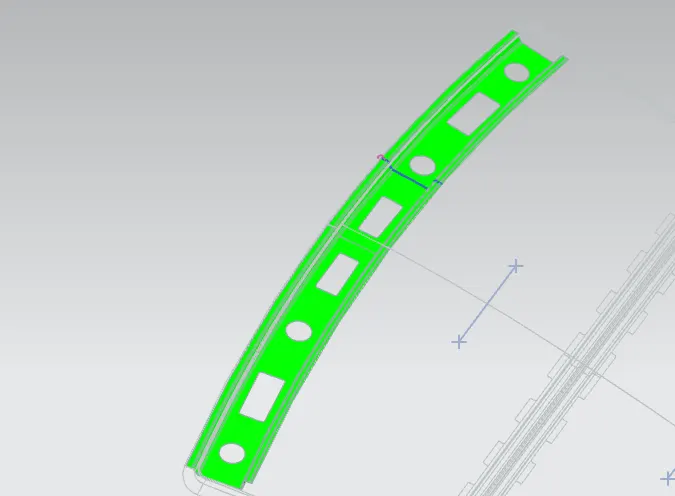
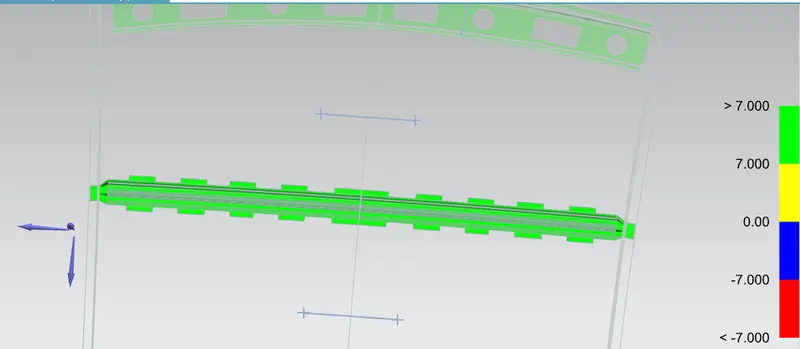
DRAFT ANALYSIS FOR BOW ROOF RAIL - 1:
DRAFT ANALYSIS FOR CENTER ROOF RAIL -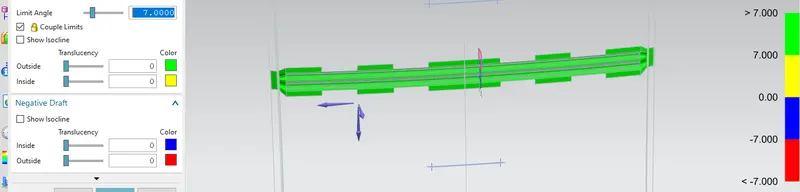
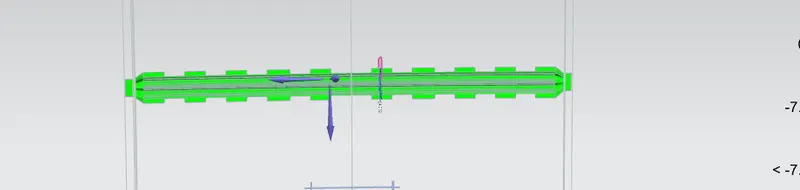
DRAFT ANALYSIS FOR BOW ROOF RAIL 2 -
DRAFT ANALYSIS FOR REAR ROOF RAIL -
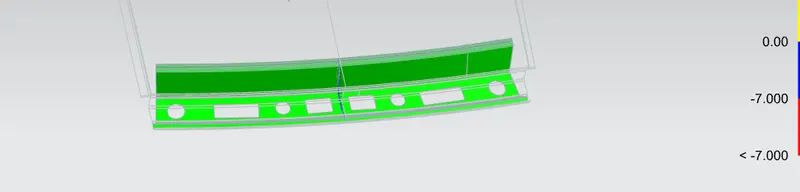
For sheet metal, the draft angle must be greater than 7 degrees along the tooling direction, and the green color shows that the above reinforcement part is ready to manufacture.
Now
Manufacturing process: Sheet metal is made by running hot slabs of metal through a series of rough rolling stands that makes them thinner and longer. To make them even thinner, these sheets go through finishing rolling stands and are then cooled and rolled into coils.
Types of processes
Bending: In bending, force is applied to a sheet metal workpiece to produce a curvature of the surface. Bending is generally used to produce simple curved surfaces rather than complex ones. A mechanically operated press drives a punch against sheet metal, forcing it into a simple die with enough pressure to produce a permanent change in the metal's shape. The amount of pressure is important. If not enough pressure is applied, the metal can simply spring back into its original shape. If too much is applied, it can break.
Drawing: In the drawing, the sheet metal is forced against a die that has been cut into the three-dimensional, often curved shape that the sheet metal is to take on. In effect, the die is used as a mold for the metal. This technique can produce relatively complex shapes. Once again, pressure is applied to the workpiece using a hydraulically or mechanically operated punch. It can crack from too much pressure or wrinkle from its interaction with the die. Lubricant can be used to make the metal slide more smoothly against the die, avoiding the possibility of wrinkling. Alternatively, the wrinkled edges can be trimmed from the metal in a separate operation. This method is commonly used to make auto body parts and fuel tanks.
Stamping: In stamping, a device called a stamping press is used with a series of dies to cut and form metal into various shapes. This is commonly used to make auto parts such as hubcaps and fenders.
Extrusion: Extrusion can be used to produce long metal objects, such as rods and tubes. The metal workpiece is forced into a die with a hole in the opposite end. The metal is extruded through the hole to form the shape. Extrusion can be used to manufacture important parts of a car's drive train or the anchors that hold seatbelts in place.
Forging: The forging process uses a hammer or press that is essentially a mechanized version of the hammers used by ancient blacksmiths. The metal is hammered against a surface that serves as an anvil. It can be hammered repeatedly so as to form complex shapes. This can be used as an alternative to the drawing process.
=============================================================
Thank you.