Roof Design
AIM:- For the Given Roof styling, create an ASSEMBLY by developing the essential flanges for the outer roof and creating the reinforcements.
Provide appropriate dimensions and check for Draft analysis.
Do a curvature study on the roof and perform calculations to determine the position of the Bow-roofs.
Suggest and implement remedies in the design if the criterion is not full-filling
Start with the creation of a roof ditch area with a tool opening angle of 7 degrees.
Develop the reinforcements as separate parts
Introduction: In this project, we will study the roofs, bow roofs, and reinforcement for the roof, different design considerations, how to develop the design to the component with the master sections, and the skin data provided.
Roof assembly: The roof assembly has the following parts;
- Roof ditch panel
- Bow roofs (2 numbers)
- Center roof rail
- Front roof rail
- Rear roof rail
Roof ditch panel: This is the aesthetic part of the vehicle which is visible to the human eye. This is the topmost part of the vehicle. The design of the roof is done using the master sketch given giving an appropriate (in this case 7 degree)draft angle for sheet metal production.
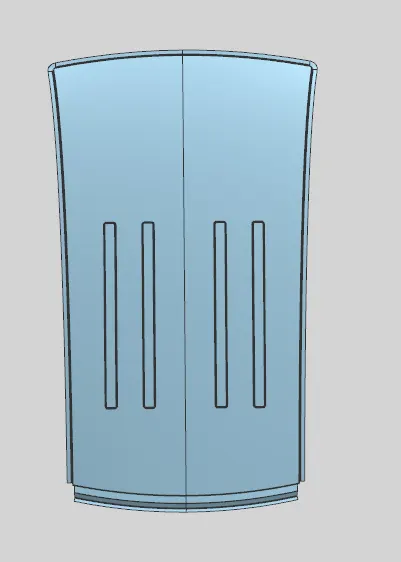
Front Roof Rail: This is the part that connects the roof ditch panel to the A-pillar of the car. Except for the roof panel all other parts provide strengthening aids to the roof panel. The Front rail is welded to the A-pillar and the roof panel. The front rail comes in the front part of the vehicle.
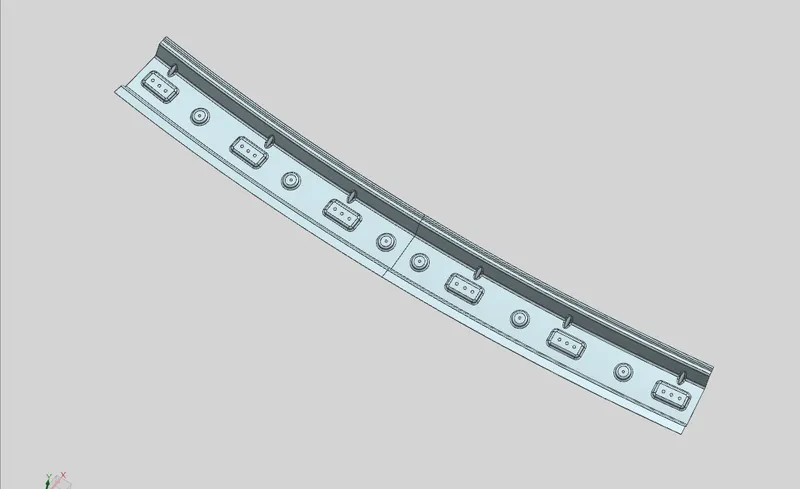
Rear Roof Rail: This part connects the roof panel to the rear pillar. This part is designed as per the opening of the back door of the Vehicle. The design is done as per the master sections provided.
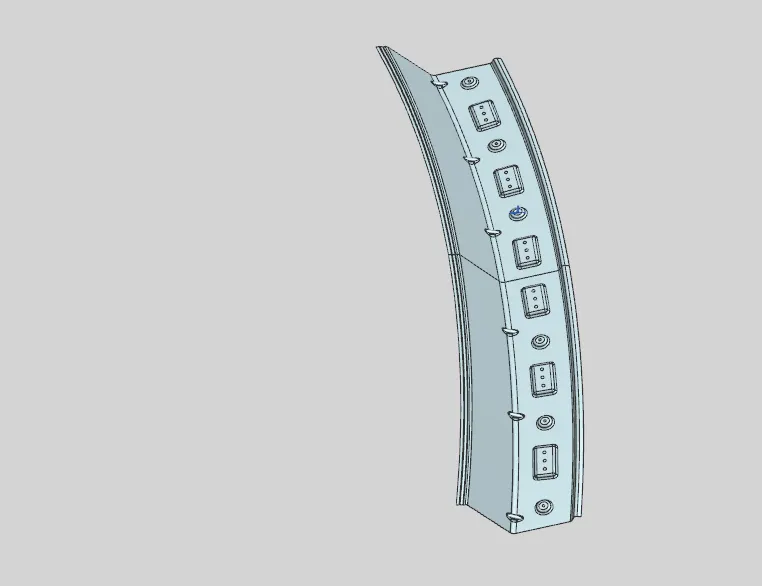
Bow Roofs: These parts are added to increase the load-carrying capacity of the roof of the car. Two bow roofs are designed for this project.
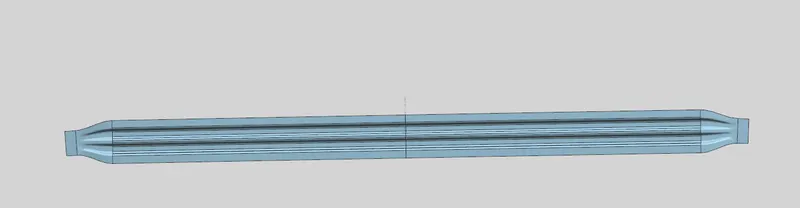
Center Roof Rail: The center roof rail is given to add more stiffness to the roof. It helps in increasing the load-carrying capacity of the roof and resists deformation caused due to any snow settling over the roof.
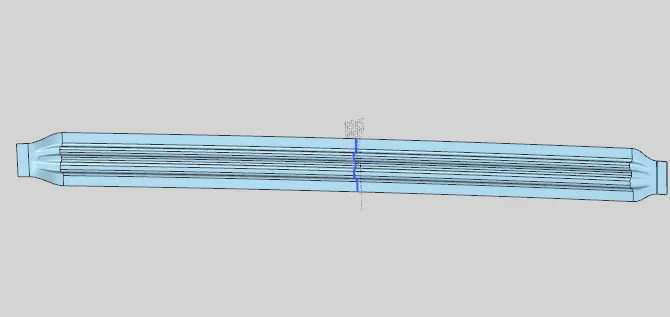
Draft analysis: All our components are prepared with sheet metal. So appropriate draft should be given to the parts we design, only then the part can be manufactured. The draft of the parts should be handled in the design stage itself. A draft angle of a minimum of 7 degrees is given to the parts.
Roof ditch panel: A separate tooling axis is provided for the draft analysis of the ditch area. Whereas I failed to provide a positive draft on the rear side of the roof.
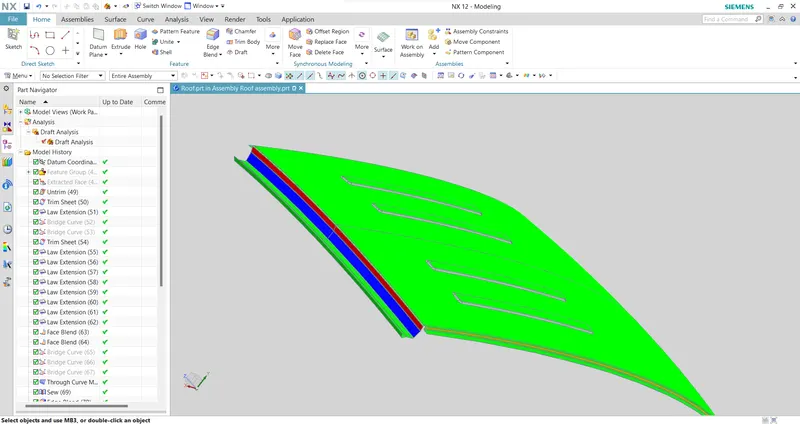
Front Roof Rail: A separate tooling axis is provided for the draft of the front roof rail.
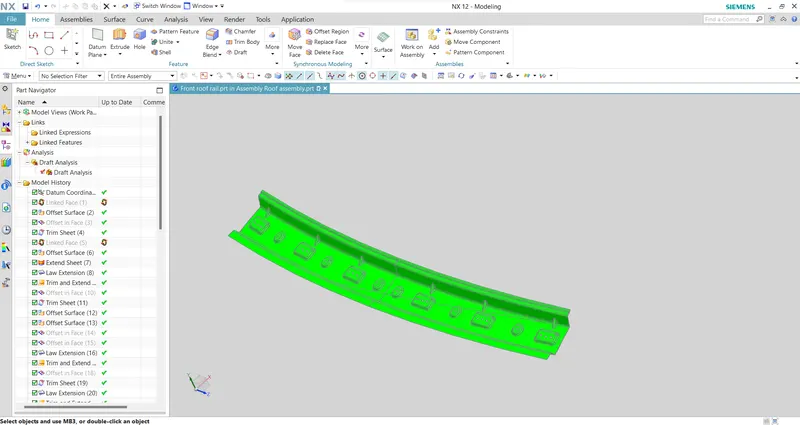
Rear roof rail: The y-axis is considered for the draft of the sheet metal as the tooling axis.
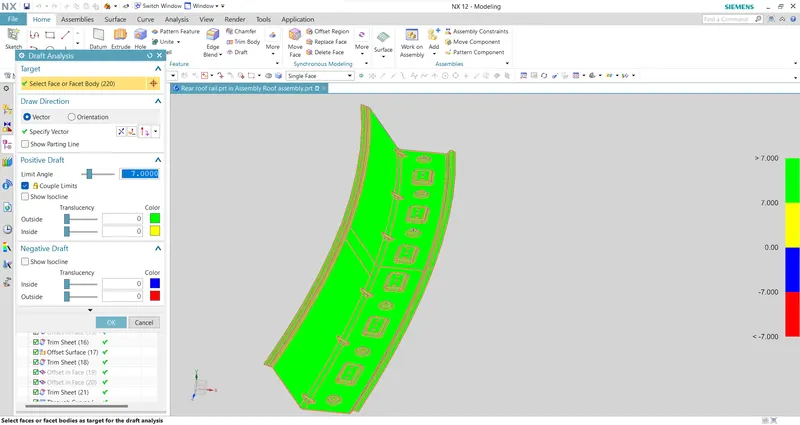
Bow roof 1: The y-axis is considered for the draft of the sheet metal as the tooling axis.
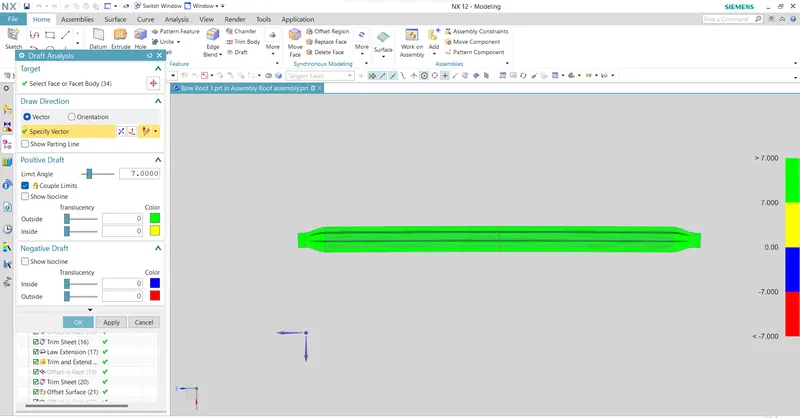
Bow roof 2: The y-axis is considered for the draft of the sheet metal as the tooling axis.
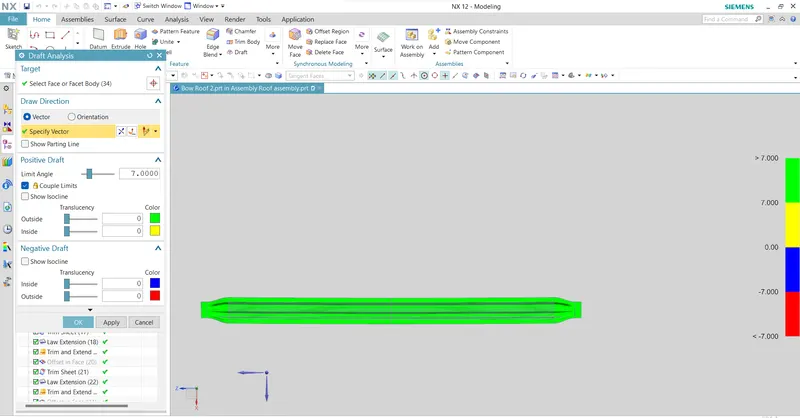
Centre Roof Rail: The y-axis is considered for the draft of the sheet metal as the tooling axis.
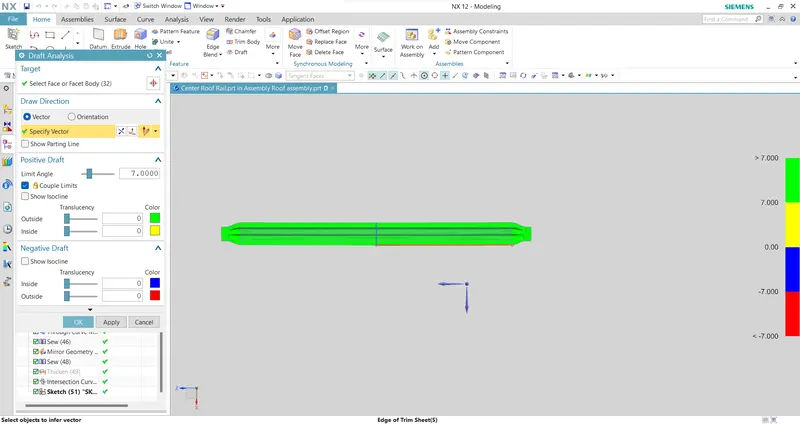
Roof has been desinged by considering all the parameters and considerations:--
After this, there is some criteria of roof to pass from it, like Heat Distortion criteria which helps us to ensure our roof whitstand the certain amount of heat and maintain there original shape and Snow load criteria ensures to help our roof maintain there original shape after external load on the roof like snow resting on roof, during roll over accidents etc. Also these calculations help in position our bow roofs on roof.
# Heat Distortion criteria
W = [1.73 x 10^(-3) x L] + [1.85 x 10^(-8) x (R^2)/t] + [ 1.10x10^(-3) x l] - 2.68
Where,
L = Roof Length in X-Direction[mm](Roof dimension in 0-Y)
R = Roof curvature
R = 2(Rx*Ry)/(Rx+Ry)
Rx = X curvature
Ry = Y curvature
t = Roof plate thickness [mm]
l = Bow Roof Span [mm]
Judgment Condition
OK< 2.7
All the value derived from roof design using sketch command and Tabulate here.
| Heat Distortion Calculation | |||||||||
| Section | Rx | Ry | R | L | l | t | W | OK | Remark |
| FRR to BR1 | 5739.35 | 2530.1 | 3512 | 2024.8 | 339.34 | 0.75 | 1.5 | OK< 2.7 | Pass |
| BR1 to CRR | 4934.19 | 6361.82 | 5558 | 2024.8 | 513.25 | 0.75 | 2.14 | OK< 2.7 | Pass |
| CRR to BR2 | 3853.65 | 11222.32 | 5737.2 | 2024.8 | 460 | 0.75 | 2.14 | OK< 2.7 | Pass |
| BR2 to RRR | 3237.62 | 14870.58 | 5317.5 | 2024.8 | 249.16 | 0.75 | 1.8 | OK< 2.7 | Pass |
So, Getting the value less than 2.7 means our roof pass the heat distortion criteria.
Section modulus of Centre roof rail
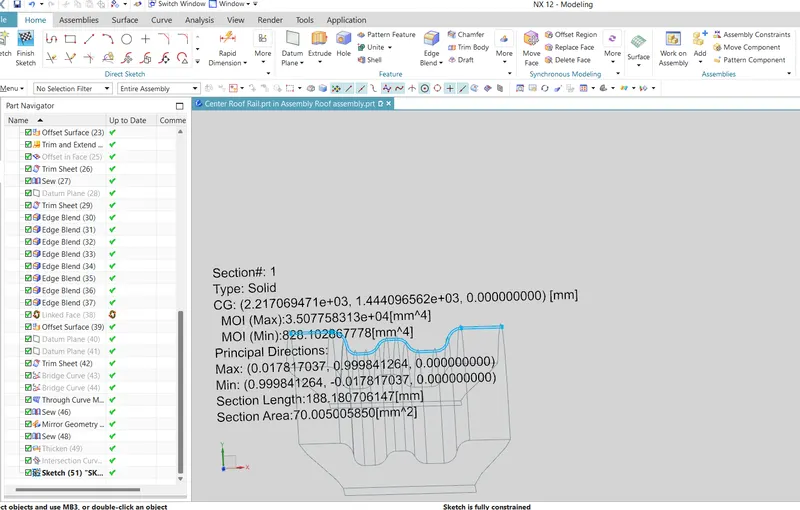
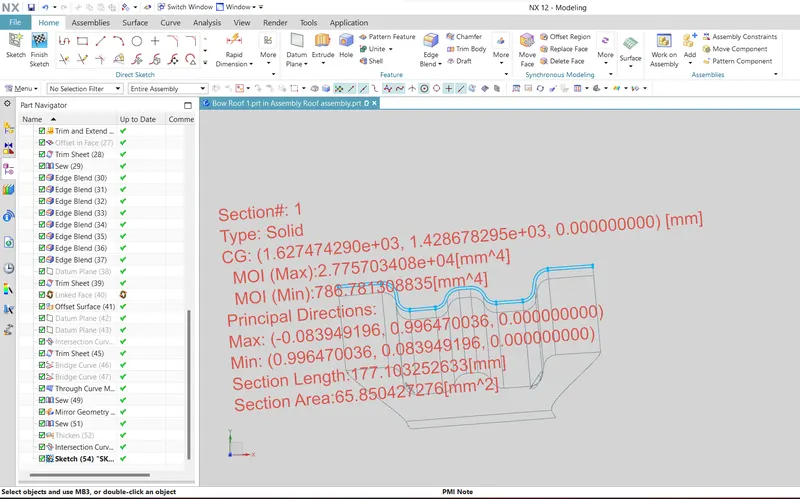
Section modulus of Bow Roof 1
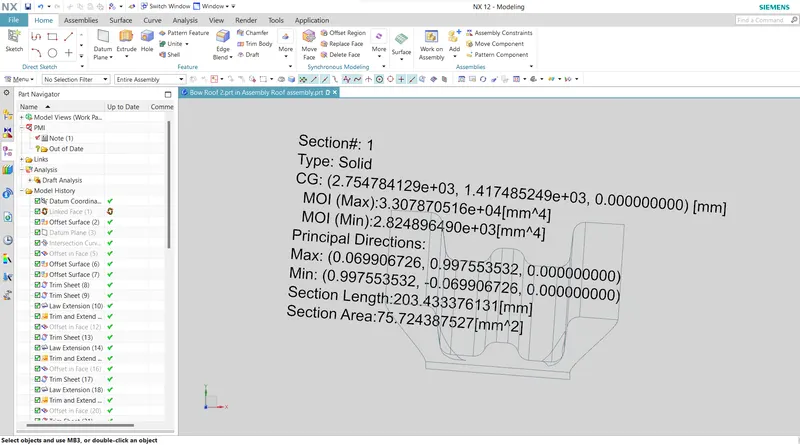
Section modulus of Bow Roof 2
Moving on We also ensure to check it whether our design passes the snow load criteria.
# Snow Load Prediction Formula
Qr = [Iy x t2] / [α x s x [(Rx + Ry)/2]2 x 10-8]
Where,
α = My x Lx2 x 10-12 , My = Y(Ly-Y)
t = Roof plate thickness [mm]
Ly = Distance between the front and rear roof Rails on the Vehicle along with 0Y[mm]
Length of Roof panel with the center point between Roof rail Front /Rear as the front and rear reference point.
Lx = Distance between the Left and Right end of the roof on the Roof BOW [mm]
The width of the roof panel is exposed on the surface.
Y = Distance front Front Roof Rail to Roof BOW[mm]
s = Distance for which Roof BOW bears divided load [mm]
s = L1/2 + L2/2
Iy = Geometrical moment of inertia of Roof BOW (Y cross-section )[mm4]
Rx = Lateral direction curvature radius of roof panel Y cross-section on Roof BOW [mm]
Roof panel curvature Radius of the Length Lx in Front view
Ry = Longitudinal Direction curvature radius of the Roof panel X cross-section on Roof BOW [mm]
Roof panel X curvature radius of length s in Side view
Judgment condition
Qr ≥ 3.1
250 ≤ s ≤ 380
All the value derived from roof design using sketch command and Tabulate here.
| Snow Load Calculation | |||||||||||||
| Section | Rx | Ry | Lx | Ly | Y | Iy | s | My | a | t | Qr | Ok | Remark |
| Front R to BR1 | 4539.34 | 2587.74 | 1107.2 | 1957.1 | 439.6 | 786.78 | 515 | 667093 | 0.817783865 | 0.75 | 22.27 | Qr ≥ 3.1 | Pass |
| BR1 to CRR | 3785.39 | 6480.55 | 1062.6 | 1957.1 | 1031.4 | 828.1 | 564.3 | 954767 | 1.07804533 | 0.75 | 7.811 | Qr ≥ 3.1 | Pass |
| CRR to BR2 | 4335.11 | 12287.38 | 1042.6 | 1957.1 | 1566.9 | 2824.89 | 463.6 | 953458 | 1.03642292 | 0.75 | 12.84 | Qr ≥ 3.1 | Pass |
Conclusion-
This Concludes the design and Analysis of the Roof using the styling surface given as the input.