Roof challenge
Aim:
For the given roof styling, develop the essential flanges and reinforcements, provide appropriate dimensions and perform a roof curvature study using NX-CAD
Introduction:
Roof
An automobile roof or car top is the portion of an automobile that sits above the passenger compartment, protecting the vehicle occupants from sun, wind, rain, and other external elements.
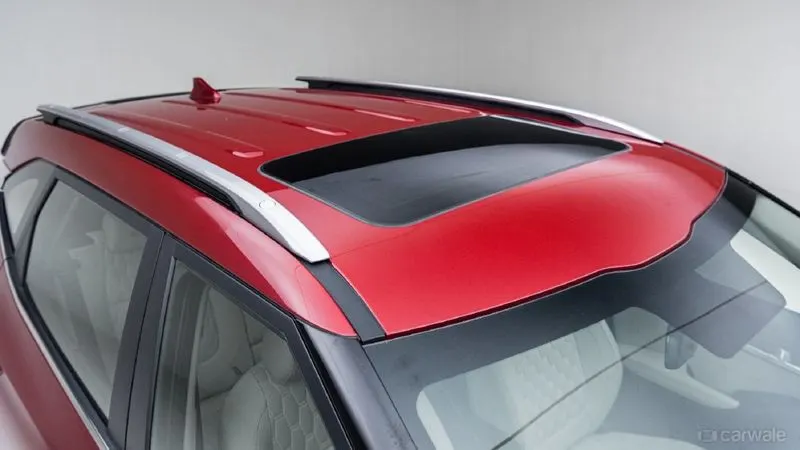
The roof is a styling surface part that is fixed with the BIW body through the rails and panels inside the upper roof to provide it strength and stiffness.
The ditch area plays an important role here to fix the reinforcement on the component.
The rails and reinforcements are joined to the ditch area with a spot weld where it's not the styling part.
The required tool opening angle is a minimum of 3 Degrees.
Factors which is considered before creating a Ditch area,
- Headroom clearance
- Visibility criteria
- Back door assembly
- Windshield assembly
Software Using NX CAD:
Class A Styling Input
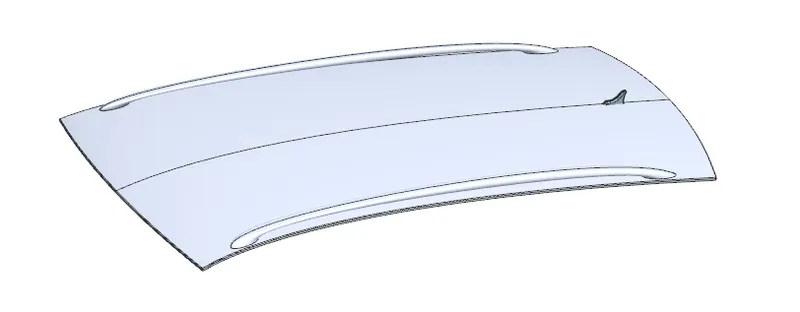
- After the file is opened, the roof part is not joined together but as individual surfaces.
- It is also seen as the surface is perfectly symmetrical in shape which helps us to work on half of the portion and reflect it which creates the whole roof. We work on half of the surface and mirror to complete the rest.
Components of roof:
- Front roof rail
- Rear roof rail
- Bow roof
- Centre roof rail
- Ditch area
Front roof rail:
It is created using the Given reference master section
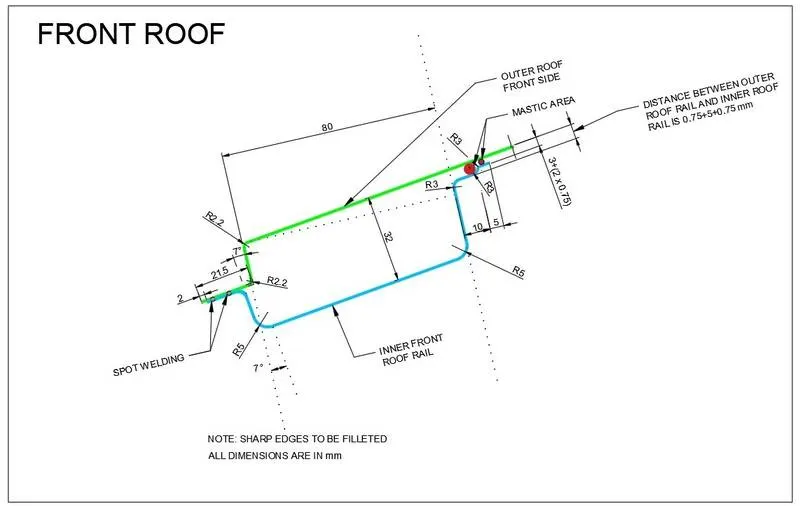
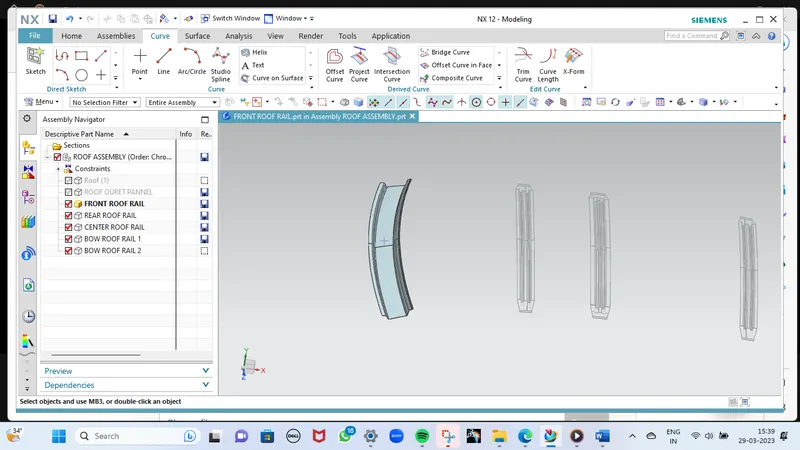
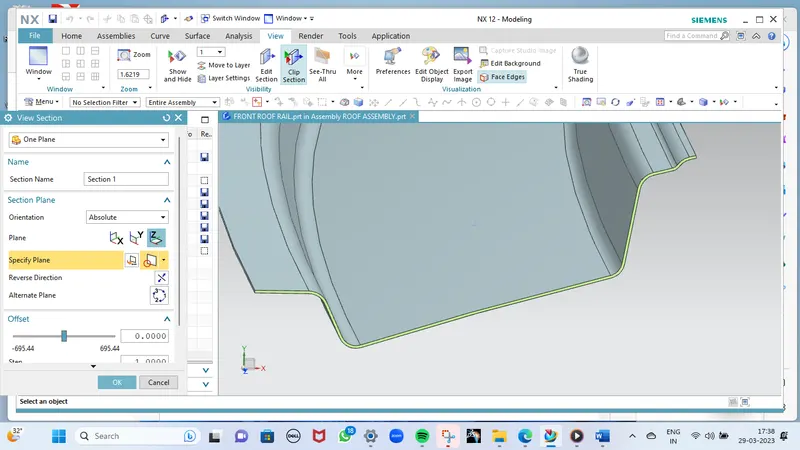
The front roof rail is used to provide strength to the roof panel front and it also acts as a link between windshield glass, roof panel, and headliner. Spot welds are applied at the wind shield end of the rail and the other end is joined with the roof using mastic sealant which also increases the strength.
CROSS SECTION VIEW
Rear roof rail:
It is created using the Given reference master section
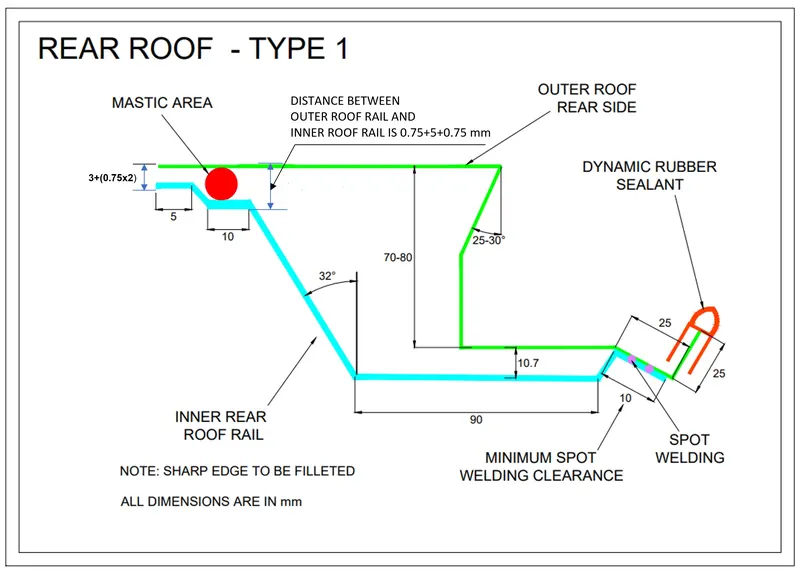
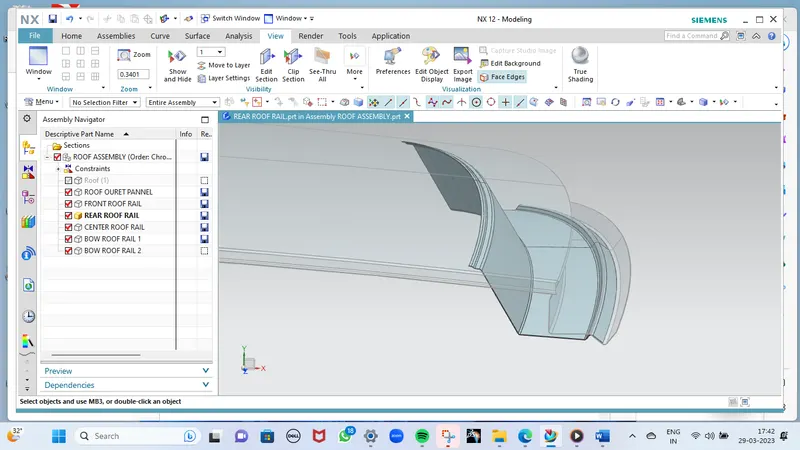
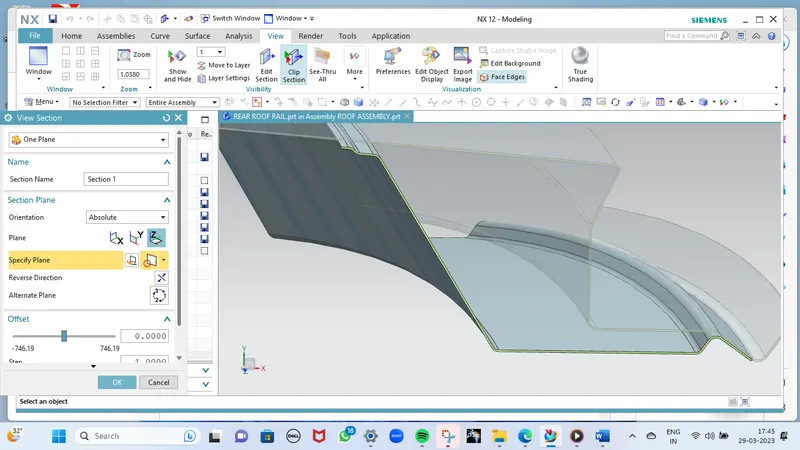
The rear roof rail is again used to strengthen the roof and it acts as a link between the back glass and the roof which is connected to the backdoor of the car. Spot welds are applied at the back door end of the rail and the other end is joined with the roof using mastic sealant.
CROSS-SECTION VIEW
Center Roof rail and Bow roof rails:
The Center roof rail will be at the center of the roof to provide strength and stability to the roof. Here the center roof rail is joined with the roof through mastic sealant.
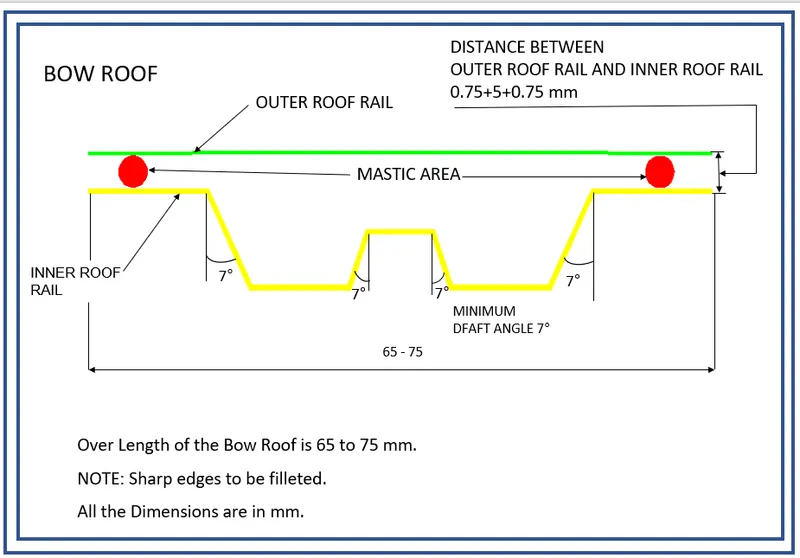
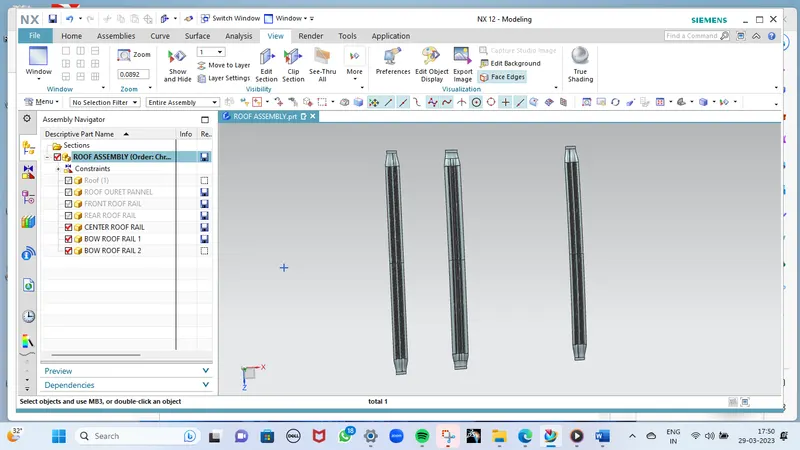
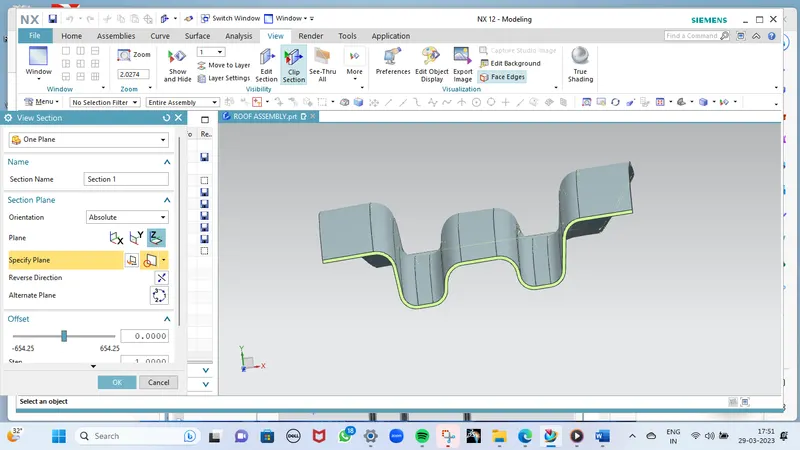
Bow roof is used for strengthening purposes and also attached to the upper roof surface with mastic sealants
CROSS-SECTION VIEW
Ditch area:
The ditch area is an extended portion of the main roof concealed by other BIW panels. The rails support of the roof is attached to the ditch area using spot weld.
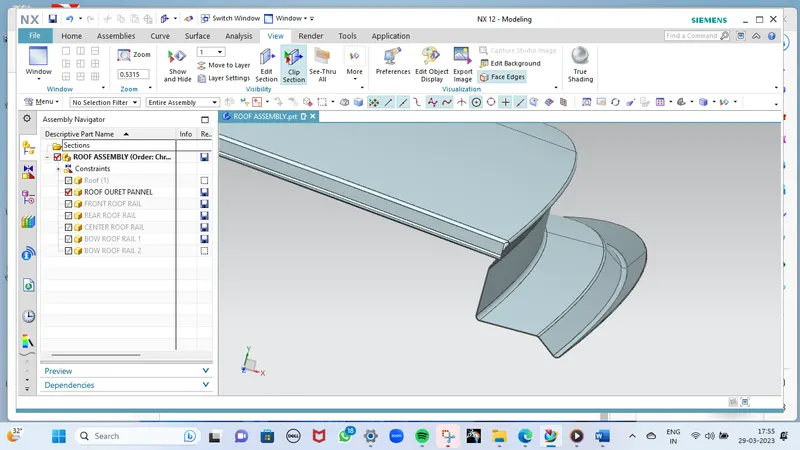
CROSS-SECTION VIEW
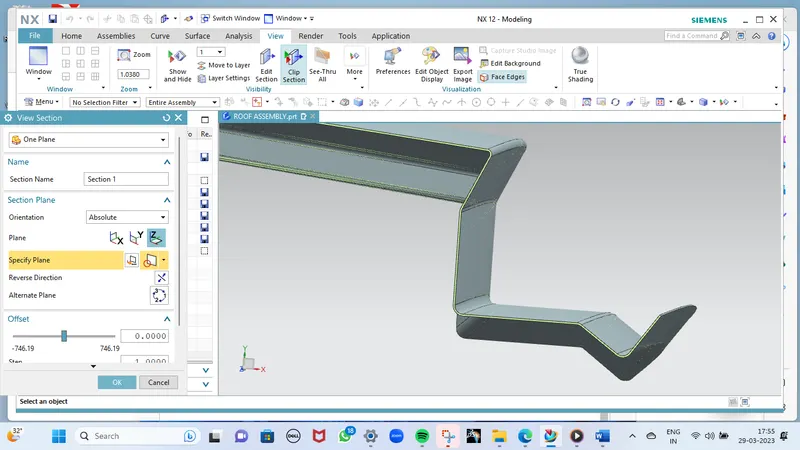
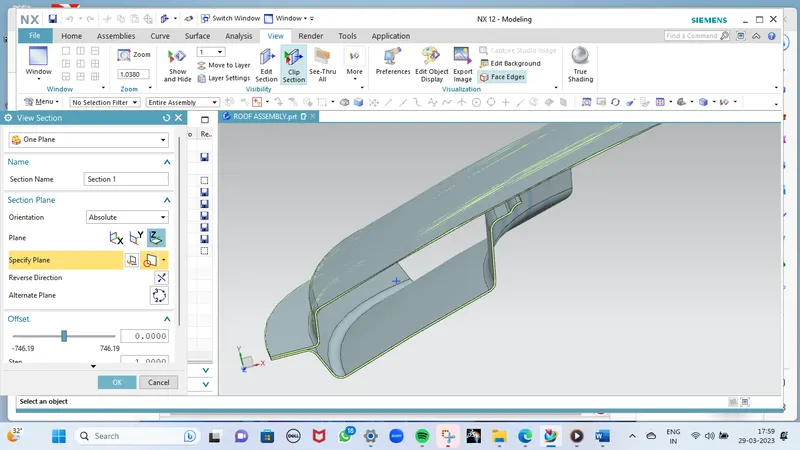
Final Model:
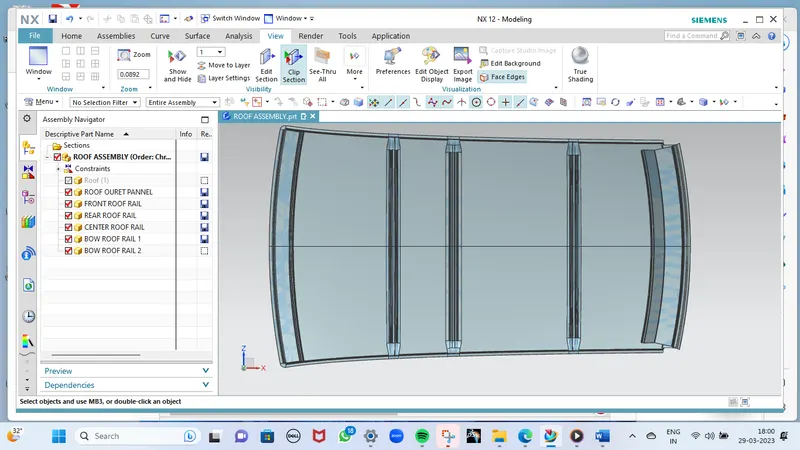
Curvature study on the Roof:
After getting the final body it has to be checked and justify that it passes the standards.
Analysis:
It is done to justify the position of the bow roofs.
1. Roof crash test.
2. Snow load test.
3. Heat distortion criteria
Heat distortion criteria:
Heat distortion temperature is the temperature at which the metal softens and deforms under a specific load. This study is done to check the ability of the roof to withstand high temperatures with respect to the position of the reinforcement which contributes to the increased strength.
- To calculate the heat distortion criteria by the bow roof position formula,
- We need to create a sketch and draw a line on the center of the roof on the OY axis (mid-horizontal axis)
- Next, draw a line from the center line by a 300mm distance
- After that draw a line from a 100mm distance on both sides of the 300mm line
- Then draw a line between the center of the roof rails and draw the lines from the center line by a distance of 100mm on both sides.
- At least make an intersection on these lines from a coincident line to get points.
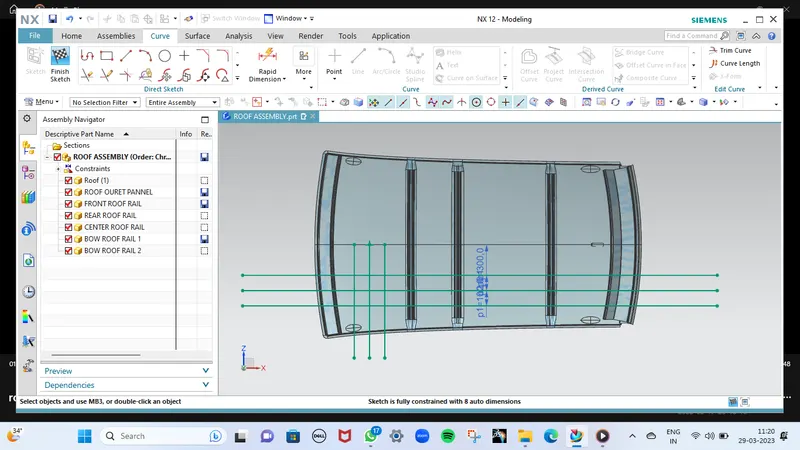
- Roof curvature (Rx & Ry) radius is measured by creating a 'Three point arc'
Prediction formula:W=[1.73×10⁻³×L] + [1.85× 10⁻⁸×R2/t]+[1.10×10-3×l]-2.68
Judgemental condition: Ok<2.7>3.1
Where
L=Roof length in X-direction in mm (Roof dimension in O-Y)
R=Roof curvature
R=2(RX×RY)/(RX+Ry)
RX=X Curvature
Ry=Y Curvature
T =Roof plate thickness in mm
L =Bow roof span in mm
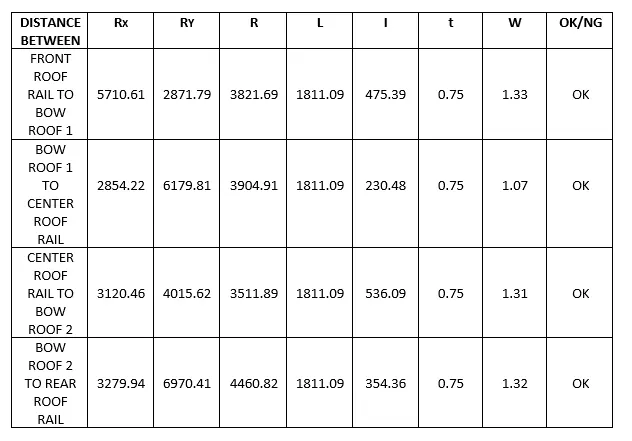
- The test value infers that the design is good and under the limit of standards.
Conclusion:
- Essential roof components such as bow and center rails required with flanges and reinforcements are designed.
- The curvature study on the roof was analyzed with heat distortion criteria.
*****THANK YOU*****