Roof challenge
DESIGN OF ROOF
OBJECTIVE:
To design car roof from the given styling surface with essential flanges like ditch area and reinforcements like front roof rail, bow roofs, central reinforcement and rear roof rail with draft analysis and to calculate the heat distortion and snow load condition to check whether the bow roofs are placed in correct positions.
SOFTWARE USED:
Siemens NX12.0
WHAT IS ROOF?
An automobile roof or car top is the portion of an automobile that sits above the passenger compartment, protecting the vehicle occupants from sun, wind, rain, and other external elements. An automobile roof consists of the following parts,
- Outer roof panel
- Front roof rail
- Bow roofs
- Reinforcements
- Rear roof rail
The above mentioned parts are designed according to the design considerations given below
DESIGN CONSIDERATION:
- Visibility criteria
- Head clearance
- Heat distortion condition
- Snow load condition
- Roof curvature study
- Draft analysis
Front roof rail:
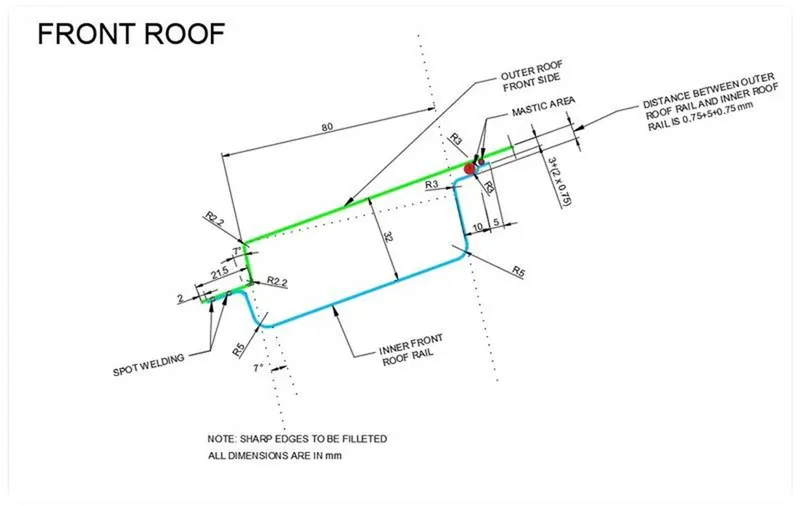
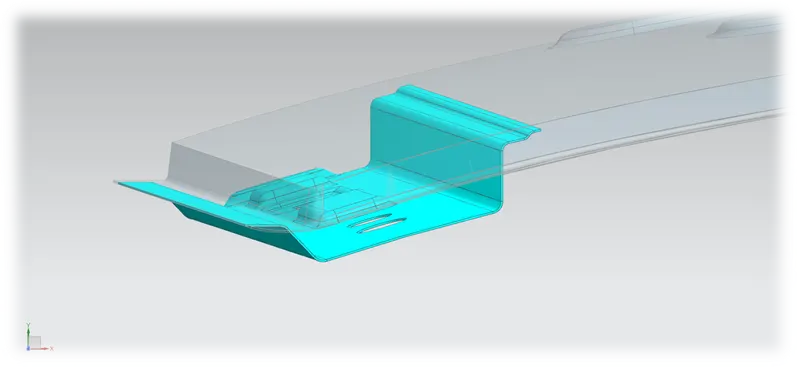
Front roof rail is located at the front of the outer roof panel that joins the wind shield glass. The front end of the rail is spot welded with the ditch area of the outer roof panel and the rear end of the rail is attached with outer roof panel through mastic joints.
Bow roofs:
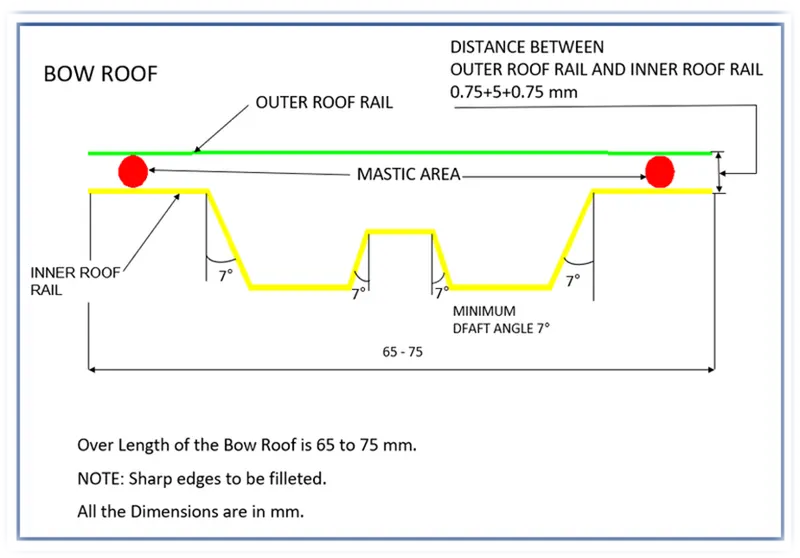
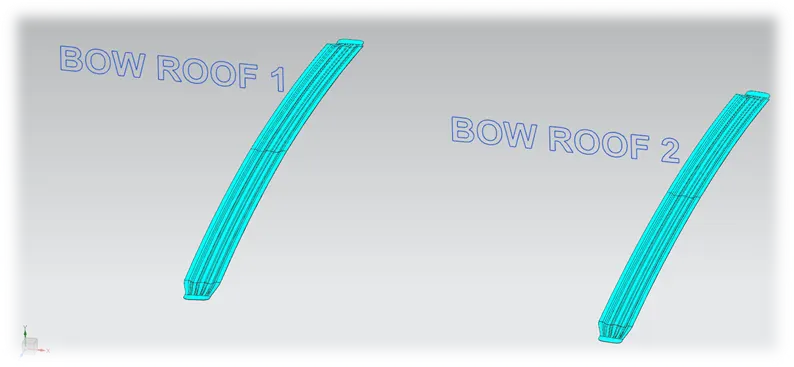
The bow roofs are provided to improve the torsional stiffness and to withstand the load bearing capacity of the outer roof. The bow roof counts depend on the length of the roof outer panel. In this case two bow roofs are provided one in between the front rail and central reinforcement and other in between the reinforcement and rear roof rail, considering overall length.
Central reinforcement:
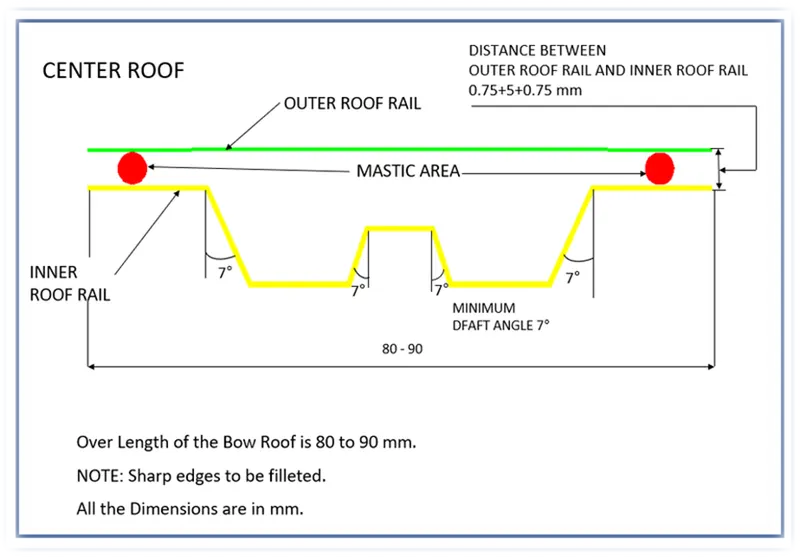
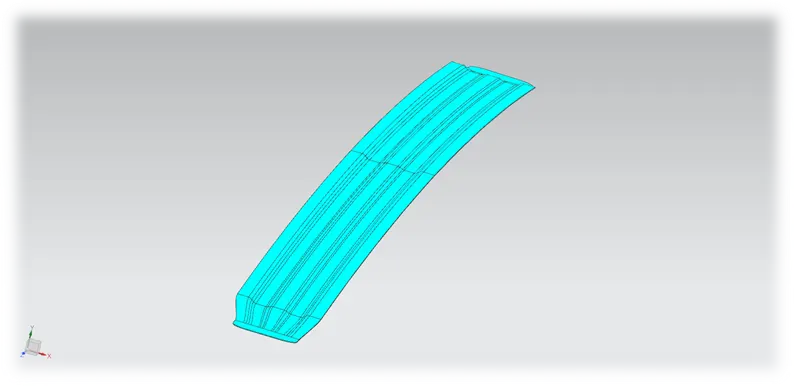
Central roof rail/central reinforcement helps in providing effective support to the flat area of the roof as it is more susceptible to failure under the action of load. Generally central roof rail is placed at the centre of the roof which is connected to the B-pillar support structure. This central roof rail helps in adding the strength to the roof during the roll- over test.
Rear roof rail:
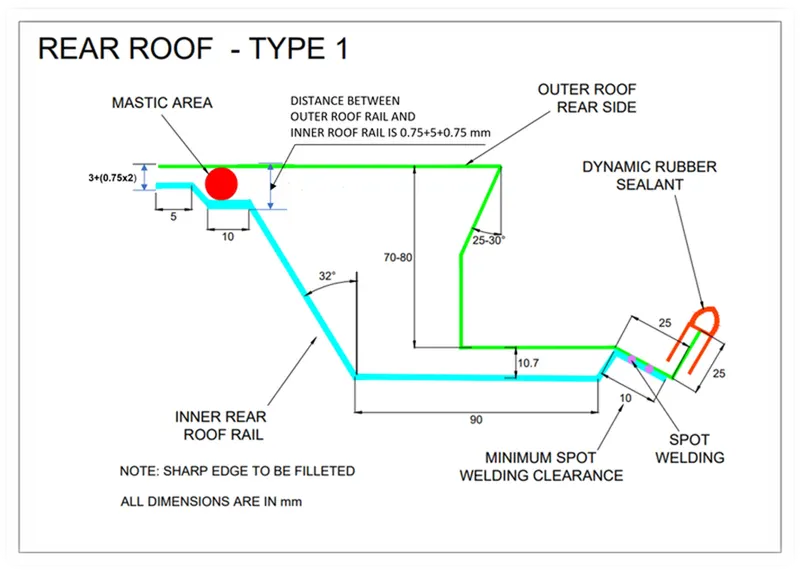
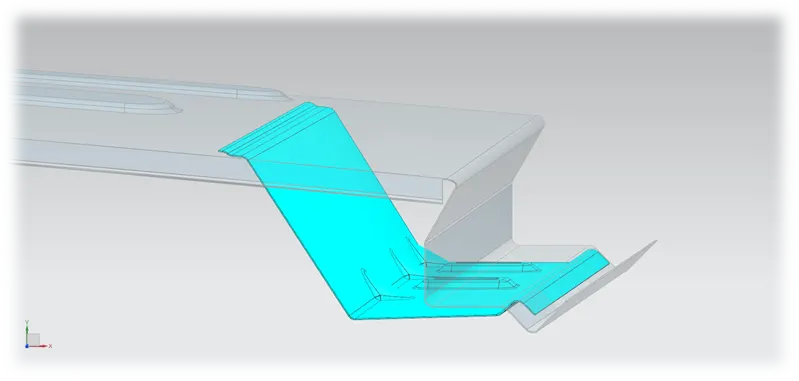
The rear roof rail provides load bearing capacity to the roof end surface and it also joins the back door and body side outer.
JOINING METHOD:
The ends of the rails and roof panel are spot welded where as the lateral surface of the rails and roof panel are joined with mastic rubbers.
DRAFT ANALYSIS:
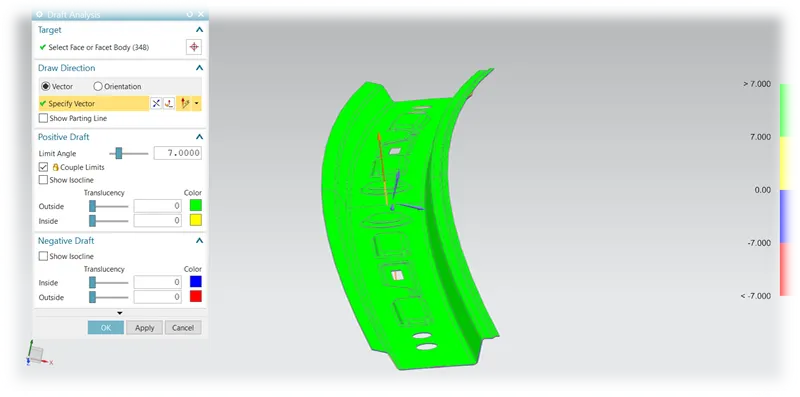
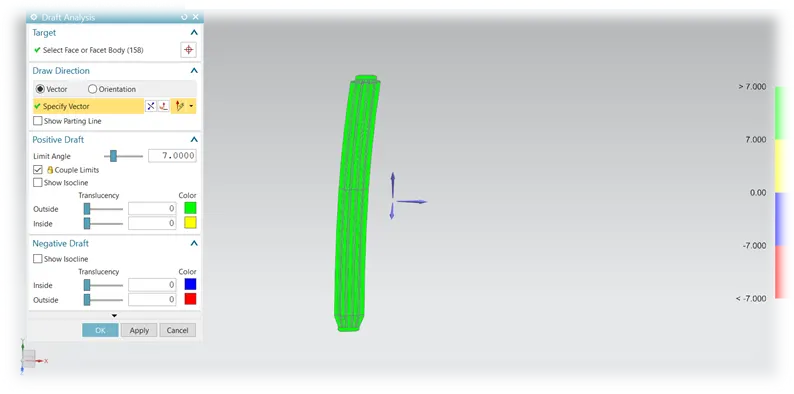
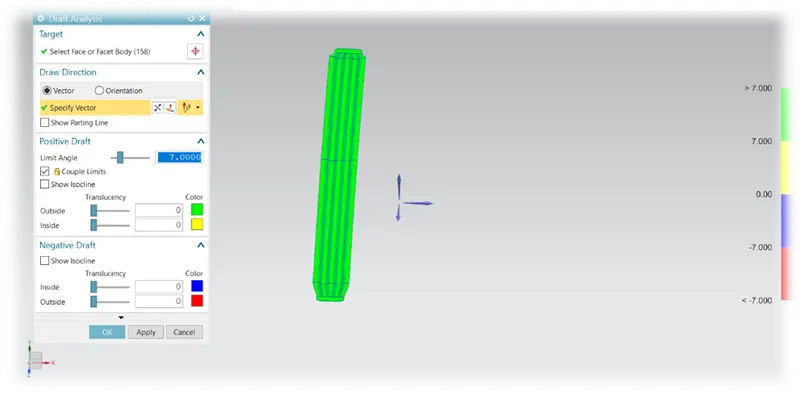
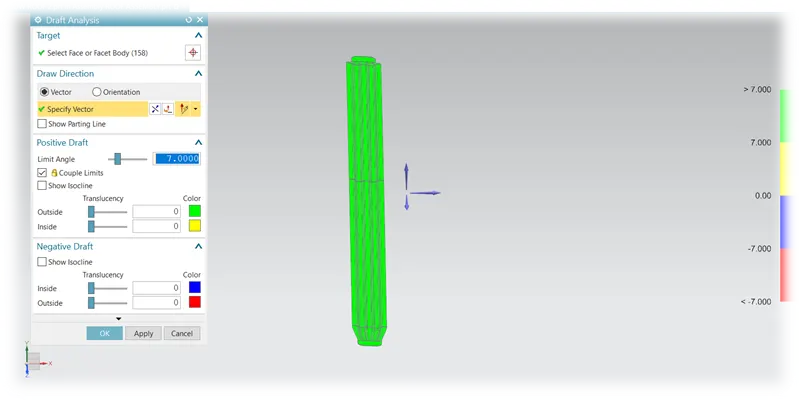
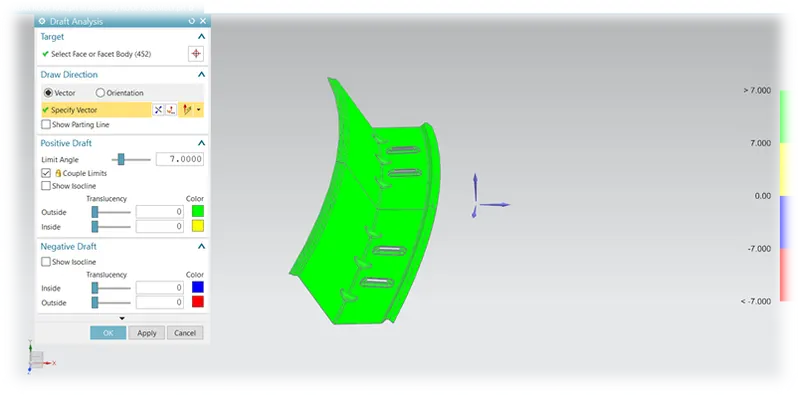
Sheet metals are manufactured by deep drawing process. If the designed parts have negative drafts it may results in tool wear or failure of the press tools. In order to overcome this issues draft analysis are performed in software. Here the designed parts are draft analysed as follows
Roof outer panel
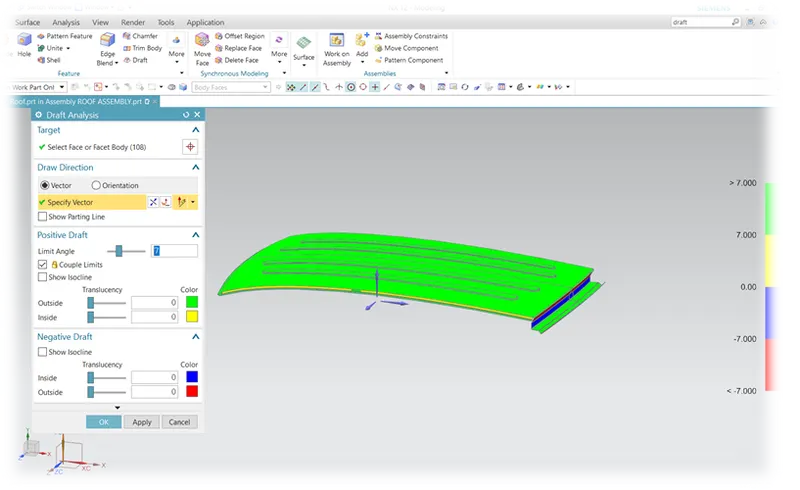
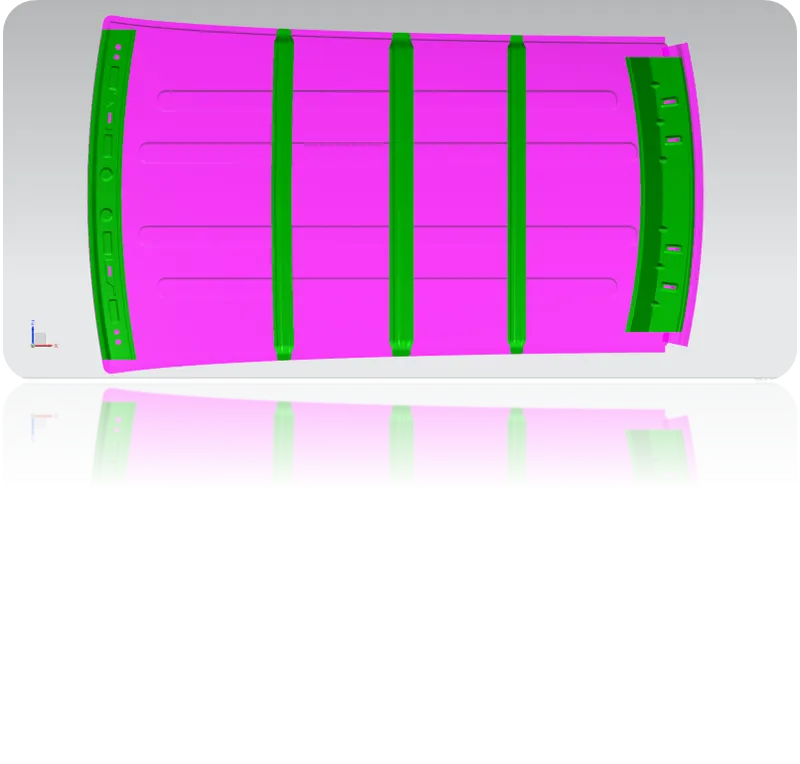
Here the limit angle is given at 7degree which is the optimal angle for deep drawing. The shadowed parts at green are above the limit angle, whereas in some case its nearly 7degrees that’s is totally fine. The rear end of the roof has negative draft with respect to the design consideration. In such case two or more deep drawn process are performed to achieve this kind of product.
Front roof rail
Bow roof 1
Central reinforcement
Bow roof 2
Rear roof rail
CURVATURE STUDY AND CALCULATIONS:
This study is about the placement of the bow roofs and reinforcement in such a position so that it can withstands the external loads.
Heat distortion calculation
The heat distortion study plays a major role in sheet metal usage. Heat distortion temperature is a temperature limit above which the material cannot be used for the structural applications. This study is used to predict the heat distortion temperature at where the material starts to soften when exposed to a fixed load at elevated temperature. In order to avoid bending or damages on the roof, based on the heat distortion temperature, this study will predict the bow roof position which helps to strengthen the roof.
Bow–Roof Prediction Formula
W = [1.73 x 10^(-3) x L] + [1.85 x 10^(-8) x (R^2)/t] + [ 1.10x10^(-3) x l] - 2.68
Where,
L = Roof Length in X-Direction[mm](Roof dimension in 0-Y)
R = Roof curvature
R = 2(Rx*Ry)/(Rx+Ry)
Rx = X curvature
Ry = Y curvature
t = Roof plate thickness [mm]
l = Bow Roof Span [mm]
Judgment Condition
OK< 2.7
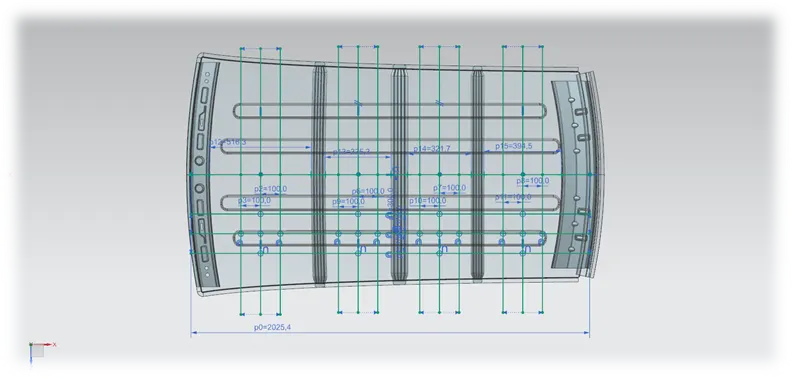
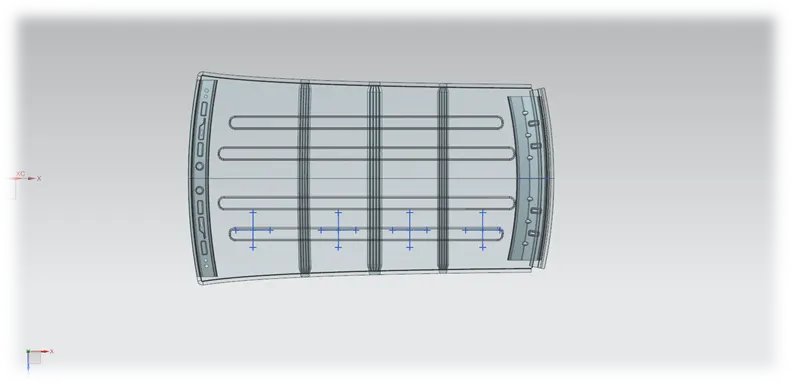
Sketches are plotted and the Rx, Ry values are obtained. These values are applied in the given formulae and the values are tabulated as below.
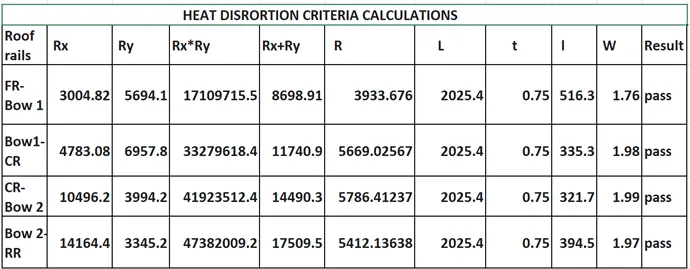
It is clearly observed that the values obtained are below 2.7 thus the roof passes the heat distortion criteria.
Snow load calculation
This test is done to know how the roof behaves when there is a snow load over it. Due to the snow mass the roof tends to bend inwards but soon after the snows are removed it should retain back to its original position. Thus, the bow roofs are placed in such a way.
Snow Load Prediction Formula
Qr = [Iy x t2] / [α x s x [(Rx + Ry)/2]2 x 10-8]
Note: The Qr value given over here is correct. There was a typo error in the formula given in the video.
Where,
α = My x Lx2 x 10-12 , My = Y(Ly-Y)
t = Roof plate thickness [mm]
Ly = Distance between the front and rear roof Rails on the Vehicle along with 0Y[mm]
Length of Roof panel with the center point between Roof rail Front /Rear as the front and rear reference point.
Lx = Distance between the Left and Right end of the roof on the Roof BOW [mm]
The width of the roof panel is exposed on the surface.
Y = Distance front Front Roof Rail to Roof BOW[mm]
s = Distance for which Roof BOW bears divided load [mm]
s = L1/2 + L2/2
Iy = Geometrical moment of inertia of Roof BOW (Y cross-section )[mm4]
Rx = Lateral direction curvature radius of roof panel Y cross-section on Roof BOW [mm]
Roof panel curvature Radius of the Length Lx in Front view
Ry = Longitudinal Direction curvature radius of the Roof panel X cross-section on Roof BOW [mm]
Roof panel X curvature radius of length s in Side view
Judgment condition
Qr ≥ 3.1
250 ≤ s ≤ 380
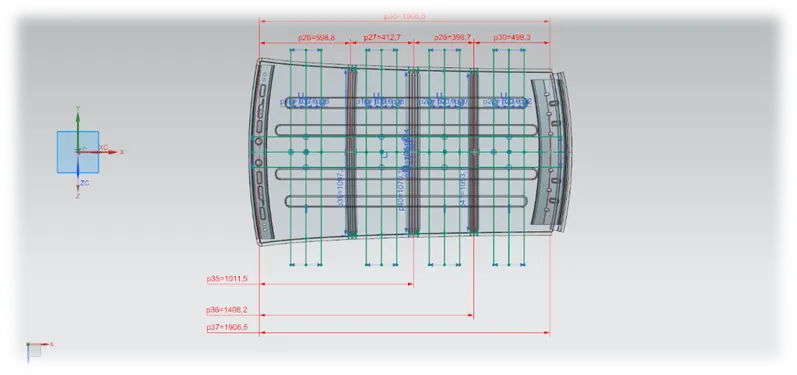
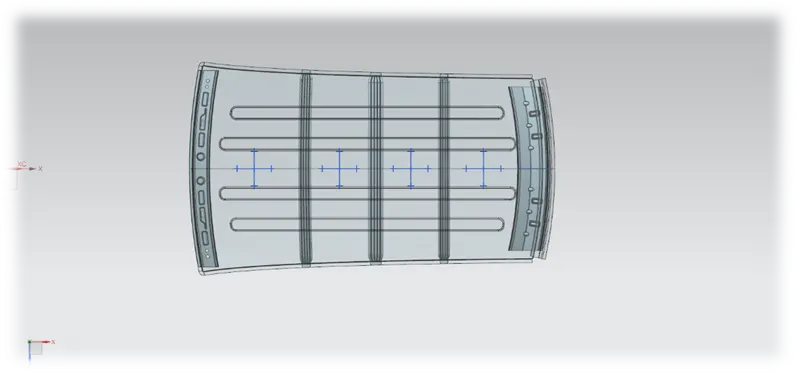
Sketches are plotted according to the snow load criteria and the Rx, Ry values are obtained.
Section inertia analysis
It is a tool in NX to calculate the principle moment of inertia, circumference, area and centre of gravity of the sections. Here in snow load condition moment of inertia is taken into account. Thus section inertia analysis is performed as follows. The minimum moment of inertia MOI(Min) is taken for the calculation.
Bow roof 1
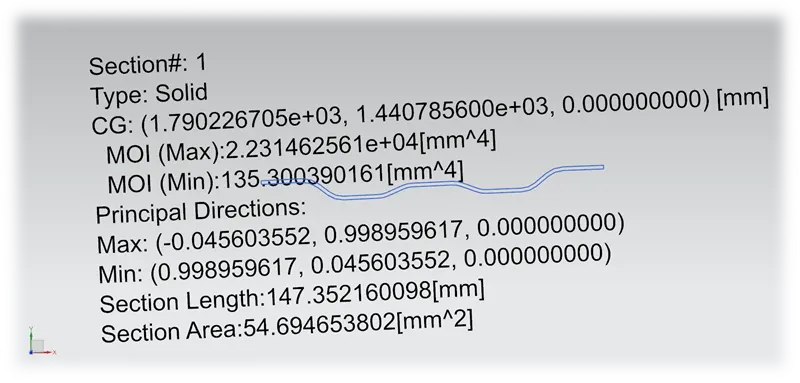
MOI(Min)=135.300390161mm4
Central reinforcement
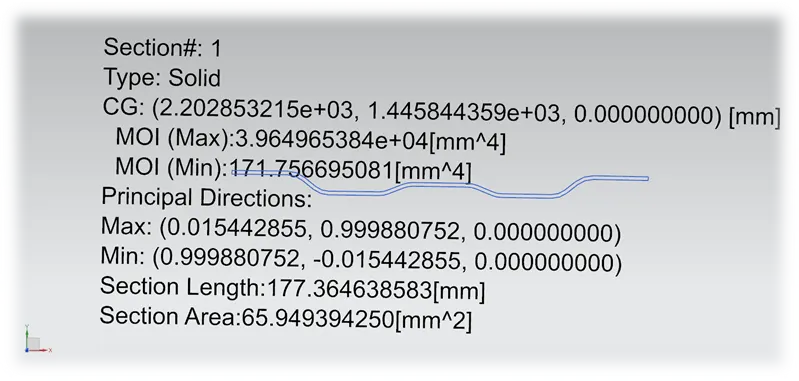
MOI(Min)=171.756695081mm4
Bow roof 2
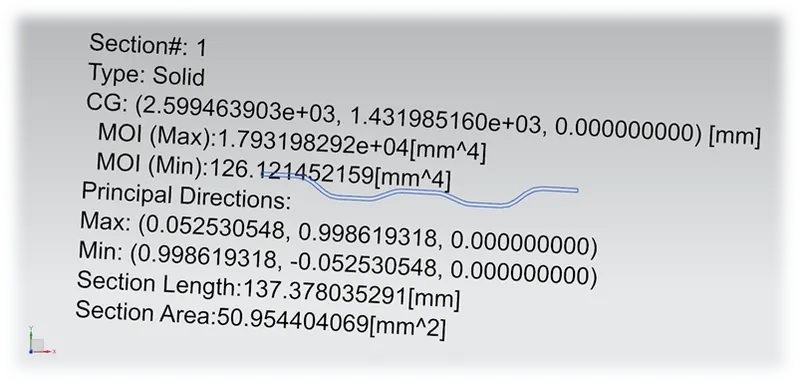
MOI(Min)=126.121452159mm4
These values are applied in the given formulae and the calculations are tabulated as follows.
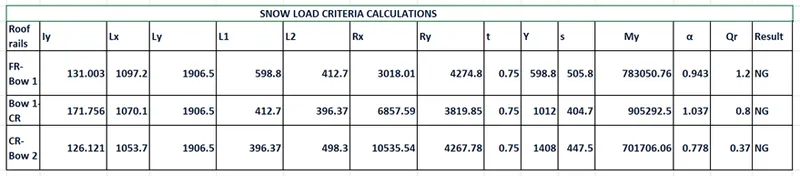
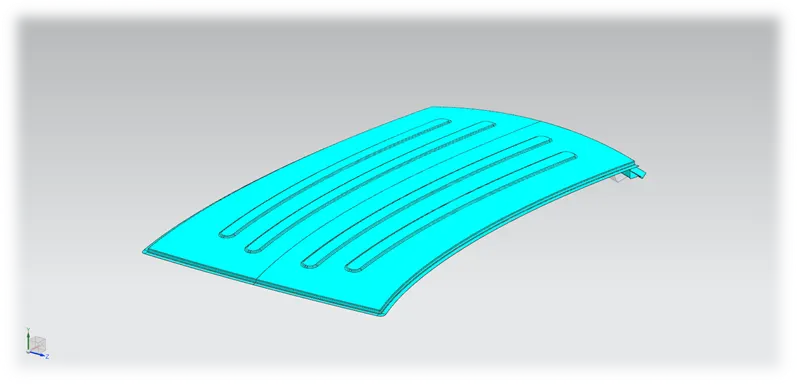
Here the values are not satisfying the snow load criteria, so embosses on the outer roof panel are designed to withstand the external load.
Roof embosses
ROOF CRUSH TEST:
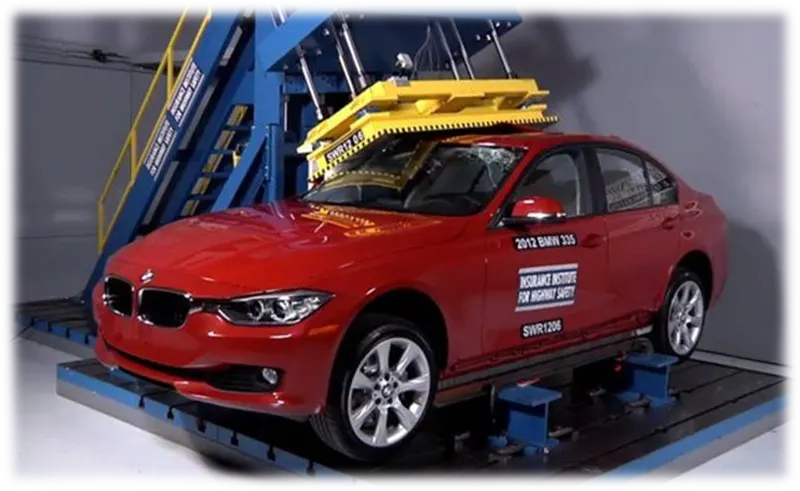
Roof crush test is the methodology given by the IIHS (Insurance Institute of Highway Safety). After analysing many accidents IIHS has fixed some regulations, to perform the crush test.
The IIHS ratings are based upon the following considerations,
- How fast the car can reform to its original shape after the roll over.
- How deep is the protrusion after the roll over.
GOAL OF ROOF CRUSH TEST:
To minimize the protrusion into the occupant compartment, so that the seat belts and air bags can protects the passengers.
CONDITIONS FOR ROOF CRUSH TEST:
Initial condition:
- Close and lock all the doors
- Close all the windows
Second condition:
Fix the body sill or chassis frame on a hard lever surface horizontally.
METHOD OF APPLYING THE FORCE :
The load is applied at 5 degree tilted towards the front end and 25 degrees tilted from the roof surface. The length and width of the load should be 1800mm and 750mm respectively. The load is applied on the roof for about 120 sec and the crush speed at 13 mm/sec.
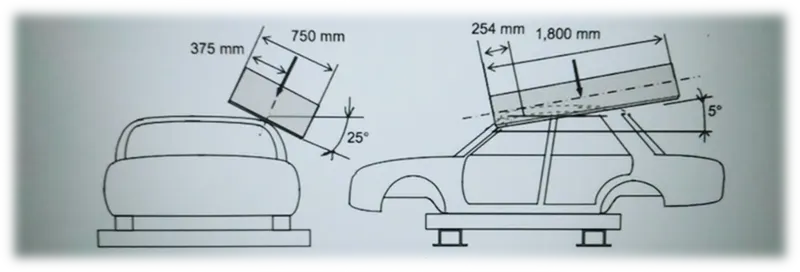
Considering these parameters, the thickness and placements of the bow roofs and reinforcements are designed.
FINAL DESIGN:
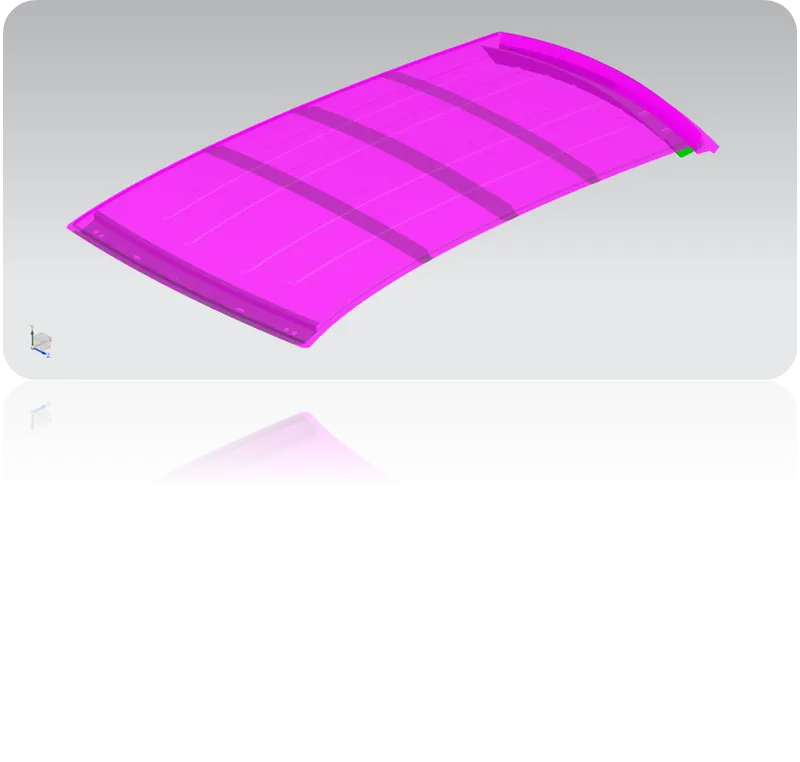
Isometric view
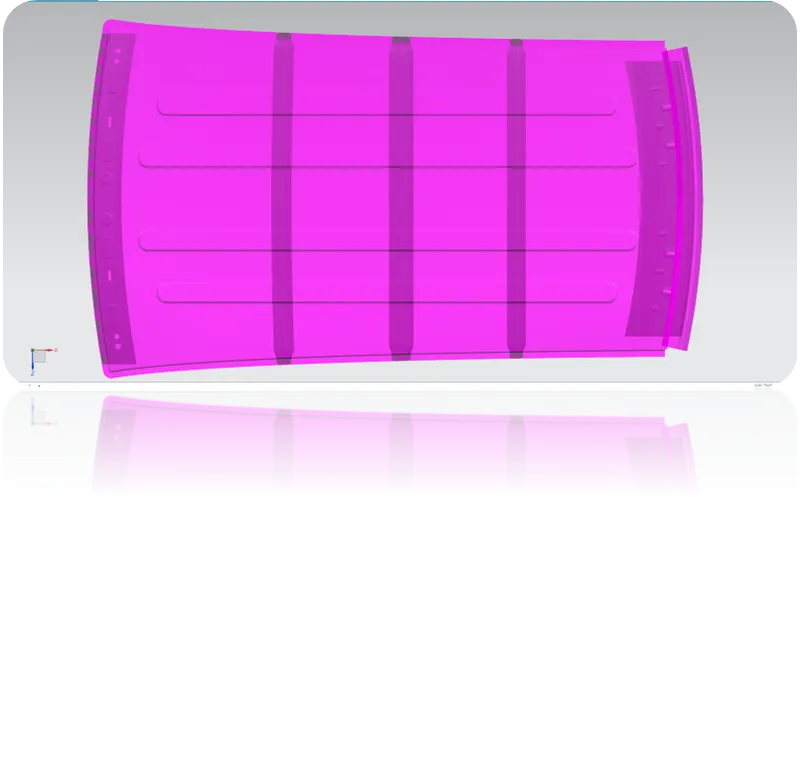
Top view
Bottom view
CONCLUSION:
Thus, the roof outer panel, roof rails, bow roofs and reinforcements are designed. The bow roofs are positioned considering the heat distortion and snow load calculations and draft analysis for the manufacturing feasibility are performed.